


SUMMARY
ZEC prices have climbed sharply in 2026, network hashrate has jumped, and big institutional players are now running mining fleets that outsize what a home setup can offer. This blog breaks down what’s pushing difficulty higher, how modern hardware stacks up, what today’s rewards actually look like, and what a miner can still do to stay profitable in this tougher environment.
Zcash mining has turned into one of the more talked-about corners of the privacy coin world this year, and for good reason. A coin that used to sit quietly in the background of most mining conversations is now pulling in institutional money, ETF inflows, and a wave of new hardware coming online. If you mined ZEC a year ago and haven’t checked in since, the landscape looks pretty different today.
What Is Pushing Zcash Network Difficulty Higher?
Difficulty in any Proof-of-Work cryptocurrency is essentially a reflection of the amount of hashpower that is focused on the blockchain. As more computers come into the system, the difficulty will adjust the challenge to maintain the same rate of blocks mined, and this makes each individual miner’s share smaller unless their hashrate increases.
For Zcash specifically, a few things are stacking up at once:
- A strong price run has made ZEC mining look attractive again to people who had parked their rigs
- Large mining companies have publicly announced sizable Equihash fleets, some representing a meaningful chunk of total network hashrate on their own
- Newer generation ASIC hardware produces far more solutions per watt than machines from just a couple of years back, so upgraded fleets add hashrate without adding proportional power draw.
- Regulatory clarity around privacy coins has improved in some regions, removing a hesitation that used to keep bigger players on the sidelines.
Network hashrate for Zcash has moved from the high teens into the mid-twenty-gigahash range over the course of the year, with some snapshots showing brief peaks close to 28 GH/s. That is a substantial jump, and it explains why daily ZEC output per machine has been trending down even while the coin’s dollar value has been trending up.
How Has ASIC Hardware Changed The Competition?
Zcash was mineable with graphics cards in its early years, and for a while that kept the network fairly open to casual miners. That window closed once purpose-built Equihash hardware arrived. A dedicated ASIC miner solves the same (200,9) parameter puzzle that a GPU does, but it does so with dramatically better efficiency, and that gap has only widened.
The current generation, led by Bitmain’s Z15 family, delivers hundreds of thousands of solutions per second from a single unit while pulling roughly 2.7 to 2.9 kilowatts. A stack of high-end graphics cards trying to match that output would burn far more electricity for a fraction of the result. That’s the core reason GPU mining on this algorithm has quietly faded into a hobbyist activity rather than a serious income source.
A quick look at how the two approaches compare today:
| Factor | GPU Rig (multi-card) | Equihash ASIC Miner |
| Typical output | 3,000–6,000 Sol/s per card | 420,000–860,000 Sol/s per unit |
| Power draw | High relative to output | Lower per solution produced |
| Setup complexity | Drivers, risers, cooling tuning | Plug in, configure pool, run |
| Noise and heat | Moderate, spread across cards | High, concentrated in one box |
| Resale and lifespan | Flexible, can mine other coins | Locked to Equihash coins only |
| Realistic profitability in 2026 | Rarely profitable after power costs | Profitable within a wide power price range |
This table sums up why the mining pools are now dominated almost entirely by ASIC hardware. A crypto miner shopping for new equipment today has very few reasons to consider anything other than a purpose-built machine if the plan is Zcash specifically.
Why Are More Institutional Miners Entering Space?
This is arguably the biggest shift of the year. Zcash used to be a coin that institutional mining firms mostly ignored in favor of Bitcoin. That changed once ZEC’s price started climbing and a spot ETF entered the picture, drawing fresh attention from traditional finance.
Reports through the summer described a US-based mining fleet coming online with several gigas of hashpower through a large equity deal, reportedly representing close to a fifth of total network hashrate at the time of launch. When a single operator can control that kind of share, smaller miners feel it immediately in the form of a higher difficulty and thinner daily rewards.
A few knock-on effects worth knowing about:
- Mining pools tied to bigger operators can capture a large share of blocks, which shifts where hashpower concentrates.
- Hardware availability tightens when large buyers place bulk ASIC miner orders, sometimes pushing lead times out for smaller retail buyers.
- Price volatility tied to ETF flows means daily earnings in dollar terms can swing quite a bit even when ZEC output stays flat.
- Coin issuance is fixed by the protocol’s emission schedule, so more competition simply divides the same reward pool into smaller pieces.
None of these considerations undermine the importance of independent mining, but they do stress the significance of entering into mining with concrete numbers.
What Do Current Zcash Mining Rewards Look Like?
Block rewards on the Zcash network are determined according to the protocol and allocated between the miners and the network funding, meaning that the personal reward will be greatly dependent on the pool share instead of being the same for each block. Below is a picture of how things currently look, taking into account the autumn of 2026. The numbers change frequently, which means that you should only use them as initial data.
| Metric | Approximate Current Reading |
| ZEC price | $1,195.83 |
| Network hashrate | 26.53 GH/s |
| Network difficulty | 259.13M |
| Z15 Pro output (840 KSol/s) | About 0.0455 ZEC per day at current difficulty |
| Time to mine 1 ZEC solo on a single unit | About 22 days, pool mining still strongly recommended |
| Typical pool fee | 0.5%–3% depending on provider |
The takeaway here is simple. Solo mining Zcash with one or two machines is essentially a lottery ticket at the current difficulty. Getting into an already established pool is what most miners, from enthusiasts to industrial-scale miners, use in order to earn regular rewards.
What Does It Cost To Run A Zcash Miner Profitably?
Electricity is the single biggest variable in whether a mining operation makes sense. Hardware cost is a one-time expense, but power is a bill that shows up every single day, and it’s the number that separates a profitable setup from a losing one.
Here’s a rough profitability breakdown using a Bitmain Antminer Z15 Pro machine at 840 KSol/s and 2,780 W draw:
| Electricity Rate | Daily Power Cost | Estimated Daily ZEC Output | Approx. Daily Profit (at $1,195.83 ZEC) |
| $0.05/kWh | ~$3.34 | ~0.0455 ZEC | ~$51.10 |
| $0.08/kWh | ~$5.34 | ~0.0455 ZEC | ~$49.10 |
| $0.10/kWh | ~$6.67 | ~0.0455 ZEC | ~$47.77 |
| $0.15/kWh | ~$10.01 | ~0.0455 ZEC | ~$44.43 |
| $0.20/kWh | ~$13.34 | ~0.0455 ZEC | ~$41.10 |
Minerstat’s own breakeven estimate puts the Z15 Pro in profit as long as electricity stays under roughly $0.82 per kWh, which is a wide enough window that most miners on residential or industrial power rates still clear a solid margin.
These numbers will shift as difficulty and price move, but the pattern holds steady. With current ZEC prices, a single efficient miner can make substantial profit regardless of the electricity rate. This comfortable situation can end once either of these parameters changes drastically, which precisely demonstrates that efficiency should be taken into consideration rather than hashrate when purchasing mining equipment.
How Can Miners Stay Competitive As Difficulty Rises?
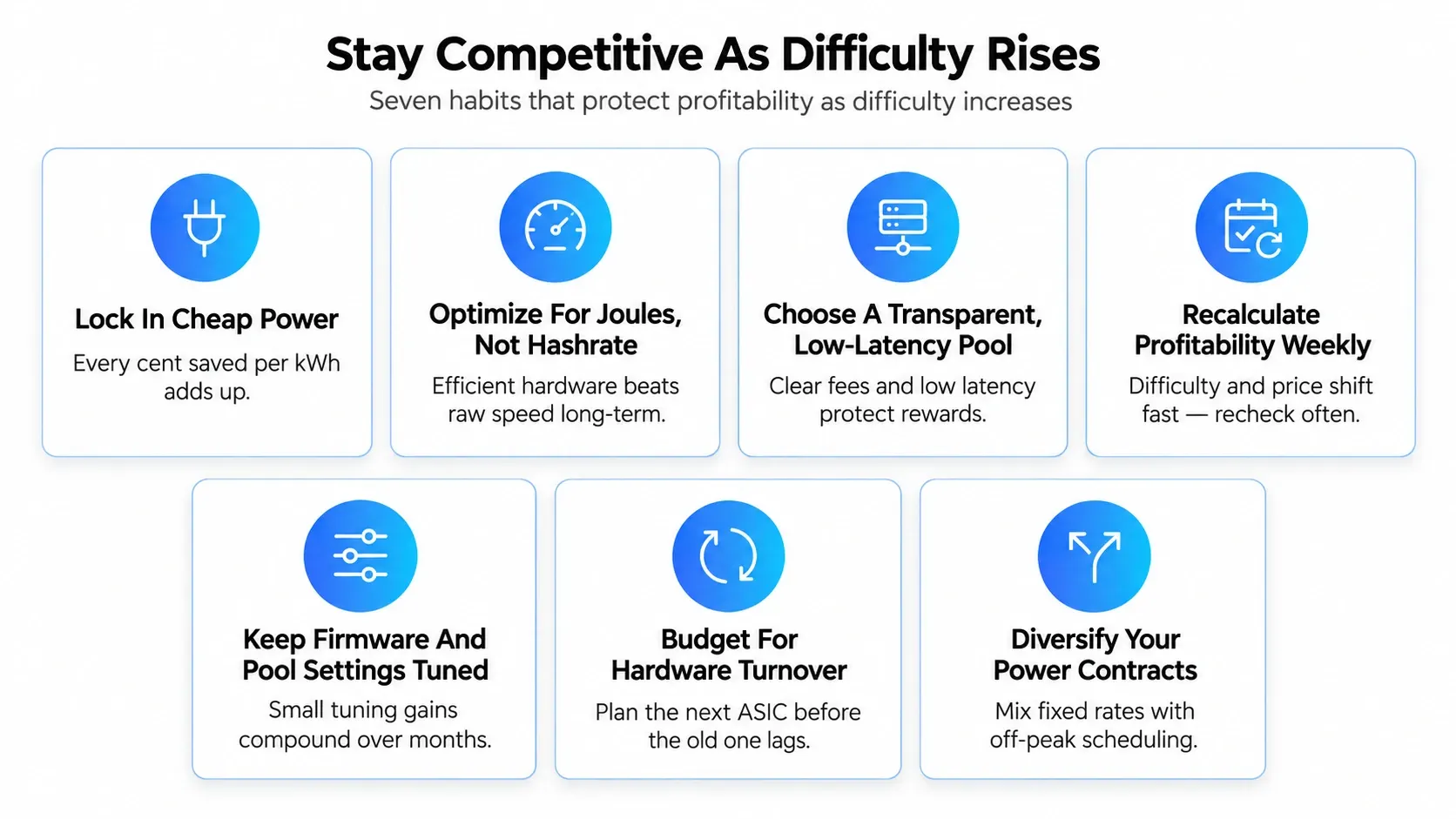
Maintaining profitability in the tough times ahead requires a few habits more than anything else.
This is how you can go about doing it, whether you have one machine or a little farm:
- Get the best possible energy supplier you can at the lowest cost. A few pennies per kilowatt-hour saved will add up to a significant sum monthly after you go beyond one unit.
- Pick hardware based on joules per solution, not just top-line hashrate. A slightly slower machine that sips less power often outperforms a flashier one over a full year.
- Join a pool with transparent fees and a server close to your location. Latency and fee structure both eat into your actual take-home rewards.
- Recalculate profitability weekly, not once at purchase. Difficulty and price both move fast enough that last month’s numbers can be misleading.
- Keep firmware and pool settings updated. Small efficiency gains from tuning add up over months of continuous operation.
- Plan for hardware turnover. Equihash ASICs have a shelf life, and budgeting for the next generation ahead of time avoids getting stuck on outdated gear.
- Diversify power costs if possible, such as combining fixed rate contracts with off-peak scheduling where your setup allows it.
None of these are expensive endeavors, but all together it is the difference between a miner who continues to earn well next year and one who quietly gets squeezed out.
What Should New Miners Know Before Buying Hardware?
Anyone coming into this space for the first time needs to think about this investment like any other, requiring research before committing the cash. A couple of points to consider before buying:
- Confirm your electricity rate and whether your circuit can actually handle a machine drawing close to 3 kW continuously
- Compare a couple of live mining calculators using your real numbers instead of relying on marketing figures from a hardware page.
- Check current wait times and shipping costs, since bulk institutional orders have occasionally stretched delivery windows for smaller buyers.
- Factor in noise and heat output if the unit will run somewhere other than a dedicated space, since these machines are genuinely loud
- Make sure that you get the information about the reputation of the pool, its payouts, and the minimum amount of the payout before you connect your hash power.
The trouble will be avoided later on down the road if these basic fundamentals are taken care of up front.
Is Zcash Mining Still Worth Starting Today?
Starting Zcash mining today can still make sense when the setup is planned carefully. The market is more mature than it was a few years ago, so the focus has shifted from simply getting online to choosing efficient hardware, keeping power costs under control, and reviewing profitability with current network conditions.
A few factors can help make the decision clearer:
- Higher difficulty creates a stronger need for efficiency. Every miner faces the same network difficulty, so a smaller operation can still compete well when the hardware is efficient, uptime is strong, and electricity cost is kept under control.
- ZEC price can improve the value of each mining reward. The daily coin emission does not increase just because more miners join the network, but a stronger ZEC price can still improve the value of the rewards a miner receives.
- Previous-generation hardware can offer good value. A well-priced used or older miner can sometimes provide a better payback period than the newest model, especially when its efficiency still works with the local electricity rate.
- Hosted mining can make setup easier. Miners who prefer to avoid managing heat, noise, power infrastructure, and maintenance at home can use a hosting facility and focus more on mining performance and operating cost.
- Regulatory awareness helps with long-term planning. Zcash sits within the privacy-coin market, so keeping an eye on policy changes can help miners make more informed decisions about hardware purchases and future profitability.
There is no single answer that fits every miner, but starting now does not automatically mean starting too late. A well-planned setup with suitable electricity rates, efficient hardware, realistic profitability checks, and regular monitoring can still give miners a practical way to participate in Zcash mining.
CONCLUSION
Zcash has gone from a relatively quiet corner of the privacy coin market to one of the more competitive Equihash mining scenes around, driven by a strong price rally, ETF attention, and large-scale institutional fleets coming online. That doesn’t mean smaller operators are out of the game. It just means there’s less room for guesswork than there used to be. Power costs, hardware picks, and which pool you join now matter more than they did a year or two back, and the miners doing well are the ones running this like an actual operation instead of a side bet, checking their numbers often and keeping firmware up to date. CryptoMinerBros is a good place to compare hardware options if you’re weighing a new purchase, and from there it mostly comes down to staying consistent with the basics.
Frequently Asked Questions
-
Is Zcash mining still profitable in 2026?
It can be, honestly, it depends mostly on your power bill. Anything under about $0.82 per kWh for a Z15 Pro should still leave you in the green most days.
-
Can you mine Zcash with a GPU?
You technically can, though most folks gave up on it once ASICs took over the Equihash side of things. A graphics card can’t keep up with efficiency anymore, so it’s mainly other coins or nothing for GPU miners now.
-
Which Zcash ASIC should I actually buy?
Honestly, the Z15 Pro is what most people are running right now. Good speed, solid efficiency, and no errors from the miners using it.
-
How long does it take to mine ZEC?
Running one Z15 Pro at today’s difficulty, expect somewhere around three weeks per coin. That number moves around a lot depending on how much hashrate is competing on the network at any given time.

Join our Newsletter
Get the week’s best cryptomining content in your inbox.

Han su
Han Su is a technical analyst at CryptoMinerBros, a leading provider of cryptocurrency mining hardware. He has over 5 years of experience in the cryptocurrency industry and is an expert in mining hardware, software, and profitability analysis.
Han is responsible for the technical analysis and research on ASIC Mining at Crypto Miner Bros. He also writes in-depth blogs on ASIC mining and cryptocurrency mining, and he has a deep understanding of the technology. His blogs are informative and engaging, and they have helped thousands of people learn about cryptocurrency mining.
He is always looking for new ways to educate people about cryptocurrency, and he is excited to see how the technology continues to develop in the years to come.
In spare time, Han enjoys hiking, camping, and spending time with his family. He is also an avid reader, and he loves to learn about new things.
Similar Blogs
BTCB2 Mining and Profitability: What Current Data Suggests
What Is BTCB2 Mining? Mining BTCB2 involves using Blake2b-compatible ASIC hardware for the BTCB2 cha...
Top Profitable Blake2b Miners in 2026
Blake2b Miners Worth a Closer Look? Blake2b Miners have become the go-to choice for anyone who wants...
Bitmain Antminer Z15K Guide: Everything You Need to Know
Bitmain Antminer Z15K Worth Considering? Bitmain Antminer Z15K is one of those newer things added to... © 2018- Miner Bros Limited. All rights reserved

 EN EN
EN EN  ES
ES