


SUMMARY
BTCB2 has seen consistent miner interest throughout the last couple of weeks, and the reason for this is simple: it was created following a Bitcoin fork and uses a new algorithm that many miners’ rigs already work with. This coin can be mined with the use of a Blake2b-compatible rig, and that is important to mention. However, it is still early, and the situation should be treated carefully. A calculator will show you how much your device can mine right now, but that is not the whole story. Current returns are better understood by weighing market price, how easily mined coins can be sold, present network conditions, and hardware efficiency together, rather than leaning on one projected number alone.
What Is BTCB2 Mining?
Mining BTCB2 involves using Blake2b-compatible ASIC hardware for the BTCB2 chain, which is an alternative Bitcoin Blake2B chain whose ticker is BTCB2 and earns miners a block reward. This chain was a result of a fork on the Bitcoin chain that took place in August 2026, as a result of issues surrounding the BIP-110 proposal. The new chain’s development team abandoned the SHA-256d algorithm for the proof of work and settled on the Blake2b algorithm.
That single change is why the coin now sits in the same hardware category as older, established Blake2b networks. The chain split itself happened at a specific block height on the original Bitcoin ledger, after which BTCB2 continued forward on its own rules while the original Bitcoin chain kept running unchanged. From that point on, the two networks share history up to the split but nothing after it: separate blocks, separate difficulty, and separate market pricing.
A few basics worth knowing before going further:
- Block reward: 3.125 BTCB2 per block
- Proof-of-work: Blake2b (also written Blake2B-Sia)
- Chain origin: August 2026 fork from the Bitcoin network
- Hardware compatibility: existing Blake2b ASICs, without new equipment purchases
Because the algorithm switch happened after the fork, not at genesis, the network’s early history looks unusual compared to a coin that launched with Blake2b from day one. This is one reason data around it is still being pieced together in real time.
Why BTCB2 Is Getting Attention From Blake2b Miners
Interest in this chain isn’t really about a new mining algorithm. It’s about a familiar algorithm applied to an unfamiliar coin. BTCB2 uses the Blake2b algorithm, which is already supported by specialized ASIC hardware used across other Blake2b-based mining networks, so operators don’t need to source or configure anything new to test it.
A few reasons this particular fork has drawn eyeballs from the wider mining community:
- Hardware overlap. Rigs bought for Siacoin or similar coins can usually be redirected with a pool and firmware change, not a hardware swap.
- Bitcoin-associated brand. Given that it was launched as a fork from Bitcoin, it received the attention of Bitcoin-related discussion forums despite now being traded separately from Bitcoin.
- Early-network price swings. New forks with thin order books often see large price movements in both directions, which naturally draws short-term observers.
- Low switching cost. Since ASIC miners running Blake2b firmware can often add a new pool endpoint in minutes, testing the network carries little operational effort.
None of this means the coin behaves like a mature, established network. It means the barrier to trying it is unusually low for anyone who already owns compatible gear.
It also helps to place BTCB2 next to the coins that popularized Blake2b mining in the first place. Siacoin has run on this algorithm since 2015, and its long track record is why so much Blake2b hardware exists today. BTCB2 did not create that hardware ecosystem; it inherited it. This is particularly relevant when interpreting any comparison between the two in a headline because the former is an established storage network and the latter is a Bitcoin spin-off that is still getting its act together.
What Hardware Can Mine BTCB2?
Any rig built for the Blake2b-Sia algorithm family can, in principle, be pointed at BTCB2 once pool support exists. This is not an endorsement of any single device; it’s simply an overview of the category of hardware already active on Blake2b networks. Most of these units were originally marketed and sold as Siacoin miners, since Sia is still the largest and most established coin using this hash function, and manufacturers built their product lines around that demand.
Below are the efficiency figures (J/TH) that have been achieved using the default operating mode for all the devices; a number of devices have an alternate low-power operating mode that will sacrifice some hashing power for a reduction in the power bill, which should be verified in the manufacturer’s manual before use. Due to the shared Blake2b algorithm used in several coins, the same device can usually switch among the coins just by pointing to a new pool.
| Miner | Hashrate | Power Draw | Efficiency | Notes |
| Goldshell SC5 Pro (11TH/s) | 11 TH/s | 2,820 W | ~256 J/TH | Standard-mode Blake2b-Sia miner |
| Goldshell SC5 Pro (14TH/s) | 14 TH/s | 3,300 W | ~236 J/TH | Higher hashrate variant of the same line |
| Goldshell SC Lite | 4.4 TH/s | 950 W | ~216 J/TH | Compact option, suited to small setups |
| iBeLink BM-S3 | 19 TH/s | 3,100 W | ~163 J/TH | Higher-hashrate unit with lower J/TH than most Goldshell models |
| Goldshell HS Box | up to 470 GH/s | 230 W | ~0.98 J/GH | Dual-algorithm home unit (Handshake / Blake2B-Sia) |
| Goldshell SC Box II | 1.9 TH/s | 400 W | ~210 J/TH | Compact, home-friendly footprint |
For those currently mining with Blake2b ASICs, a reminder to ensure that you have a pool that offers BTCB2 before proceeding, test firmware capability, and begin with one unit at a time rather than an entire rack. Thin, newly formed networks change conditions quickly, and testing at small scale limits exposure while data settles.
What Current BTCB2 Mining Data Shows
The clearest way to understand where BTCB2 stands right now is to look past the headlines and check the live network numbers directly. A recent read of the current data shows:
| Metric | Recent Reading |
| Block reward | 3.125 BTCB2 |
| Algorithm | Blake2B-Sia |
| Network founding | Aug 30, 2026 |
| Price (live) | $277.05 |
| 24-hour change | -51.73% |
| 24-hour trading volume | $158,041.31 |
| Market cap | $5.57B |
| Supported miners | Blake2b-Sia ASICs (Goldshell, iBeLink, and similar lines) |
Two facts become evident right away. The first one is that the move of 51.73% over 24 hours is quite significant, not just for crypto assets but also in line with the general price range of the coin in question, ranging from $82 to around $1,799 since its inception. The second one is the daily trading volume amounting to about $158,000, which is rather small in comparison to other cryptocurrencies. Both of these facts are much more important than any power or hashrate numbers.
It’s also worth noting that individual ASIC calculator pages can show a slightly different BTCB2 price at any given moment than a coin’s general market overview, since each calculator may be pulling from a different exchange pairing or refresh cycle. A miner checking figures across two or three sources may see prices that don’t quite match, which is itself a symptom of a market that hasn’t consolidated around one dominant venue yet. Cross-checking more than one source, rather than trusting a single number, is a reasonable habit while that consolidation is still happening.
BTCB2 Mining Revenue vs Actual Profitability
A mining calculator can only work with the inputs it’s given: hashrate, power draw, coin price, and network difficulty at that exact moment. Plugging current numbers into a calculator for a device like the iBeLink BM-S3 or a Goldshell SC5 Pro II can show a striking daily figure, because BTCB2’s early network difficulty is still low relative to the hashrate some miners are pointing at it.
That estimated revenue is real in the sense that the math is accurate for that instant. What it doesn’t capture on its own is whether the coins earned can be sold at that same price, in that same volume, without moving the market. This is where the gap between a calculator screen and an actual bank balance opens up. Current mining profitability should still be checked against live hashrate, power consumption, coin pricing, and market conditions rather than treated as a fixed return, and that check matters more for a young fork than for an established coin with years of trading history.
A calculator might show that a 14 TH/s Blake2b-Sia miner earns a strong daily figure at a quoted price of $350 per BTCB2. If a miner accumulates several coins over a week and then tries to sell all of them at once on a thin exchange, the realized price could land well below that quoted figure, simply because the sell order is large relative to the market’s daily turnover. The calculator was not wrong; it just answered a narrower question than “what will I actually receive?”
Put simply:
- Revenue = hashrate × block reward × price, at a fixed point in time
- Profitability = revenue minus power cost, hardware wear, and pool fees, and the ability to convert coins to cash at a workable price
A calculator answers the first question. Only market data answers the second.
Why Market Liquidity Matters for BTCB2 Miners

Liquidity is the part of this story that’s easy to skip past and important not to. A market with $75,000–$150,000 in daily volume across a handful of exchanges behaves very differently from one with tens of millions in daily turnover.
Here’s why that distinction matters in practice:
- Selling pressure moves prices fast. In a thin market, even a modest sell order can shift the quoted price noticeably.
- Quoted price and achievable price can diverge. The number shown on a chart is not always the number a seller actually receives once an order fills.
- Exchange coverage is still limited. BTCB2 currently trades on a small set of venues, including NonKYC and OTC-style platforms, rather than the broad exchange network that older coins have built over years.
- Volatility compounds the liquidity issue. Because the coin is new, price discovery is still happening, which adds extra swings on top of the liquidity effect.
None of this is a verdict on the coin. It’s simply the operating environment miners are working within right now, and it’s the missing piece that a bare revenue estimate doesn’t show. Liquidity tends to improve gradually as more exchanges list a coin, more market makers step in, and daily volume compounds over months rather than days, a pattern seen with most young networks, not something unique to this one.
What Affects BTCB2 Mining Profitability?
There are many factors at work here, and none alone will give you the complete picture.
| Factor | Why It Matters |
| Network difficulty | Rises as more hashrate joins, directly cutting each miner’s expected share of blocks |
| Coin price | Determines the dollar value of each block reward, and is currently volatile |
| Market liquidity | Affects whether mined coins can actually be sold near the quoted price |
| Electricity cost | A fixed input regardless of coin price, so it sets the profitability floor |
| Hardware efficiency (J/TH) | Lower J/TH figures mean less power spent per unit of hashrate |
| Pool fees | Typically 1–2%, a small but constant drag on net output |
Because BTCB2’s network is still young, difficulty and hashrate are both moving targets. A snapshot taken today may already look different by the time this is read, which is exactly why ongoing data checks matter more than a single calculator run. Of these variables, electricity cost is the one most within a miner’s direct control, and it’s usually the first thing worth optimizing before looking at anything else on the list. A lower power rate improves the outcome across every coin a rig might ever mine, not just this one.
What Should Blake2b Miners Monitor Going Forward?
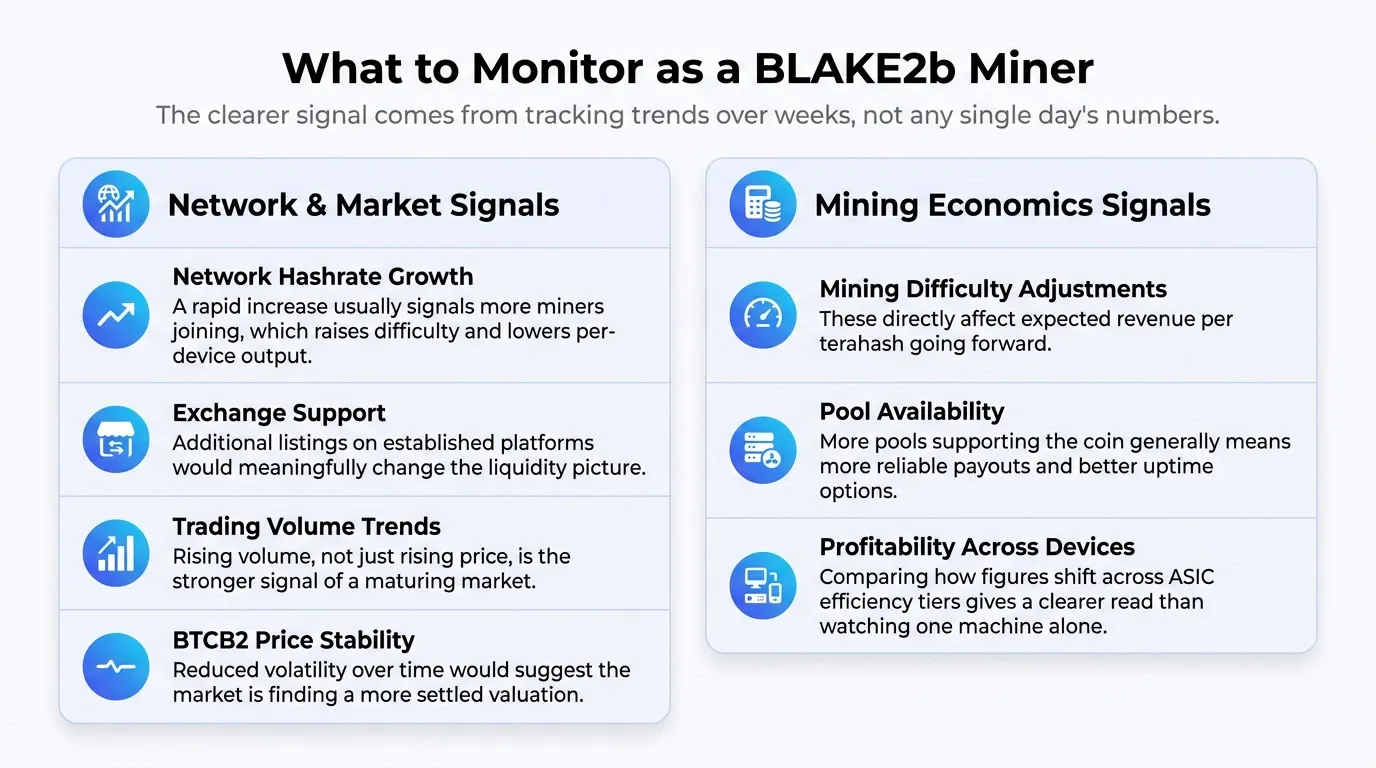
It would be better to follow the progress of the picture, rather than assuming that the present picture is static. Some points to consider over the next weeks:
- Network hashrate growth. A rapid increase usually signals more miners joining, which raises difficulty and lowers per-device output.
- Exchange support. Additional listings on established platforms would meaningfully change the liquidity picture.
- Trading volume trends. Rising volume, not just rising price, is the stronger signal of a maturing market.
- Mining difficulty adjustments. These directly affect expected revenue per terahash going forward.
- BTCB2 price stability. Reduced volatility over time would suggest the market is finding a more settled valuation.
- Pool availability. More pools supporting the coin generally means more reliable payouts and better uptime options.
- Changes in estimated profitability across devices. Comparing how figures shift for ASIC miners of different efficiency tiers gives a clearer read than watching one machine alone.
Tracking these points over time, rather than reacting to any single day’s numbers, is the more grounded way to understand where this network is headed.
CONCLUSION
BTCB2 is a young network built on a familiar algorithm, which is why it has caught the interest of miners who already run Blake2b hardware, including many who previously focused on Siacoin miners. The data available so far shows a coin with real block production, a functioning reward structure, and growing but still thin trading activity. Sources such as CryptoMinerBros track this kind of hardware and network data as it develops, which is useful context alongside live calculator figures. Reading that data correctly means looking past a single calculator figure and weighing price, liquidity, and network conditions together. Keeping an eye on live specs, hardware compatibility, and current market listings as this network develops remains the most useful approach for anyone tracking it.
Frequently Asked Questions
-
What is a BTCB2 coin?
The BTCB2 Bitcoin fork changed the mining method to Blake2b in August 2026. After forking, it operates independently of Bitcoin, using its own blocks, difficulty, and price.
-
Can Siacoin miners be used to mine BTCB2?
Most Blake2b-based rigs built for Siacoin can be redirected to BTCB2 with a pool change and updated firmware. No new hardware purchase is needed to give it a try.
-
Is BTCB2 mining profitable right now?
That depends on more than what a calculator shows: coin price, market liquidity, and difficulty are all still shifting on this young network. Checking live data before committing hardware is the safer call.

Join our Newsletter
Get the week’s best cryptomining content in your inbox.

Han su
Han Su is a technical analyst at CryptoMinerBros, a leading provider of cryptocurrency mining hardware. He has over 5 years of experience in the cryptocurrency industry and is an expert in mining hardware, software, and profitability analysis.
Han is responsible for the technical analysis and research on ASIC Mining at Crypto Miner Bros. He also writes in-depth blogs on ASIC mining and cryptocurrency mining, and he has a deep understanding of the technology. His blogs are informative and engaging, and they have helped thousands of people learn about cryptocurrency mining.
He is always looking for new ways to educate people about cryptocurrency, and he is excited to see how the technology continues to develop in the years to come.
In spare time, Han enjoys hiking, camping, and spending time with his family. He is also an avid reader, and he loves to learn about new things.
Similar Blogs

Best Bitcoin Miners Under $3,000 (2026): Top ASIC Picks for Home and Small-Scale Mining
The choice of a Bitcoin miner under $3000 will mostly depend on your budget, electricity cost, and s...
Goldshell SC5 Pro Review: Profitability and Buying Guide
Is the Goldshell SC5 Pro worth buying? Check its latest price, profitability, resale value, key risk...
Why Is Zcash Mining Getting More Competitive?
Zcash Mining: Why Is It Getting More Attention? Zcash mining has turned into one of the more talked-... © 2018- Miner Bros Limited. All rights reserved

 EN EN
EN EN  ES
ES