


SUMMARY
Buying a Bitcoin miner is not only about finding a powerful machine. The timing also matters. Bitcoin price, mining difficulty, hardware cost, electricity rate, and miner efficiency can all change the final result. This is why miners should read the market before buying, holding, or upgrading.
In this guide, we will look at the main Bitcoin mining market signals that help buyers make better decisions. We will also explain when it may make sense to buy a new miner, hold your current machine, or upgrade to a more efficient model.
Why Bitcoin Mining Market Signals Matter Before You Buy
Bitcoin mining market signals are the numbers miners look at before deciding whether to buy a new machine, keep the current one running, or move into a better model. The machine itself matters, of course, but the market around that machine can change the result a lot.
A miner can look strong on paper and still be a poor fit for the current moment. Bitcoin price may be moving up, but hardware prices may also be moving up. Difficulty may drop for a short period, but electricity cost can still keep the margin tight. This is why one signal alone does not really tell the full story.
The useful way to look at the market is simple. Check what can improve revenue, check what can increase cost, and then see what is left after the machine runs every day. That final number matters more than the excitement around a new model or a short market move.
Bitcoin mining works through a competitive process where miners help confirm transactions and the network adjusts difficulty as mining power changes.
This is also where timing becomes important. You are not trying to guess the perfect top or bottom of the market. That is not realistic. You are just trying to understand whether the numbers are friendly enough for your setup before spending money on hardware.
What Are the Main Bitcoin Mining Market Signals?
Bitcoin mining market signals are practical indicators. Some show how much revenue may be possible. Some show how much pressure the miner may face. Some are more about your own setup, like electricity cost and uptime.
Before comparing market signals, buyers should understand how hashrate, power use, and efficiency affect the final result.
| Market Signal | What It Shows | Why It Matters |
| Bitcoin price | Market value of BTC | Higher BTC price can improve mining revenue |
| Mining difficulty | How hard it is to mine blocks | Higher difficulty can reduce each miner’s reward share |
| Network hashrate | Total mining power on the network | More hashrate usually means stronger competition |
| Hashprice | Earning value of mining hashrate | Helps miners judge short-term revenue conditions |
| Electricity cost | Cost to run the miner | Directly affects profit after power bill |
| Miner efficiency | Power used for mining output | Better efficiency can protect margins |
| Hardware price | Cost of buying the machine | Affects ROI and payback period |
| Uptime and repairs | Machine stability and maintenance | Downtime can reduce monthly earnings |
This table gives the basic picture, but the real answer comes from reading these signals together. A higher BTC price can improve revenue, but if miner prices rise at the same time, the buying decision may still need more thought. A difficulty drop can improve short-term conditions, but if BTC price is weak, the gain may not be enough to change the full ROI picture.
Live difficulty and network hashrate are worth checking before making a buying or upgrade decision, especially when the market is moving fast. The point is not to make mining complicated. It is to avoid buying based only on one good-looking number.
When to Buy a Bitcoin Miner?

A good buying time usually appears when hardware price, power cost, and expected revenue all work together. It does not mean the market has to be perfect. It just means the setup should have enough room to make sense after costs.
A stable or improving Bitcoin price can be a good sign, especially when miner prices are still reasonable. But if BTC price rises quickly, demand for mining hardware can also rise. That can push machine prices higher and stretch the payback period.
Electricity cost is just as important. If your power rate is low, the miner has more space to handle difficulty changes, price dips, and normal operating costs. This is why the same machine can look better for one buyer than another.
Efficient hardware also matters here. A miner with better J/TH wastes less electricity for the work it does. That is useful because mining is not a one-day setup. The machine keeps running, and the power bill keeps following it.
For a crypto miner buyer, the cleanest number is not gross daily revenue. It is what remains after electricity, pool fees, cooling, and downtime are counted.
Buying may make sense when these signals line up:
- BTC price is stable or improving while miner prices are still fair.
- Electricity cost is low enough to leave margin after the power bill.
- The machine is efficient compared with older models.
- Difficulty is not rising faster than revenue can support.
- Power, cooling, and setup space are already prepared.
If only one of these looks good, it may be better to wait. A smart purchase happens when the full setup works, not when one market signal looks exciting for a few days.
When to Hold Your Current Miner?
Holding your current miner can be the better move when it is already paid off, running steadily, and still producing profit after electricity. A new model launch does not automatically mean your current machine needs to be replaced.
This happens a lot in mining. A newer model comes out, the specs look better, and buyers start thinking they need to upgrade right away. But if the current machine is still stable and the payback is already done, it may still have value in the setup.
Holding also makes sense when hardware prices are high. During a stronger market, miner demand can rise fast. If you buy at that point, the machine may still be good, but the purchase price can make ROI longer.
There is also no harm in waiting when the market is unclear. If BTC price, difficulty, and miner prices are all moving sharply, holding gives you more time to see how the numbers settle. The current miner can keep working while you watch for a better entry point.
Still, holding should not mean ignoring the machine. Keep an eye on uptime, temperature, power use, repair cost, and monthly net output. If those numbers start slipping, the hold decision may need to change.
A paid-off miner that still runs properly can be useful for longer than buyers sometimes expect. The real question is whether it still earns enough after real operating costs.
When to Upgrade Your ASIC Miner?
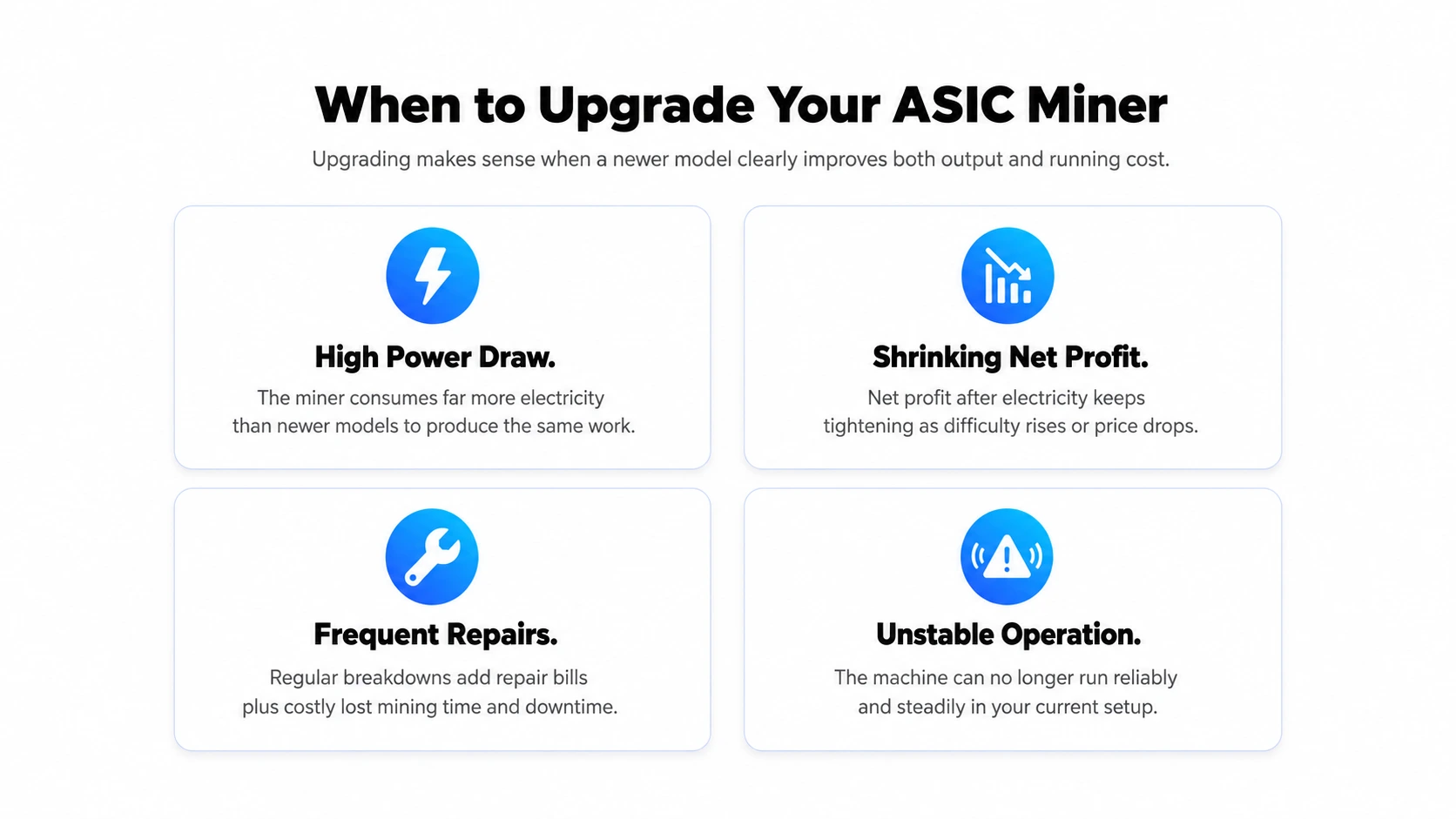
Upgrading makes sense when a newer machine clearly improves both output and running cost. A higher hashrate sounds nice, but the better question is whether the new miner can leave more after power, setup cost, and downtime.
A modern ASIC miner with stronger efficiency can stay useful longer when difficulty rises, or electricity cost starts cutting into margins.
The first sign is high power draw. If the current miner uses much more electricity than newer models for similar output, it may slowly become harder to justify. It may still be mining, but too much of the revenue can go straight into the power bill.
The second sign is shrinking net profit. This can happen when difficulty rises, BTC price drops, or electricity cost increases. A miner that was once comfortable may start giving only a thin margin, and that is when comparing newer models becomes important.
Frequent repairs are another clear sign. Repair bills matter, but lost mining time matters too. If the machine keeps going offline, the actual monthly result may be lower than the calculator estimate.
Unstable operation should also be taken seriously. If the miner needs constant restarts, runs too hot, or struggles to stay steady in your setup, it can become more work than it is worth.
Still, upgrading should be calculated, not guessed. A new miner may be more efficient, but if the purchase price is too high, the payback period can still stretch. Compare the current miner’s monthly net result with the expected result from the upgrade before making the move.
Bitcoin Price vs Mining Difficulty: Which Signal Matters More?
Bitcoin price and mining difficulty both matter, but they affect the miner in different ways.
Bitcoin price affects the value of the rewards. If BTC price rises, the same mined amount becomes worth more in dollar terms. That can improve revenue and make the market look better.
Mining difficulty affects how hard it is to earn a share of rewards. When more mining power joins the network, competition usually increases. That means each machine may receive a smaller share unless it has enough hashrate and efficiency to stay competitive.
This is why a price rise is not always a clean buying signal. If difficulty also rises quickly, some of the benefit can be reduced. A difficulty drop can help too, but if BTC price is weak, the improvement may not be strong enough.
The better way is to compare both together. If BTC price is stable or rising while difficulty is flat or falling, the setup may look more favorable. If BTC price is falling while difficulty is rising, margins can tighten.
These Bitcoin mining market signals help buyers avoid reacting to one headline and missing the rest of the math.
How Electricity Cost Changes the Buy, Hold or Upgrade Decision
Electricity cost can change the whole mining result. The same miner can work well for one buyer and look much harder to justify for another only because the power rate is different. A miner runs all day, so electricity is not a small side expense. It is one of the main numbers that decides whether the setup can keep producing a real margin.
If electricity cost is low, the miner has more room to handle market changes. It may still stay practical when difficulty rises, or BTC price slows down. Low power cost can also help older machines keep running for longer.
If electricity cost is high, the decision becomes much tighter. A buyer may need a more efficient machine, or may need to wait until hardware prices improve. Even a strong miner can become less attractive when too much revenue goes into the power bill.
This is where efficiency becomes important. A machine with better J/TH uses less electricity for the mining output it gives. Over time, that difference can protect margins.
Mining Profitability is not just the daily earning number shown before costs. It should be checked with real power cost, miner efficiency, hardware price, cooling needs, and expected uptime.
Buy, Hold or Upgrade: Simple Decision Table
Here is a simple way to read the signals.
| Situation | Better Action | Why |
| BTC price is stable, machine price is fair, and power cost is low | Buy | The setup has more room for profit |
| Current miner is paid off and still profitable | Hold | No need to rush into new hardware |
| Current miner uses high power and earns less after electricity | Upgrade | Better efficiency may improve margins |
| Difficulty drops, but BTC price is weak | Wait and compare | One signal alone is not enough |
| Hardware prices are too high during market hype | Hold or wait | Buying price can stretch ROI |
| Power cost is too high for most machines | Avoid or pause | Electricity can eat most of the profit |
| New efficient model gives better net profit after cost | Upgrade | Better output and lower power use can help ROI |
This table is only a guide. A buyer still needs to check local electricity rate, miner price, shipping cost, cooling needs, warranty, and expected uptime.
The main idea is to avoid buying or upgrading only because one signal looks attractive. If most signals support the move, buying or upgrading can make sense. If the numbers are mixed, holding or waiting may be the better decision.
Common Mistakes Miners Make When Reading Market Signals
Market signals are useful, but they can still be read the wrong way. Most mistakes happen when buyers focus on one number and ignore the rest of the setup.
Buying only because Bitcoin price is rising
A rising BTC price can improve revenue, but it can also increase miner demand and hardware prices. If the machine is bought at a high price, ROI may take longer.
Ignoring electricity cost
Power cost directly affects net profit. A miner with strong revenue can still leave a smaller margin if electricity is expensive.
Comparing only hashrate
Hashrate matters, but it is not the full decision. Efficiency, hardware price, cooling, uptime, and repair cost also affect the final result.
Treating a difficulty drop as a guaranteed buying signal
A difficulty drop can help, but it should be checked with BTC price, hashprice, and power cost. One positive signal is not enough.
Forgetting downtime and repair cost
A miner that goes offline often loses earning time. Repair bills and downtime should both be included in the decision.
Buying during market hype without checking ROI
During high-demand periods, machine prices can rise quickly. Even a good miner can become less attractive if the buying price stretches the payback period.
Final Buying Checklist Before Making a Decision
Before buying, holding, or upgrading, it helps to review the full setup once. Check Bitcoin price, mining difficulty, network hashrate, electricity rate, miner efficiency, machine price, setup cost, warranty, uptime history, and estimated payback period. This does not make the process difficult. It simply makes the decision more realistic. Mining hardware is a serious purchase, and a few checks before buying can help avoid a much bigger mistake later.
Bitcoin mining market signals do not give a perfect answer, but they do make the decision clearer. If the numbers support the setup, buying or upgrading can be considered. If the current miner is still stable and profitable, holding can be the smarter move.
CONCLUSION
Bitcoin mining market signals help buyers understand when it may be better to buy, hold, or upgrade. Bitcoin price, mining difficulty, electricity cost, miner efficiency, hardware price, uptime, and repair cost all affect the final result.
A good decision is not based on a single signal. A rising BTC price, a drop in difficulty, or a new miner launch can all look exciting, but the real answer comes down to net profit and ROI. Buyers should compare the machine cost, power cost, setup needs, and expected performance before making a move.
For buyers who want to compare Bitcoin mining hardware with clear product details and practical options, CryptoMinerBros can be a useful place to review available miners before making the final decision.
Frequently Asked Questions
-
What are Bitcoin mining market signals?
Bitcoin mining market signals are key indicators that help miners understand whether it may be a good time to buy, hold, upgrade, or pause mining hardware. These signals can include BTC price, mining difficulty, hashprice, electricity cost, miner efficiency, hardware price, and uptime.
-
How do I know when to buy a Bitcoin miner?
You can look at signals like Bitcoin price, mining difficulty, hashprice, electricity cost, miner efficiency, and hardware prices before buying a Bitcoin miner. If the machine price is reasonable and your electricity rate supports profit after power costs, buying may make more sense.
-
When should I upgrade my ASIC miner?
You should consider upgrading when your current miner uses too much power, earns less after electricity costs, has frequent downtime, or cannot compete with newer efficient models. The upgrade should still be checked with ROI, not only hashrate.
-
Should I buy a Bitcoin miner when mining difficulty drops?
A difficulty drop can improve short-term mining conditions, but you should still check hashprice, electricity cost, BTC price, and miner availability before buying. A difficulty drop alone is not enough to make a buying decision.
-
What is the most important signal for Bitcoin mining profitability?
Electricity cost and miner efficiency are two of the most important signals because they directly affect how much profit remains after paying the power bill. BTC price and mining difficulty also matter because they affect revenue and competition.

Join our Newsletter
Get the week’s best cryptomining content in your inbox.

Han su
Han Su is a technical analyst at CryptoMinerBros, a leading provider of cryptocurrency mining hardware. He has over 5 years of experience in the cryptocurrency industry and is an expert in mining hardware, software, and profitability analysis.
Han is responsible for the technical analysis and research on ASIC Mining at Crypto Miner Bros. He also writes in-depth blogs on ASIC mining and cryptocurrency mining, and he has a deep understanding of the technology. His blogs are informative and engaging, and they have helped thousands of people learn about cryptocurrency mining.
He is always looking for new ways to educate people about cryptocurrency, and he is excited to see how the technology continues to develop in the years to come.
In spare time, Han enjoys hiking, camping, and spending time with his family. He is also an avid reader, and he loves to learn about new things.
Similar Blogs

Why Is Zcash Mining Getting More Competitive?
Zcash Mining: Why Is It Getting More Attention? Zcash mining has turned into one of the more talked-...
BTCB2 Mining and Profitability: What Current Data Suggests
What Is BTCB2 Mining? Mining BTCB2 involves using Blake2b-compatible ASIC hardware for the BTCB2 cha...
Top Profitable Blake2b Miners in 2026
Blake2b Miners Worth a Closer Look? Blake2b Miners have become the go-to choice for anyone who wants... © 2018- Miner Bros Limited. All rights reserved

 EN EN
EN EN  ES
ES