


SUMMARY
SHA-256 and Scrypt are two different mining algorithms, and here’s the bit people skip right over: they don’t mine the same coins. SHA-256 runs Bitcoin. Scrypt runs Litecoin and Dogecoin. Sounds like a small distinction, but it’s really not, because a machine built for one can’t switch over to the other. Buy the wrong type, and you’re sitting on hardware that won’t touch the coin you actually wanted.
In this guide, we’ll walk through how SHA-256 vs Scrypt Mining really works for ASIC hardware, what separates the two algorithms, and which kind of machine fits which setup. We’ll also put the popular SHA-256 machines, the Antminer S21 XP, S21 Pro, and S21+, next to Scrypt options like the L11, L9, and D1 Mini Pre, so you can see where each one actually lands before spending a cent.
SHA-256 vs Scrypt Mining is one of those questions that sounds purely technical until you realize it quietly decides your whole setup: the coin you walk away with, the machine you’re even allowed to buy, and how much you’ll pay to keep it running. Plenty of first-time buyers grab a miner before they’ve settled this one, and honestly that’s how people end up stuck with the wrong hardware for the coin they actually wanted. So before we get into specs, power, and profit, let’s untangle what really separates the two, in plain terms, so the rest of this guide just clicks into place.
What Is SHA-256 Mining?
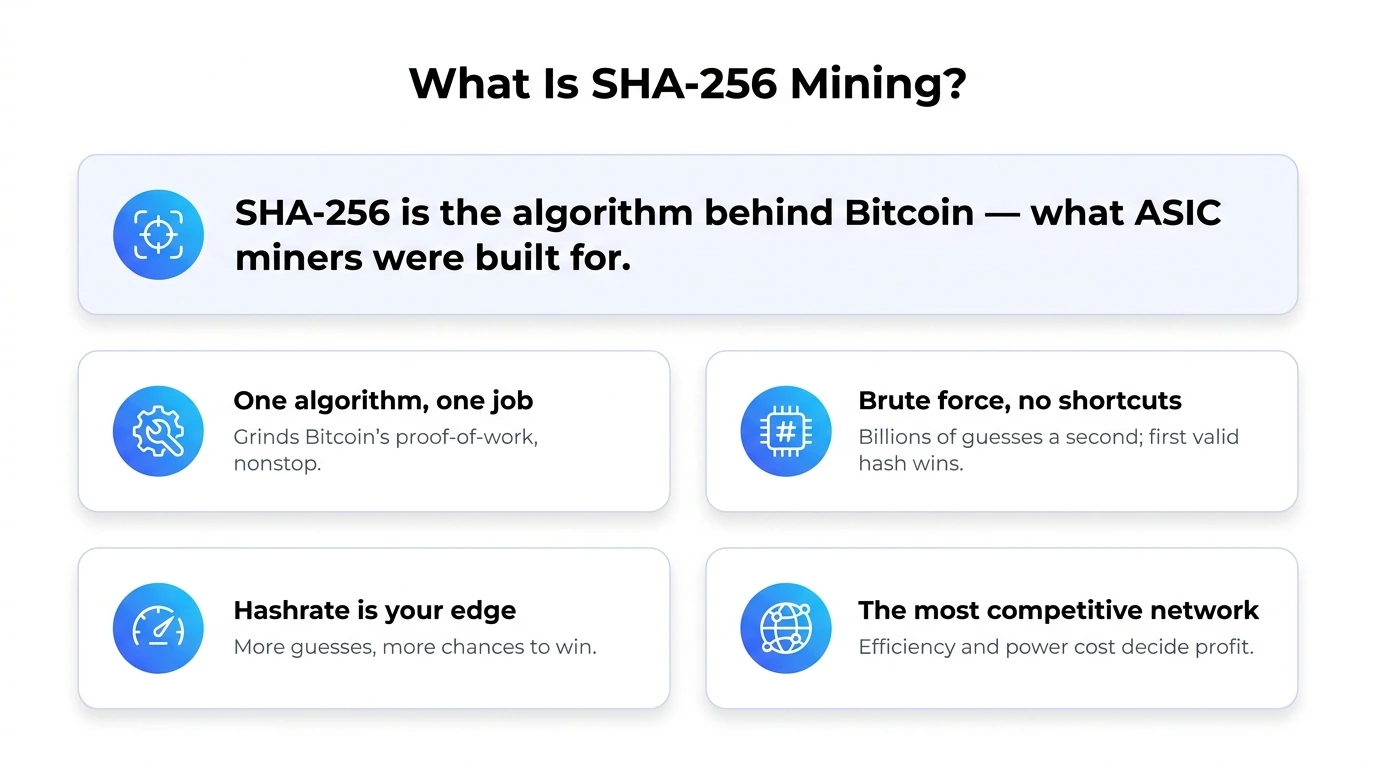
SHA-256 is the algorithm sitting behind Bitcoin, and it’s the workload that ASIC mining was basically born to chew through. A SHA-256 miner does one thing: it grinds through Bitcoin’s proof-of-work sums, over and over, as fast as the chips can physically go. One algorithm, one job, and honestly, that tunnel vision is exactly why it’s so good at it.
The way proof-of-work works, the machine is basically racing to find a number that, when run through the SHA-256 hash alongside the block data, lands under a certain target. No clever trick, no shortcut. It’s brute force, billions of guesses a second, and whoever hits a valid answer first takes the block reward. That’s the whole reason hashrate matters so much here: more guesses per second, more chances to win.
Because Bitcoin has the largest mining network on the planet, SHA-256 is also the most competitive corner of the whole space, by a wide margin. That’s not a small detail you can wave away. When you’re up against that much global hashrate, the little things are what decide whether you profit or slowly bleed money. Efficiency, electricity cost, cooling, what you paid for the machine, all of it counts for way more than it would on some smaller network. And since Bitcoin’s block reward is halved roughly every 4 years, that squeeze only gets tighter over time.
This is exactly why the newer machines get so much attention. The Antminer S21 XP, S21 Pro, and S21+ are some of the most capable Bitcoin miners you can buy right now, and they compete almost entirely on efficiency that quiet number that decides how much of your revenue actually survives the power bill. We’ll get into their exact specs a bit further down, but the short version is that on a network this crowded, an efficient machine isn’t a luxury; it’s the whole game.
What Is Scrypt Mining?
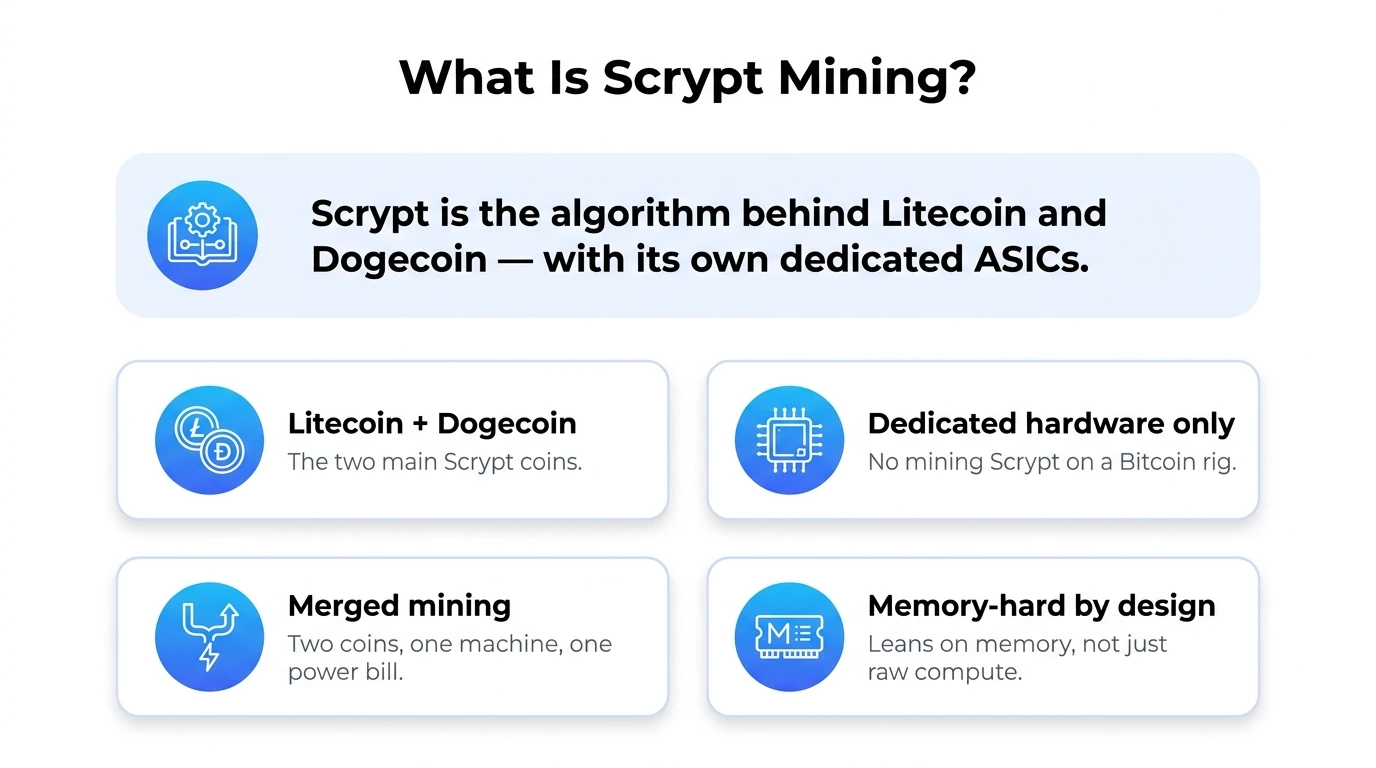
Scrypt is the algorithm behind Litecoin and Dogecoin, and it wants its own dedicated hardware, no exceptions. You can’t mine Scrypt coins on a Bitcoin machine, full stop. If Litecoin or Dogecoin is what you’re after, you need a Scrypt ASIC built for that algorithm specifically.
Scrypt was built to be a bit different from SHA-256 on purpose. It’s what folks call “memory-hard,” which just means it leans on memory as much as raw compute, the original idea being to make it tougher for specialized hardware to take over. That plan didn’t totally hold up; ASICs showed up for Scrypt eventually too, but that design quirk is why Scrypt machines are built the way they are, and why their numbers look nothing like a Bitcoin rig’s.
There’s one twist that makes Scrypt genuinely interesting, though, and that’s merged mining. Since Litecoin and Dogecoin share the Scrypt algorithm, supported pools let you mine both at once, off the same machine, without really splitting your hashrate in any painful way. Point the miner at a merged-mining pool, and it just works on both coins together, two payouts, one power bill. That two-for-one deal is a big part of why buyers still take Scrypt hardware seriously, even with Bitcoin hogging the headlines.
On the hardware side, the Antminer L11 and L9 are strong Scrypt miners built for exactly this: high Litecoin and Dogecoin output, while the smaller VolcMiner D1 Mini Pre covers the quieter home end of the range. We’ll break down all three shortly, but the takeaway is that Scrypt has its own healthy little ecosystem that runs in parallel to the Bitcoin world, not underneath it.
How Did the Two Algorithms End Up Powering Different Coins?
A bit of history helps here, because it explains why the split exists at all. SHA-256 came first, baked into Bitcoin from day one as its proof-of-work. Then Litecoin showed up a couple of years later and deliberately went with Scrypt instead, partly to stand apart from Bitcoin, partly hoping to stay friendly to ordinary hardware for a while longer. Dogecoin came along after that, picked up Scrypt too, and later tied itself to Litecoin through merged mining, which is why you almost always hear the two names together now.
So the difference isn’t random, and it isn’t a case of one being a newer version of the other. They’re parallel designs that different coins committed to years ago, and those commitments are permanent. A coin’s algorithm is fixed at the protocol level, which is exactly why your hardware choice has to follow the coin, not the other way around. That’s the whole reason this comparison matters instead of being a footnote.
What’s the Main Difference in SHA-256 vs Scrypt Mining?
Let’s keep this simple. SHA-256 is for Bitcoin-focused mining. Scrypt is for Litecoin and Dogecoin. Both run on ASIC miners, sure, but the hardware inside is built differently, and the two never cross over.
Here’s the framing that actually matters, though. SHA-256 vs Scrypt Mining isn’t just a technical footnote to nod at and scroll past. It decides which coins you can mine, which machines you’re even allowed to buy, and how your whole setup should be planned, from the power circuit right down to the pool. Get the algorithm right first, and everything after it- the machine, the cooling, the pool, the wallet- falls neatly into place. Get it wrong, and no amount of clever setup saves you; you’ve just bought the wrong tool for the coin you wanted.
Which Coins Can You Mine With SHA-256 and Scrypt?
Quick reference before we go deeper:
| Mining Algorithm | Common Coins | Miner Type |
| SHA-256 | Bitcoin | SHA-256 ASIC miner |
| Scrypt | Litecoin, Dogecoin | Scrypt ASIC miner |
One thing worth doing before you set anything up: check both pool support and coin compatibility for the exact machine you’re buying. Usually it’s straightforward, but the check takes about thirty seconds, and it saves you from a genuinely annoying surprise on day one. Some machines lock to certain coins or want particular pool settings, so a glance at the listing beats assuming.
How Do SHA-256 Miners Work?
SHA-256 machines are all about raw terahash output. Their hashrate is measured in TH/s (terahashes per second), and their power draw is measured in watts, and the relationship between those two numbers, the efficiency, is what separates a good machine from an expensive space heater that happens to hash.
Here’s how the three main SHA-256 options stack up:
| SHA-256 Miner | Hashrate | Power | Best For |
| Antminer S21 XP | 270 TH/s | 3645W | High-efficiency Bitcoin mining |
| Antminer S21 Pro | 234–245 TH/s | 3510W | Serious Bitcoin mining setups |
| Antminer S21+ | 216–235 TH/s | 3564W | Balanced SHA-256 performance |
Reading between the numbers: the S21 XP is the efficiency leader here at around 13.5 J/TH, which is why it carries the highest price tag of the three. The S21 Pro sits in the middle, 234–245 TH/s at about 15 J/TH, and it’s arguably the sweet spot for people who want strong output without the flagship sticker. The S21+ rounds things out at 216–235 TH/s and about 16.5 J/TH, usually the most affordable entry of the trio.
All three are purpose-built bitcoin miners, engineered purely for SHA-256 work and nothing else, and all three ship with the PSU included and a 365-day warranty. That single-mindedness is the whole reason they hash as hard as they do; every watt is aimed at Bitcoin’s proof-of-work, and nothing is wasted on flexibility you’d never use.
How Do Scrypt Miners Work?
Scrypt machines are measured in GH/s (gigahashes per second), not TH/s, and this trips up loads of first-time buyers. A smaller-looking number here does not mean a weaker machine. Different algorithm, different kind of work, so the units just aren’t on the same scale, and lining them up straight across tells you nothing.
Here’s the Scrypt lineup:
| Scrypt Miner | Hashrate | Power | Best For |
| Antminer L11 | 20 GH/s | 3680W | High-output Dogecoin & Litecoin mining |
| Antminer L9 | 15–17 GH/s | 3360–3570W | Strong, proven Scrypt setups |
| VolcMiner D1 Mini Pre | 2.2 GH/s | 500W | Compact home Scrypt mining |
The L11 is the heavy hitter at 20 GH/s and 3680W, the priciest option here, and it’s built for people who want serious Litecoin and Dogecoin output and have the power to feed it. The L9 is the popular workhorse, 15–17 GH/s depending on the batch, drawing 3360–3570W, and carrying a strong track record with buyers. And the D1 Mini Pre is the outlier in the best way: just 2.2 GH/s at only 500W, the most affordable pick here, and quiet enough at 45 dB to actually live in a home. It won’t out-earn the big two, obviously, but it was never meant to; it’s the friendly, low-commitment way in.
One more thing worth noting: the L11 and L9 carry a 180-day warranty, while the little D1 Mini Pre actually gets a full 365 days, so warranty length here follows the model, not the algorithm.
How Do You Read Efficiency: J/TH vs J/MH?
Efficiency is the number I’d tell anyone to check first, but here’s the catch: the two algorithms even measure it differently, which throws people off. SHA-256 machines are rated in joules per terahash (J/TH), so the S21 XP’s 13.5 J/TH just means it burns 13.5 joules for every terahash of work. Lower is better, always. Scrypt machines, on the other hand, are often rated in joules per megahash (J/MH), a different unit for a different algorithm.
The practical point isn’t the unit, it’s the habit. Within SHA-256, compare J/TH against J/TH. Within Scrypt, compare like against like. Never try to bridge the two, because a “good” number on one algorithm tells you nothing about the other. This focus on squeezing more work out of every watt is a huge part of what keeps ASIC mining competitive, since on crowded networks the most efficient machines are the ones still standing when margins get thin.
Why Shouldn’t You Compare TH/s and GH/s Directly?
This one’s worth slowing down for, because it’s the mix-up I see more than any other. You’ll spot a SHA-256 machine at 270 TH/s next to a Scrypt machine at 20 GH/s and instinctively figure the Bitcoin one is thousands of times “stronger.” It isn’t. They’re not even in the same race.
Think of it like comparing a sprinter’s 100-metre time to a swimmer’s lap. Both elite, both fast, but the numbers measure totally different events and mean nothing side by side. So don’t line up 270 TH/s against 20 GH/s like one obviously wins; they belong to different algorithms, different coins, different markets, full stop. The only fair comparison is machine against machine inside the same algorithm, an S21 versus an S21, or an L-series versus another L-series. Across algorithms, the numbers are just noise.
How Does Profitability Differ Between SHA-256 and Scrypt Mining?
Honestly? Profitability shifts daily, for both sides. What a machine earns rides on a whole stack of moving parts: the coin’s price, network difficulty, efficiency, your electricity rate, pool fees, hardware cost, and uptime, and no one can promise you a fixed number. At current prices, the calculators put the S21 XP near the top of the SHA-256 group, with the L11 leading on the Scrypt side, but next week those figures could look completely different, since Bitcoin, Litecoin, and Dogecoin each swing on their own clock.
So always run the numbers through a live profitability calculator right before you buy, using your own real electricity rate rather than some default. A machine that looked incredible in a bull week can sit dead at breakeven once difficulty climbs, so treat any figure you see as a snapshot, not a promise.
It’s also worth thinking in payback terms, not just daily profit; price divided by realistic daily profit, which on today’s tighter margins usually lands in years rather than months. Smart crypto miners run that math every single time instead of trusting a month-old screenshot, because your electricity rate and purchase price end up mattering just as much as the raw hashrate printed on the box.
Why Does Electricity Cost Matter for Both Algorithms?
Because it’s the one number that quietly decides everything, on either side of the fence. SHA-256 machines can post huge hashrate, but they pull serious power to do it; the S21 trio all sit around 3500 to 3650W. Scrypt isn’t gentle either; the L11 and L9 draw 3360 to 3680W, right in the same neighbourhood. So “which algorithm uses less power” isn’t really the right question, because the big machines on both sides are hungry.
That’s why your rate per kWh often matters more than which algorithm you pick in the first place. A cheaper machine running on cheap power can quietly out-earn a pricier one running on expensive power, month after month, without the spec sheet ever hinting at it. If you specifically want lower draw, the D1 Mini Pre is the obvious pick at just 500W, though remember you’re trading away output for that gentler power bill; it’s nowhere near the L9 or L11 in raw hashrate. Different tool, different goal. The rule holds across both algorithms: find your real rate first, then shop.
What About Merged Mining Litecoin and Dogecoin?
This one deserves its own moment, because it’s genuinely one of Scrypt’s best tricks and plenty of newcomers don’t even know it’s there. Merged mining lets a single Scrypt machine work on Litecoin and Dogecoin at once, through a supported pool, without really dividing your effort. You’re not picking one over the other; you’re earning both off the same hashrate and the same electricity.
Practically, that changes the profitability picture in Scrypt’s favour more than the headline hashrate suggests, because two revenue streams stack on one power bill. It’s part of why plenty of crypto miners still put Scrypt machines like the L9 and L11 on their shortlist even in a Bitcoin-dominated market. You do want to confirm your pool supports merged mining and set it up correctly, but once it’s running, it’s a nice, quiet edge that Bitcoin-only machines simply don’t have.
How Does Setup Differ for SHA-256 vs Scrypt Miners?
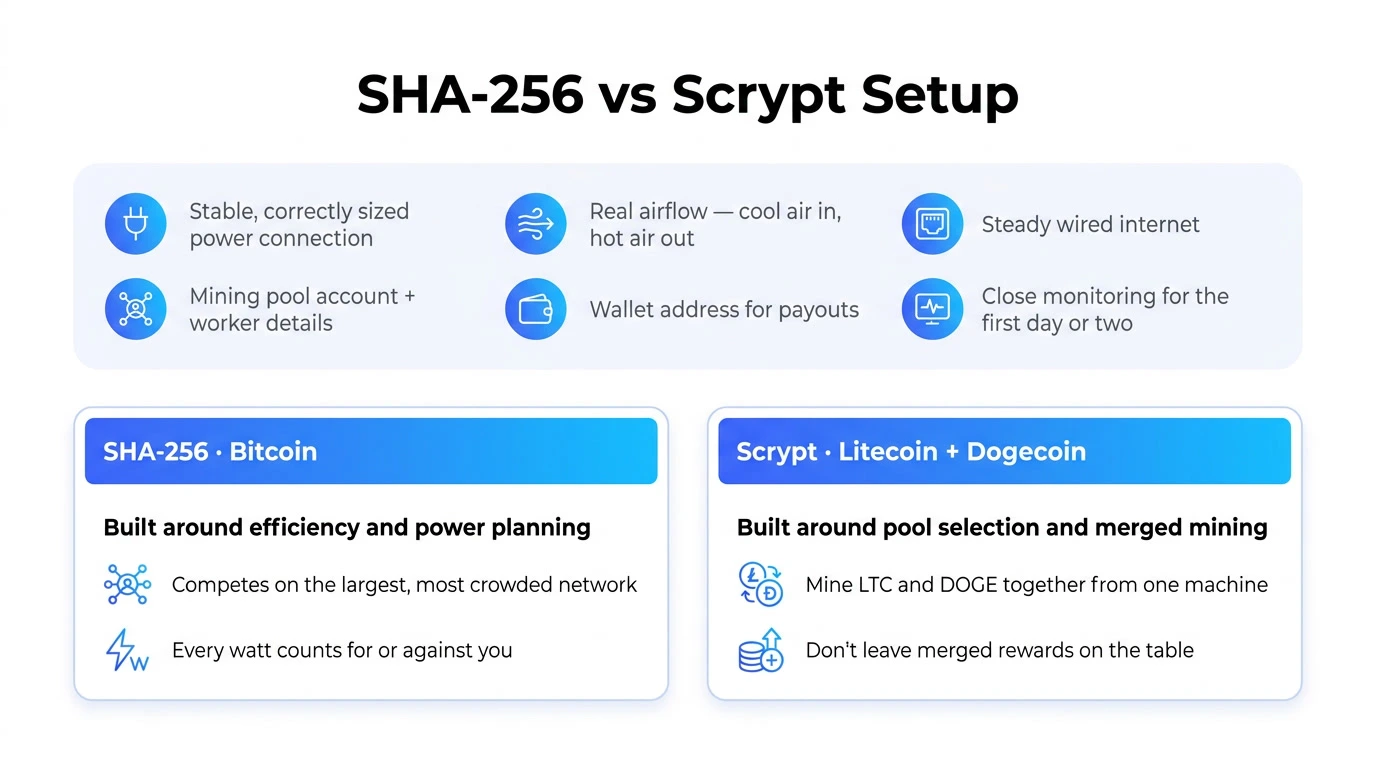
At a basic level, both types want the same things to run well:
- A proper, stable power connection sized for the machine
- Real ventilation and airflow, with cool air in and hot air out
- A steady, ideally wired, internet connection
- A mining pool account with your worker details
- A wallet address for your payouts
- Regular monitoring, especially over the first day or two
Where they diverge is the goal of the setup. A SHA-256 setup is usually built around Bitcoin efficiency and power planning, since you’re competing on the biggest, most crowded network and every watt genuinely counts against you or for you. A Scrypt setup leans more toward pool selection and merged-mining support, because getting Litecoin and Dogecoin flowing together from one machine is a big part of the appeal and you don’t want to leave that on the table. Same fundamentals, slightly different priorities once you’re actually dialing it in. Both, though, reward the same first-day discipline: watch the temperatures, confirm the hashrate holds near spec, and make sure accepted shares are climbing before you walk away.
What Pools and Wallets Do You Need for Each?
Whichever algorithm you land on, two things get you ready to earn: a pool and a wallet. On the SHA-256 side, you point the machine at a Bitcoin pool and add a Bitcoin wallet address for payouts. ViaBTC, Kryptex, and NiceHash are all popular, well-supported choices, and the S21 machines connect to any of them in a few clicks. Since Bitcoin’s network is so large, joining a pool is the smart, standard route; it turns your rewards into steady, predictable payouts that track the work your machine contributes.
On the Scrypt side, the setup is much the same, with one nice bonus: pick a pool that supports Litecoin and Dogecoin, ideally with merged mining, and both coins pay out from a single worker. NiceHash is a popular option for the L-series and the D1 Mini Pre, so have your wallet addresses ready before you begin. Either way, keep your pool credentials handy, copy them in carefully, and give them a quick double-check, since an accurate stratum URL and worker name are what get a brand-new machine hashing smoothly from the first try. A couple of minutes of care here sets you up for a clean, hassle-free start.
Is There a Noise and Cooling Difference?
Not in the way people assume. Plenty of buyers expect Scrypt to be quiet and SHA-256 to be loud, or the reverse, but the algorithm honestly doesn’t decide that at all. The machine does.
Look at the actual numbers: the big SHA-256 units and the big Scrypt units both sit around 75 to 76 dB, which is loud, roughly vacuum-cleaner-in-the-room territory, so neither belongs in a bedroom or a shared living space. The D1 Mini Pre, on the other hand, runs closer to 45 dB, quiet enough for a home office, and it’s a Scrypt machine. So the pattern isn’t “Scrypt equals quiet.” It’s that machine design, cooling system, power draw, and fan behavior decide the noise, not the algorithm printed on the box. Judge each model on its own spec sheet, and if noise is a real concern for where you’ll run it, that single number on the listing tells you more than the algorithm ever will.
Which Algorithm Holds Up Better Long-Term?
Fair question, and the honest answer is “it depends on what you value.” On the SHA-256 side, Bitcoin’s sheer size and staying power mean the top machines tend to hold resale value reasonably well as long as they stay efficient relative to the network, and dedicated bitcoin miners like the S21 line stay competitive longer simply because Bitcoin’s difficulty rises steadily rather than lurching. The flip side is that same rising difficulty slowly eats into what any single machine earns, so the clock is always ticking a little.
On the Scrypt side, the Litecoin-and-Dogecoin pairing gives the algorithm a durable niche, and merged mining sweetens the long-term case. Difficulty still climbs, and coin prices still swing, but you’re spreading your exposure across two coins instead of one. Neither algorithm is a guaranteed winner over years; both are tied to prices and difficulty nobody can predict, but if you want the biggest, most liquid network, SHA-256 leans that way, and if you want a two-coin niche with a merged-mining bonus, Scrypt makes its case.
Which Algorithm Is Better for Beginners?
Here’s the balanced answer, because there genuinely isn’t a single winner. SHA-256 is the better pick if you mainly want Bitcoin. Scrypt is the better pick if you want exposure to Litecoin and Dogecoin. That’s really the first fork in the road, and it comes down to which coin you actually want to hold at the end of the day.
For a beginner, though, the “best” machine isn’t the most powerful one on the page. It’s the one that fits your budget, your electricity cost, your space, and your coin goal all at once. A monster miner you can’t comfortably afford to run isn’t a good deal; it’s a liability that’ll stress you out every time you look at the power bill. Matching the machine to the goal is the part that helps new crypto miners avoid an expensive first mistake, and it beats chasing the biggest hashrate number on the page every single time. Start with the coin, then the budget, then the machine, in that order.
Top SHA-256 Miners to Look
Three machines worth putting side by side if Bitcoin is your target:
Antminer S21 XP — the efficiency champ of the group at 270 TH/s and around 13.5 J/TH. This is the one to look at if you want maximum SHA-256 output and the best power-per-hash on this list, and you’re okay paying the premium to get there. Over a long run, that efficiency is what protects your margins as difficulty climbs.
Antminer S21 Pro — a serious machine at 234–245 TH/s and about 15 J/TH, sitting in the mid-range on price. It’s for miners who want strong Bitcoin-focused output and are ready to handle the power, heat, and setup properly. For a lot of people, this is the practical sweet spot: most of the XP’s capability, noticeably less upfront.
Antminer S21+ — the balanced pick at 216–235 TH/s and about 16.5 J/TH, usually the cheapest of the three. Good for buyers who want solid performance but still want to weigh price, power, and ROI carefully before jumping to a higher-end unit. A sensible first serious Bitcoin machine.
Top Scrypt Miners to Look
And the three to weigh if Litecoin and Dogecoin are your goal:
Antminer L11 — the high-output option at 20 GH/s and 3680W, and the priciest machine on this list. Best suited to buyers who want the strongest Scrypt performance on this list and have the electrical setup to support that draw comfortably. If you’re going big on Litecoin and Dogecoin, this is the top of the range.
Antminer L9 — the proven, popular choice at 15–17 GH/s and 3360–3570W depending on the batch. It makes a lot of sense for anyone who wants strong hashrate in a well-established Scrypt machine without stretching all the way to L11 money. A reliable middle ground with a solid reputation behind it.
VolcMiner D1 Mini Pre — the compact entry point at 2.2 GH/s and just 500W, and the most affordable machine here. Much lower output than the big two, sure, but also far lower power and noise, which makes it the friendliest way to get into Dogecoin and Litecoin mining from home without rewiring anything or filling a room with fan noise.
SHA-256 vs Scrypt Mining: Which Direction Fits Your Goal?
Sometimes the cleanest way to decide is just to match your goal to the hardware. Here’s SHA-256 vs Scrypt Mining boiled down to a buyer’s cheat sheet:
| Buyer Goal | Better Direction | Why |
| Mine Bitcoin | SHA-256 | Bitcoin runs on SHA-256 |
| Mine Litecoin | Scrypt | Litecoin runs on Scrypt |
| Mine Dogecoin | Scrypt | Dogecoin is commonly mined with Scrypt |
| Highest BTC-focused hashrate | SHA-256 | SHA-256 machines are built for Bitcoin output |
| Smaller Scrypt entry point | D1 Mini Pre | Lower power than the large Scrypt models |
| Strong Scrypt output | L11 or L9 | Built for Litecoin and Dogecoin |
| Serious Bitcoin setup | S21 XP, S21 Pro, S21+ | Built for SHA-256 mining |
What Common Mistakes Should Buyers Avoid?
Most first-time mistakes come from rushing the order before the basics are settled. The usual ones:
- Buying a miner before deciding which coin you actually want to mine
- Comparing TH/s and GH/s directly, as if they’re on the same scale
- Ignoring electricity cost until the first bill lands
- Assuming one ASIC can mine every coin (it genuinely can’t)
- Forgetting to check pool compatibility before ordering
- Looking at revenue but never net profit after power
- Overlooking heat, noise, and the power setup the machine actually needs
None of these are hard to avoid. They just need a little planning before you click buy, not after it arrives. The pattern behind almost all of them is the same: deciding on the machine before deciding on the coin and the setup, and flipping that order around fixes most of them on its own.
What Should Buyers Check Before Choosing an Algorithm?
Before you commit to SHA-256 or Scrypt, run down a short checklist: the coin you want, the algorithm it uses, the miner’s specs, its power draw, your real electricity cost, pool support, noise, cooling needs, and the expected ROI at today’s numbers rather than last month’s. Tick those off honestly, and the right direction usually becomes obvious, because the machine stops being an abstract spec sheet and starts being something that either fits your actual situation or doesn’t. That five-minute check is the difference between a purchase you’re happy with in six months and one you quietly regret.
CONCLUSION
SHA-256 vs Scrypt Mining mainly comes down to coin choice and hardware compatibility. SHA-256 miners are built for Bitcoin and similar coins, while Scrypt miners are built for Litecoin, Dogecoin, and related mining setups. A miner made for one algorithm cannot be used freely for the other, so choosing the right algorithm should come before choosing the machine.
For buyers, the practical step is simple: decide which coin you want to mine, then compare hashrate, power use, efficiency, noise, cooling needs, and electricity cost. CryptoMinerBros can be a useful place to review SHA-256 and Scrypt ASIC miners before making the final buying decision.
Frequently Asked Questions
-
What is the main difference between SHA-256 and Scrypt mining?
The main difference is the algorithm and coin support. SHA-256 is used for Bitcoin mining, while Scrypt is commonly used for Litecoin and Dogecoin mining. Both require different ASIC miners.
-
Can a SHA-256 ASIC miner mine Scrypt coins?
No. A SHA-256 ASIC miner cannot mine Scrypt coins because both algorithms are different. You need a dedicated Scrypt ASIC miner for coins like Litecoin and Dogecoin.
-
Which miners are used for SHA-256 mining?
Popular SHA-256 miners include models like the Antminer S21 XP, Antminer S21 Pro, and Antminer S21+. These machines are mainly used for Bitcoin-focused mining.
-
Which miners are used for Scrypt mining?
Popular Scrypt miners include models like L11, L9, and D1 Mini Pre. These machines are commonly used for Litecoin and Dogecoin mining.
-
Is SHA-256 mining better than Scrypt mining?
Neither is automatically better. SHA-256 is better for Bitcoin mining, while Scrypt is better for Litecoin and Dogecoin mining. The right choice depends on your coin preference, power cost, budget, and mining goal.
-
Should beginners choose SHA-256 or Scrypt mining?
Beginners should first decide which coin they want to mine. If they want Bitcoin, SHA-256 is the right option. If they want Litecoin or Dogecoin, Scrypt mining is the better direction.

Join our Newsletter
Get the week’s best cryptomining content in your inbox.

Han su
Han Su is a technical analyst at CryptoMinerBros, a leading provider of cryptocurrency mining hardware. He has over 5 years of experience in the cryptocurrency industry and is an expert in mining hardware, software, and profitability analysis.
Han is responsible for the technical analysis and research on ASIC Mining at Crypto Miner Bros. He also writes in-depth blogs on ASIC mining and cryptocurrency mining, and he has a deep understanding of the technology. His blogs are informative and engaging, and they have helped thousands of people learn about cryptocurrency mining.
He is always looking for new ways to educate people about cryptocurrency, and he is excited to see how the technology continues to develop in the years to come.
In spare time, Han enjoys hiking, camping, and spending time with his family. He is also an avid reader, and he loves to learn about new things.
Similar Blogs
Goldshell SC5 Pro Review: Profitability and Buying Guide
Is the Goldshell SC5 Pro worth buying? Check its latest price, profitability, resale value, key risk...
Why Is Zcash Mining Getting More Competitive?
Zcash Mining: Why Is It Getting More Attention? Zcash mining has turned into one of the more talked-...
BTCB2 Mining and Profitability: What Current Data Suggests
What Is BTCB2 Mining? Mining BTCB2 involves using Blake2b-compatible ASIC hardware for the BTCB2 cha... © 2018- Miner Bros Limited. All rights reserved

 EN EN
EN EN  ES
ES