


Bitcoin Mining Electricity Cost is where most of your mining budget actually goes. You could buy the fastest ASIC miner out there, but if you’re not paying attention to its power draw, you might end up losing money every day instead of making it. We come to examine the power consumption of various models, how to calculate the actual costs, and a few tips for keeping the electric bill under control.
What Makes One ASIC Miner More Power Hungry Than Another?
Any ASIC miner draws a constant amount of power from the power supply, measured in watts (W). However, the mere wattage is not sufficient to judge a computer’s buying value. One of the most crucial factors is the performance of the device, which in this context is given in joules per terahash or simply J/TH. This metric indicates the amount of power the miner consumes to produce one terahash of processing power.
Here’s the formula, and it’s pretty simple:
J/TH = Power Consumption (Watts) ÷ Hashrate (TH/s)
Assuming that a machine has a power consumption of 3,500 watts and produces 200 TH/s. This means it has 17.5 J/TH. The smaller this figure is, the less electricity you’ll spend on each unit of mining capacity that your device generates. In a way, it resembles a car’s mileage. Even if two devices appear to be identical, the more work a device does with each watt, the better.
Here are the factors that affect how much power a miner actually draws:
- Chip configuration: more modern chips based on smaller nanometers have low power consumption at similar performance levels.
- Cooling system: computers with air cooling will be hotter and less efficient compared to the hydro- and immersion-cooled ones.
- Overclocking/underclocking: going overboard with the hash rate and power consumption of your mining rig causes rapid growth in power consumption compared to performance. In contrast, underclocking works oppositely.
- Firmware: customized firmware allows you to tweak voltage and frequency in order to get slightly increased efficiency.
- Temperature of the room: hot rooms cause fans to work faster, and this also silently increases power consumption.
If you’re in the market for a bitcoin miner, efficiency deserves just as much attention as price and hashrate.
A cheap machine can turn into an expensive one fast if it’s inefficient.
How Much Power Do The Top ASIC Miners Use In 2026?
Here’s a look at some popular ASIC mining models and where they stand on power draw. As a general rule, hydro- and immersion-cooled units tend to post better efficiency than air-cooled versions of similar hardware.
| Model | Hashrate | Power Draw | Efficiency (J/TH) | Cooling Type |
| Bitmain Antminer S23 Hyd | 580 TH/s | 5,510 W | 9.5 | Hydro |
| Bitmain Antminer S23 | 318 TH/s | 3,498 W | 11.0 | Air |
| Bitdeer SealMiner A3 Pro Hydro | 660 TH/s | 8,250 W | 12.5 | Hydro |
| Bitmain Antminer S21 XP Hyd | 473 TH/s | 5,676 W | 12.0 | Hydro |
| Bitmain Antminer S21 XP | 270 TH/s | 3,645 W | 13.5 | Air |
| MicroBT Whatsminer M73S+ | 540 TH/s | 7,200 W | 13.3 | Hydro |
| Bitmain Antminer S21 Pro | 234 TH/s | 3,510 W | 15.0 | Air |
| Bitmain Antminer S21+ | 216 TH/s | 3,564 W | 16.5 | Air |
| Bitmain Antminer S21 | 200 TH/s | 3,550 W | 17.5 | Air |
| MicroBT Whatsminer M60S+ | 178 TH/s | 3,441 W | 18.5 | Air |
Many miners of cryptocurrency still use Scrypt machines for mining Dogecoin or Litecoin as opposed to SHA-256 mining machines. The Bitmain Antminer L9 machine has a hashing power of 16-17 TH/s and consumes 3,360 to 3,570 watts, whereas the Antminer L11 Pro can achieve 21 GH/s hashing power, consuming 3,612 watts. You can’t compare these directly to SHA-256 machines since they run on a different algorithm, but the same rule applies either way: less power per unit of output means better returns down the line.
Look at the gap between the best and worst performers on that list. A miner running at 9.5 J/TH uses almost half the electricity of one at 18.5 J/TH for the same amount of hashrate. Run that difference for a few months straight, and you’re talking about thousands of dollars.
How Do You Calculate Your Actual Electricity Cost?
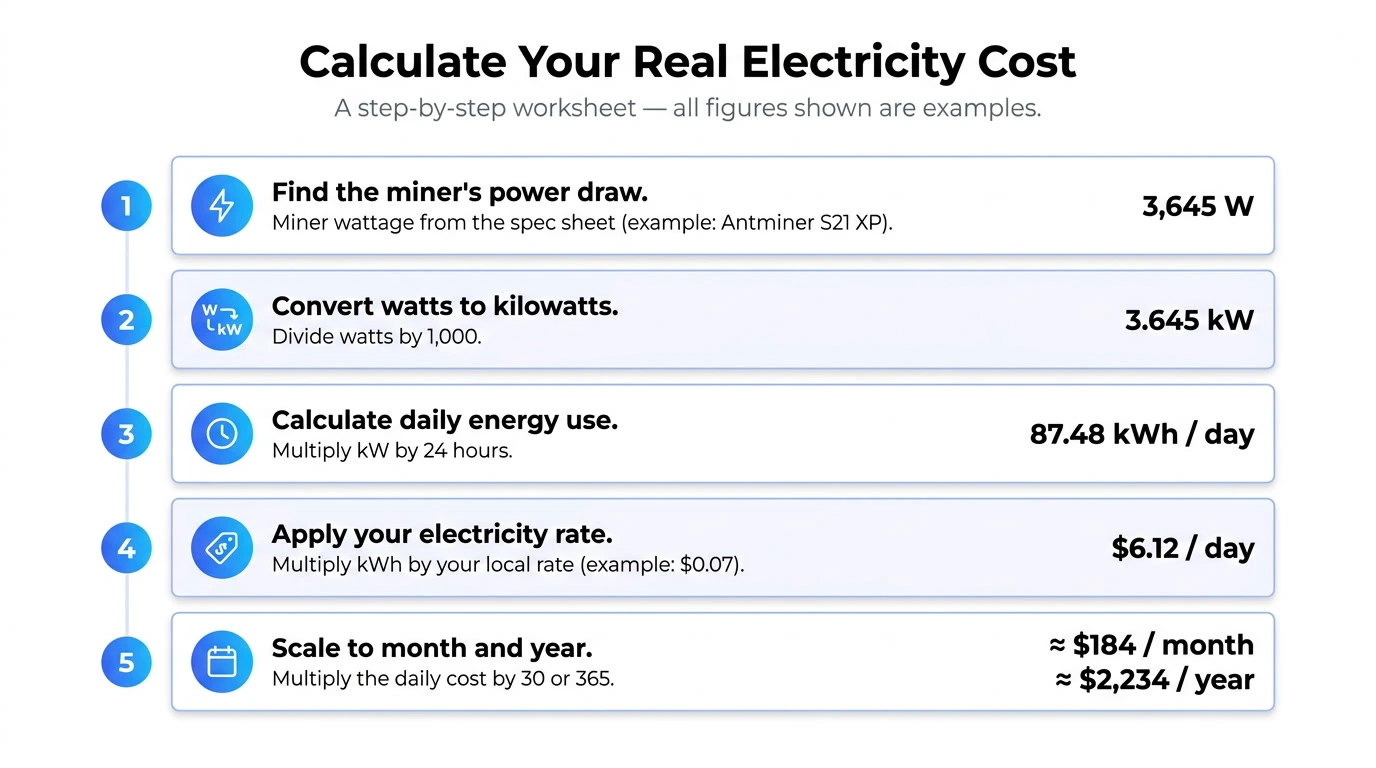
After you find out the wattage of your miner, the calculation of the daily cost is quite simple.
Here’s how to do it:
- Find the miner’s energy consumption in Watts, which is mentioned in the specification; for instance, Antminer S21 XP consumes 3,645 W.
- Calculate kilowatts by dividing watts by 1,000, which equals 3.645 kW.
- Multiply by 24 hours and get energy usage per day, which equals kilowatt-hour (kWh. So, 3.645 kW x 24 = 87.48 kWh per day.
- Multiply 87.48 kWh by the price of energy in your country; let’s take $0.07, and get 87.48 x 0.07 = $6.12 per day.
- Now multiply by 30 days for a monthly calculation, or even by 365 for a yearly one.
Got an entire fleet of ASIC miners instead of just one? Simply multiply the above number by the total number of mining devices in use. You can even add a 5-10% margin in order to allow for the loss caused by cooling fans and ventilation systems.
A Real-World Example
Let’s run the Antminer S21 XP (270 TH/s, 3,645 W) through a mining profitability calculator like WhatToMine at $0.07 per kWh and see what the estimated daily profit looks like and see what comes out:
| Category | Daily | Monthly | Yearly |
| Income | $8.12 | $243.74 | $2,965.50 |
| Electricity | -$6.12 | -$183.71 | -$2,235.11 |
| Profit | $2.00 | $60.03 | $730.39 |
At that rate, electricity swallows roughly 75% of the machine’s gross income, leaving just $2.00 in daily profit. Stretch that out over a year and you’re looking at around $730 net, assuming Bitcoin’s price and network difficulty don’t shift much. It’s a good reminder that electricity isn’t some side expense; it’s basically the deciding factor in whether a Bitcoin miner is worth running at all. Bump your local rate up by even a couple cents, and that margin can disappear fast, so run your own numbers before you buy anything.
Practical Steps That Can Lower Your Bitcoin Mining Electricity Cost
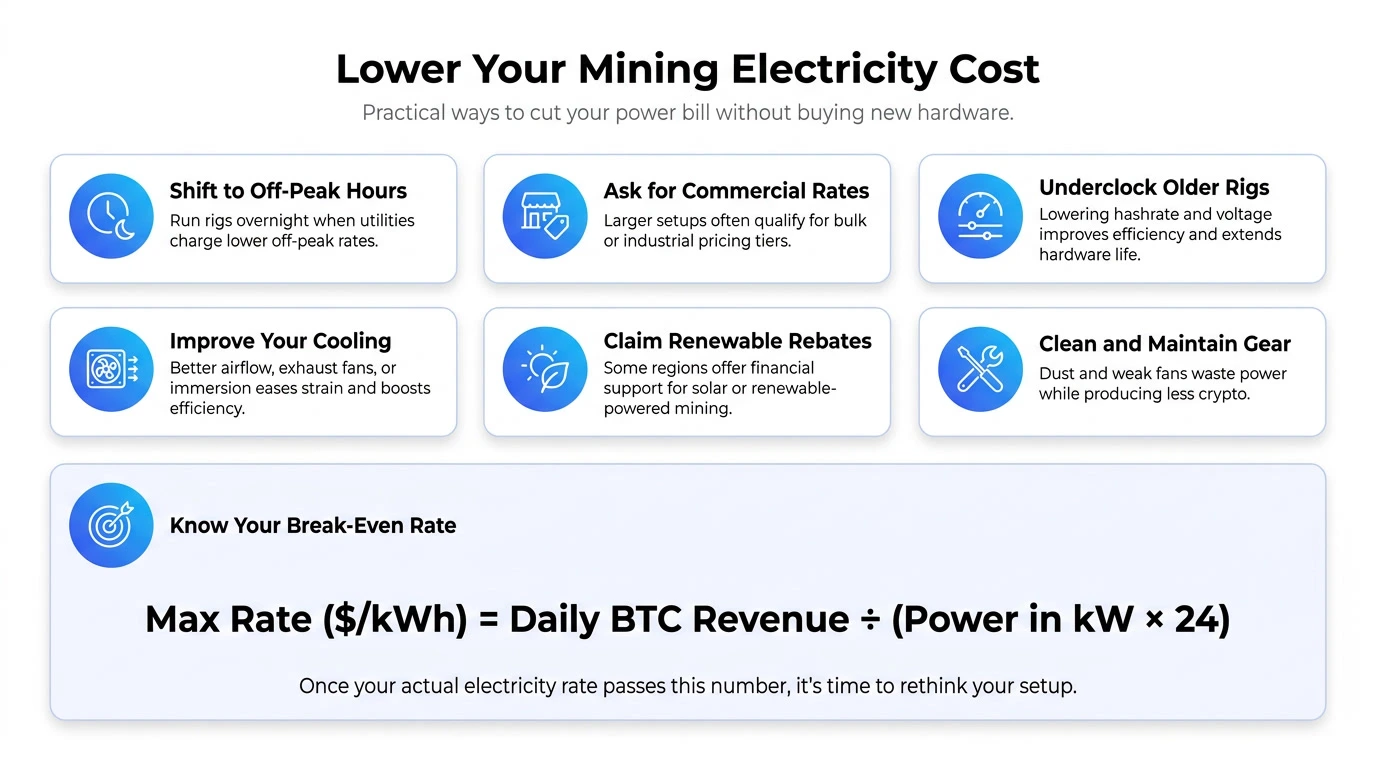
You don’t always need new hardware to cut your power costs. A few things any crypto miner can try:
- Look into off-peak electricity rates. A lot of utility providers charge less overnight or during off-peak windows. Running your rigs during those hours, when you can, adds up over time.
- Ask about industrial or commercial rates. Running a bigger setup? Check with your utility about bulk pricing tiers, which usually beat standard residential rates.
- Underclock older machines. Dialing back hashrate and voltage a bit on aging hardware can improve efficiency and stretch out its useful life.
- Fix up your cooling. Better airflow, exhaust fans, or even a simple immersion setup takes strain off your fans and helps efficiency across the board.
- Check out rebates available for solar or renewable energy. In some locations, there is financial support for using renewable energy in mining activities.
- Check your equipment. If a miner is covered in dirt or has an inefficient fan, it will consume more electricity but produce less cryptocurrency.
- Know your break-even rate. Max Rate ($/kWh) = Daily BTC Revenue ÷ (Power in kW x 24). Once your actual electricity rate creeps past that number, it’s time to rethink your setup.
Which ASIC Miner Should You Choose Based On Power Usage?
Really, it comes down to your setup and what you’re trying to accomplish:
- For large or industrial-scale mining, it would be more appropriate to go for the hydro or immersion cooling system type of miner, such as the S23 Hyd and SealMiner A3 Pro Hydro.
- As far as smaller-scale operations go, the air-cooled miner, such as the S21 Pro or S21 XP, is fine since there will be no hydro connections or three-phase electricity necessary.
- Budget-minded beginners could look at older, discounted units, but crunch the numbers carefully first. A lot of that older hardware sits above 17-18 J/TH, and that eats into margins hard as difficulty keeps climbing.
Before you buy any bitcoin miner, run it through a mining profitability calculator using your actual electricity rate, not a rough guess. Plug in the real wattage, current network difficulty, and today’s block reward so you’re looking at genuine expected returns instead of marketing numbers.
CONCLUSION
At the end of the day, understanding Bitcoin Mining Electricity Cost power usage by ASIC model is what separates a mining setup that actually turns a profit from one that quietly drains your bank account. Compare efficiency in J/TH, run your electricity costs using your actual local rate, and pick hardware that matches your scale and setup. Whether you’re running one rig in a garage or building out a bigger fleet, the miners who stay on top of power efficiency are the ones still profitable when the market gets rough. If you need a hand picking the right hardware for your budget and power situation, the team at Cryptominerbros is a good place to start comparing specs before you commit.
Frequently Asked Questions
-
How much electricity does an ASIC miner use?
Most modern ASIC miners use somewhere between 3,400 and 8,300 watts, depending on the model and cooling type. Efficient units like the Antminer S23 Hyd sit closer to the lower end per unit of hashrate, while high-hashrate hydro units draw more overall power.
-
How much does it cost in electricity to run a Bitcoin miner?
At $0.07 per kWh, an Antminer S21 XP costs around $6.12 a day, or roughly $184 a month, to run. Your actual cost depends on the machine’s wattage and your local electricity rate.
-
How many kWh does it take to mine one BTC?
This varies constantly with network difficulty and hashrate, so there’s no fixed number, but at current difficulty levels it typically takes hundreds of thousands of kWh across a mining operation to produce one BTC. Solo miners with a single ASIC miner would need an extremely long time to mine a full coin on their own.
-
How many watts does it take to run a Bitcoin miner?
Bitcoin miners typically use between 3,400 and 8,300 watts, depending on the model and hashrate. Air-cooled units usually sit lower, while high-output hydro-cooled machines draw significantly more power.

Join our Newsletter
Get the week’s best cryptomining content in your inbox.

Han su
Han Su is a technical analyst at CryptoMinerBros, a leading provider of cryptocurrency mining hardware. He has over 5 years of experience in the cryptocurrency industry and is an expert in mining hardware, software, and profitability analysis.
Han is responsible for the technical analysis and research on ASIC Mining at Crypto Miner Bros. He also writes in-depth blogs on ASIC mining and cryptocurrency mining, and he has a deep understanding of the technology. His blogs are informative and engaging, and they have helped thousands of people learn about cryptocurrency mining.
He is always looking for new ways to educate people about cryptocurrency, and he is excited to see how the technology continues to develop in the years to come.
In spare time, Han enjoys hiking, camping, and spending time with his family. He is also an avid reader, and he loves to learn about new things.
Similar Blogs

Bitaxe Gamma 602 Review: Specs, Features & Buying Guide
Gamma 602 Bitcoin Miner The Bitaxe Gamma 602 is a compact Bitcoin miner manufactured by Bitaxe, a br...
SHA-256 vs Scrypt Mining: What’s the Difference for ASIC Miners?
SHA-256 vs Scrypt Mining is one of those questions that sounds purely technical until you realize it...
Bitcoin Mining Market Signals: When to Buy, Hold or Upgrade
Learn the key Bitcoin mining market signals to watch before buying, holding, or upgrading your ASIC ... © 2018- Miner Bros Limited. All rights reserved

 EN EN
EN EN  ES
ES