




El coste de la electricidad para la minería de Bitcoin es donde va la mayor parte de su presupuesto de minería. Podría comprar el minero ASIC más rápido del mercado, pero si no presta atención a su consumo de energía, podría terminar perdiendo dinero cada día en lugar de ganarlo. Examinamos el consumo de energía de varios modelos, cómo calcular los costes reales y algunos consejos para mantener la factura eléctrica bajo control.
¿Qué hace que un minero ASIC consuma más energía que otro?
Cualquier minero ASIC consume una cantidad constante de energía de la fuente de alimentación, medida en vatios (W). Sin embargo, la mera potencia no es suficiente para juzgar el valor de compra de un ordenador. Uno de los factores más cruciales es el rendimiento del dispositivo, que en este contexto se expresa en julios por terahash o simplemente J/TH. Esta métrica indica la cantidad de energía que el minero consume para producir un terahash de potencia de procesamiento.
Aquí está la fórmula, y es bastante simple:
J/TH = Consumo de energía (Vatios) ÷ Hashrate (TH/s)
Suponiendo que una máquina tiene un consumo de energía de 3.500 vatios y produce 200 TH/s. Esto significa que tiene 17,5 J/TH. Cuanto menor sea esta cifra, menos electricidad gastará por cada unidad de capacidad de minería que genere su dispositivo. En cierto modo, se asemeja al kilometraje de un coche. Incluso si dos dispositivos parecen idénticos, cuanto más trabajo realiza un dispositivo con cada vatio, mejor.
Estos son los factores que afectan a la cantidad de energía que consume un minero:
- Configuración del chip: los chips más modernos basados en nanómetros más pequeños tienen un bajo consumo de energía con niveles de rendimiento similares.
- Sistema de refrigeración: los ordenadores con refrigeración por aire serán más calientes y menos eficientes en comparación con los refrigerados por hydro y por inmersión.
- Overclocking/underclocking: excederse con el hashrate y el consumo de energía de su plataforma de minería provoca un rápido crecimiento del consumo de energía en comparación con el rendimiento. Por el contrario, el underclocking funciona de forma opuesta.
- Firmware: el firmware personalizado le permite ajustar el voltaje y la frecuencia para obtener una eficiencia ligeramente mayor.
- Temperatura de la habitación: las habitaciones calientes hacen que los ventiladores funcionen más rápido, y esto también aumenta silenciosamente el consumo de energía.
Si está buscando un minero de bitcoin, la eficiencia merece tanta atención como el precio y el hashrate.
Una máquina barata puede convertirse rápidamente en una cara si es ineficiente.
¿Cuánta energía consumen los principales mineros ASIC en 2026?
Aquí tienes un vistazo a algunos populares modelos de minería ASIC y su consumo de energía. Como regla general, las unidades refrigeradas por agua o inmersión tienden a mostrar una mejor eficiencia que las versiones refrigeradas por aire del hardware similar.
| Modelo | Tasa de hash | Consumo de potencia | Eficiencia (J/TH) | Tipo de refrigeración |
| Bitmain Antminer S23 Hyd | 580 TH/s | 5.510 W | 9.5 | Hydro |
| Bitmain Antminer S23 | 318 TH/s | 3.498 W | 11.0 | Aire |
| Bitdeer SealMiner A3 Pro Hydro | 660 TH/s | 8.250 W | 12.5 | Hydro |
| Bitmain Antminer S21 XP Hyd | 473 TH/s | 5.676 W | 12.0 | Hydro |
| Bitmain Antminer S21XP | 270 TH/s | 3.645 W | 13.5 | Aire |
| MicroBT Whatsminer M73S+ | 540 TH/s | 7.200 W | 13.3 | Hydro |
| Bitmain Antminer S21 Pro | 234 TH/s | 3.510 W | 15.0 | Aire |
| Bitmain Antminer S21+ | 216 TH/s | 3.564 W | 16.5 | Aire |
| Bitmain Antminer S21 | 200 TH/s | 3.550 W | 17.5 | Aire |
| MicroBT Whatsminer M60S+ | 178 TH/s | 3.441 W | 18.5 | Aire |
Muchos mineros de criptomonedas todavía usan máquinas Scrypt para minar Dogecoin o Litecoin en lugar de máquinas de minería SHA-256. La Bitmain Antminer L9 máquina tiene una potencia de hash de 16-17 TH/s y consume de 3.360 a 3.570 vatios, mientras que la Antminer L11 Pro puede alcanzar una potencia de hash de 21 GH/s, consumiendo 3.612 vatios. No puedes comparar estas directamente con las máquinas SHA-256, ya que funcionan con un algoritmo diferente, pero la misma regla se aplica de todos modos: menos potencia por unidad de salida significa mejores rendimientos a largo plazo.
Mira la diferencia entre los mejores y los peores en esa lista. Un minero que funciona a 9,5 J/TH consume casi la mitad de electricidad que uno a 18,5 J/TH para la misma cantidad de hashrate. Si aplicas esa diferencia durante unos meses seguidos, estarás hablando de miles de dólares.
¿Cómo calcular tu coste real de electricidad?
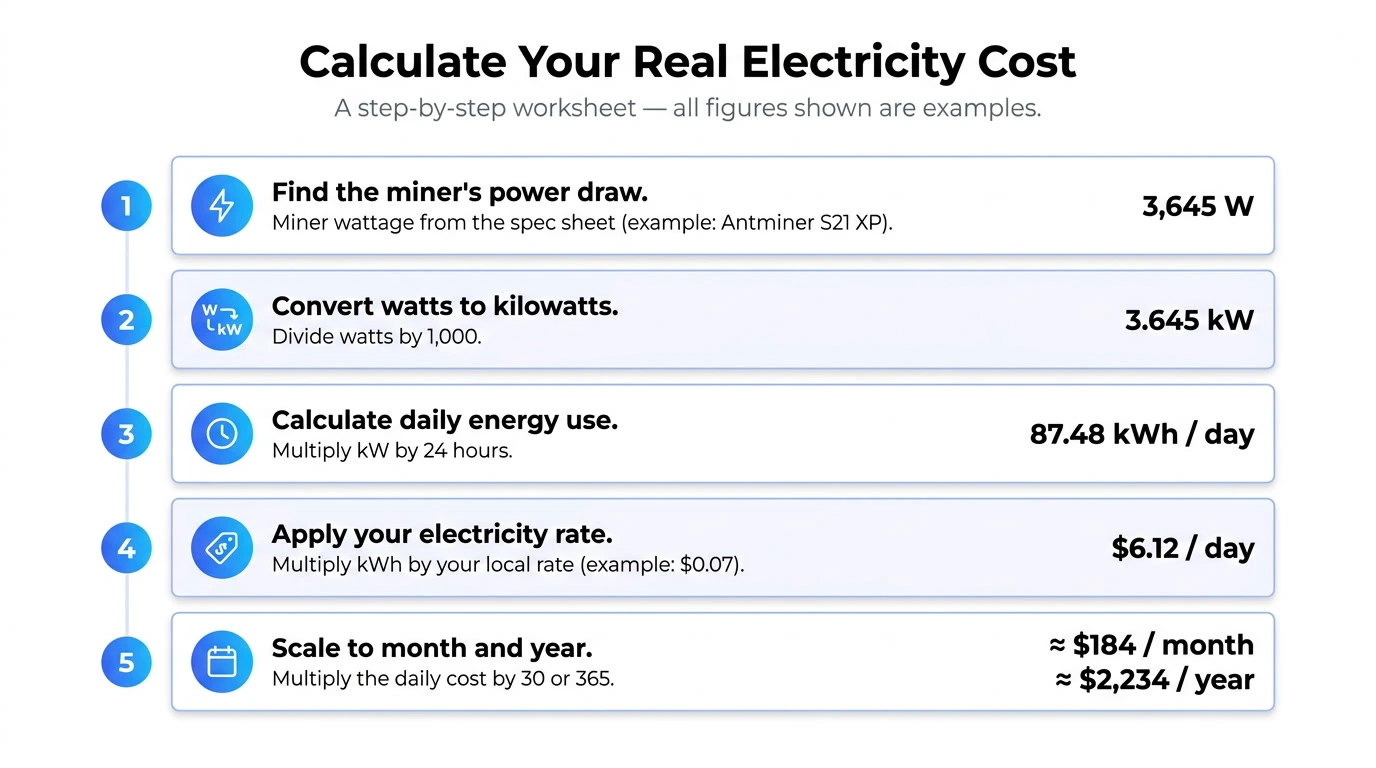
Una vez que averigues la potencia de tu minero en vatios, el cálculo del coste diario es bastante sencillo.
Aquí te explicamos cómo hacerlo:
- Encuentra el consumo de energía del minero en vatios, que se menciona en las especificaciones; por ejemplo, el Antminer S21 XP consume 3.645 W.
- Calcula los kilovatios dividiendo los vatios entre 1.000, lo que equivale a 3,645 kW.
- Multiplica por 24 horas y obtén el consumo de energía por día, que equivale a kilovatio-hora (kWh). Por lo tanto, 3,645 kW x 24 = 87,48 kWh por día.
- Multiplica 87,48 kWh por el precio de la energía en tu país; tomemos 0,07 $, y obtendrás 87,48 x 0,07 = 6,12 $ por día.
- Ahora multiplica por 30 días para un cálculo mensual, o incluso por 365 para uno anual.
¿Tienes toda una flota de mineros ASIC en lugar de solo uno? Simplemente multiplica el número anterior por el número total de dispositivos de minería en uso. Incluso puedes añadir un margen del 5-10% para tener en cuenta la pérdida causada por los ventiladores de refrigeración y los sistemas de ventilación.
Un ejemplo del mundo real
Vamos a ejecutar el Antminer S21 XP (270 TH/s, 3.645 W) a través de una calculadora de rentabilidad de minería como Qué es mío a $0.07 por kWh y veamos cómo se ve el beneficio diario estimado y qué resulta:
| Categoría | Diario | Mensual | Anual |
| Ingreso | $8.12 | $243.74 | $2,965.50 |
| Electricidad | -$6.12 | -$183.71 | -$2,235.11 |
| Ganancia | $2.00 | $60.03 | $730.39 |
A esa tasa, la electricidad consume aproximadamente el 75% de los ingresos brutos de la máquina, dejando solo 2,00 $ de beneficio diario. Si estiras eso durante un año, estarás hablando de alrededor de 730 $ netos, asumiendo que el precio de Bitcoin y la dificultad de la red no cambien mucho. Es un buen recordatorio de que la electricidad no es un gasto secundario; es básicamente el factor decisivo para saber si vale la pena ejecutar un minero de Bitcoin. Si aumentas tu tarifa local incluso en un par de céntimos, ese margen puede desaparecer rápidamente, así que haz tus propios cálculos antes de comprar nada.
Pasos prácticos que pueden reducir tu coste de electricidad para minar Bitcoin
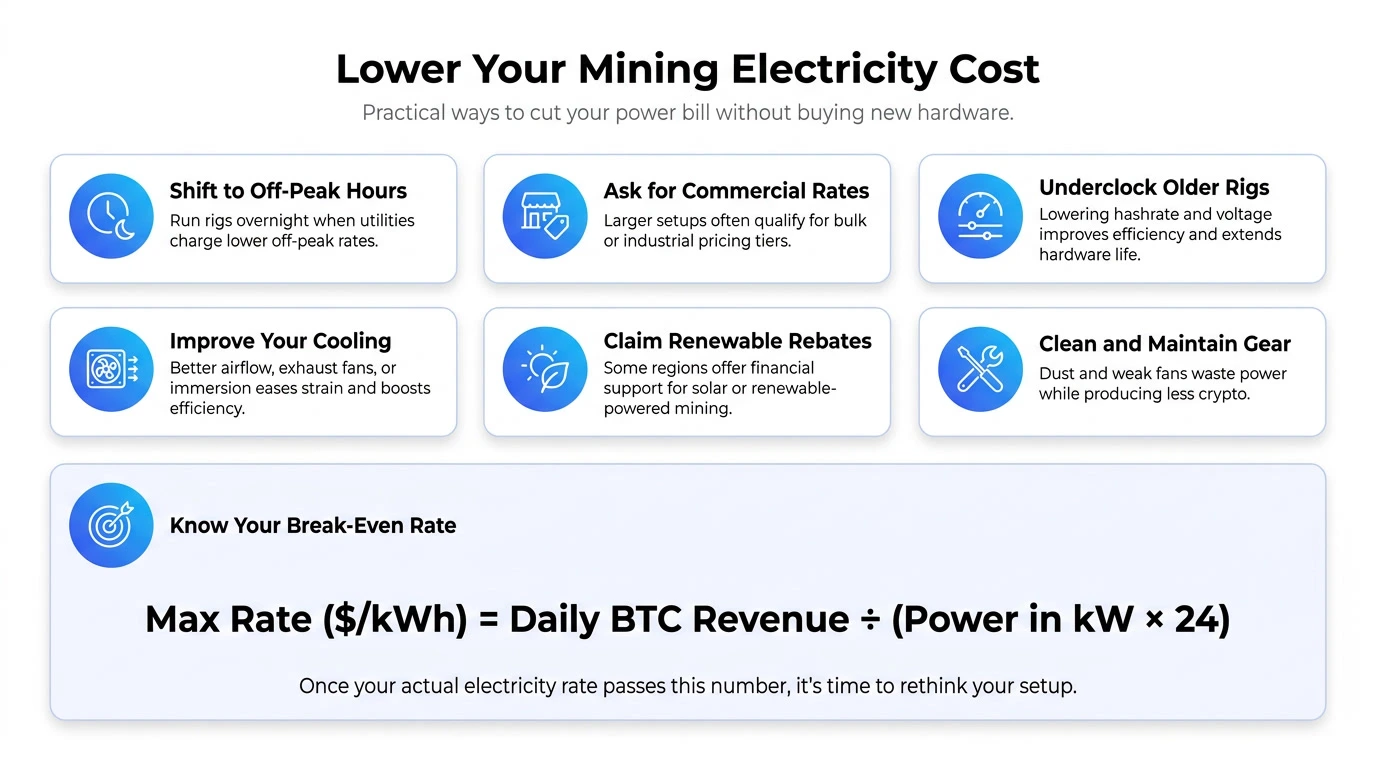
No siempre necesitas hardware nuevo para reducir tus costes de energía. Algunas cosas que cualquier minero de criptomonedas puede intentar:
- Considera las tarifas de electricidad fuera de horas punta. Muchos proveedores de servicios públicos cobran menos por la noche o durante las ventanas de menor demanda. Ejecutar tus equipos durante esas horas, cuando puedas, suma con el tiempo.
- Pregunta por tarifas industriales o comerciales. ¿Tienes una configuración más grande? Consulta con tu proveedor sobre los niveles de precios por volumen, que suelen superar las tarifas residenciales estándar.
- Reduce la velocidad de reloj de las máquinas antiguas. Reducir un poco el hashrate y el voltaje en hardware antiguo puede mejorar la eficiencia y prolongar su vida útil.
- Mejora tu refrigeración. Un mejor flujo de aire, ventiladores de extracción o incluso una configuración de inmersión simple reduce la carga en tus ventiladores y mejora la eficiencia en general.
- Consulta las subvenciones disponibles para energía solar o renovable. En algunos lugares, hay apoyo financiero para el uso de energía renovable en actividades de minería.
- Revisa tu equipo. Si un minero está cubierto de suciedad o tiene un ventilador ineficiente, consumirá más electricidad pero producirá menos criptomonedas.
- Conoce tu tasa de punto de equilibrio. Tasa máxima ($/kWh) = Ingresos diarios de BTC ÷ (Potencia en kW x 24). Una vez que tu tasa de electricidad real supere ese número, es hora de replantear tu configuración.
¿Qué minero ASIC elegir según el consumo de energía?
Realmente, depende de tu configuración y de lo que intentes lograr:
- Para minería a gran escala o industrial, sería más apropiado optar por el tipo de minero con sistema de refrigeración por agua o inmersión, como el S23 Hyd y el SealMiner A3 Pro Hydro.
- En cuanto a las operaciones a menor escala, el minero refrigerado por aire, como el S21 Pro o el S21 XP, está bien, ya que no se necesitarán conexiones de agua ni electricidad trifásica.
- Principiantes con presupuesto limitado podrían considerar unidades más antiguas con descuento, pero calculen los números cuidadosamente primero. Gran parte de ese hardware antiguo supera los 17-18 J/TH, y eso reduce los márgenes considerablemente a medida que la dificultad sigue aumentando.
Antes de comprar cualquier minero de bitcoin, ejecútalo a través de una calculadora de rentabilidad de minería utilizando tu tarifa eléctrica real, no una estimación aproximada. Introduce la potencia real, la dificultad actual de la red y la recompensa por bloque de hoy para que estés viendo rendimientos esperados genuinos en lugar de números de marketing.
CONCLUSIÓN
Al final del día, comprender el consumo de energía del Costo de Electricidad de Minería de Bitcoin por modelo de ASIC es lo que separa una configuración de minería que realmente genera ganancias de una que agota silenciosamente tu cuenta bancaria. Compara la eficiencia en J/TH, calcula tus costos de electricidad utilizando tu tarifa local real y elige hardware que se ajuste a tu escala y configuración. Ya sea que estés ejecutando una sola máquina en un garaje o construyendo una flota más grande, los mineros que se mantienen al tanto de la eficiencia energética son los que siguen siendo rentables cuando el mercado se pone difícil. Si necesitas ayuda para elegir el hardware adecuado para tu presupuesto y situación de energía, el equipo de Cryptominerbros es un buen lugar para empezar a comparar especificaciones antes de comprometerte.
Preguntas frecuentes
-
¿Cuánta electricidad utiliza un minero ASIC?
La mayoría de los mineros ASIC modernos utilizan entre 3.400 y 8.300 vatios, dependiendo del modelo y el tipo de refrigeración. Las unidades eficientes como la Antminer S23 Hydro se acercan al extremo inferior por unidad de hashrate, mientras que las unidades hydro de alto hashrate consumen más energía en general.
-
¿Cuánto cuesta en electricidad hacer funcionar un minero de Bitcoin?
A 0,07 $ por kWh, una Antminer S21 XP cuesta alrededor de 6,12 $ al día, o aproximadamente 184 $ al mes, para funcionar. Su coste real depende de la potencia de la máquina y de su tarifa eléctrica local.
-
¿Cuántos kWh se necesitan para minar un BTC?
Esto varía constantemente con la dificultad de la red y el hashrate, por lo que no hay un número fijo, pero en los niveles de dificultad actuales, normalmente se necesitan cientos de miles de kWh en una operación de minería para producir un BTC. Los mineros individuales con un solo minero ASIC necesitarían un tiempo extremadamente largo para minar una moneda completa por sí mismos.
-
¿Cuántos vatios se necesitan para hacer funcionar un minero de Bitcoin?
Los mineros de Bitcoin suelen utilizar entre 3.400 y 8.300 vatios, dependiendo del modelo y el hashrate. Las unidades refrigeradas por aire suelen estar en el rango inferior, mientras que las máquinas refrigeradas por hydro de alta potencia consumen significativamente más energía.

Únete a nuestro Newsletter
Recibe el mejor contenido de minería de la semana en tu bandeja de entrada.

Han su
Han Su es un analista técnico en CryptoMinerBros, un proveedor líder de hardware de minería de criptomonedas. Tiene más de 5 años de experiencia en la industria de las criptomonedas y es un experto en hardware de minería, software y análisis de rentabilidad.
Han es responsable del análisis técnico y la investigación sobre minería ASIC en Crypto Miner Bros. También escribe blogs en profundidad sobre minería ASIC y minería de criptomonedas, y tiene un profundo conocimiento de la tecnología. Sus blogs son informativos y entretenidos, y han ayudado a miles de personas a aprender sobre la minería de criptomonedas.
Siempre está buscando nuevas formas de educar a la gente sobre las criptomonedas, y está emocionado de ver cómo la tecnología sigue desarrollándose en los próximos años.
En su tiempo libre, a Han le gusta hacer senderismo, acampar y pasar tiempo con su familia. También es un ávido lector, y le encanta aprender sobre cosas nuevas.
Blogs similares
Goldshell SC5 Pro Review: Profitability and Buying Guide
Is the Goldshell SC5 Pro worth buying? Check its latest price, profitability, resale value, key risk...
Why Is Zcash Mining Getting More Competitive?
Zcash Mining: Why Is It Getting More Attention? Zcash mining has turned into one of the more talked-...
BTCB2 Mining and Profitability: What Current Data Suggests
What Is BTCB2 Mining? Mining BTCB2 involves using Blake2b-compatible ASIC hardware for the BTCB2 cha... © 2018- Miner Bros Limited. Todos los derechos reservados

 EN EN
EN EN  ES
ES