




RESUMEN
Power cost decides how much you earn. At $0.10 per kWh, only the most efficient of the three machines tested stays above break-even. Difficulty rose significantly recently, so efficiency matters even more now. Efficient machines, low power costs, and steady uptime protect your earnings. This guide shows the math and a step-by-step plan, so recheck your numbers every two weeks.
Which Factors Matter Most for Maximizing ASIC Miner Profitability?
Maximize ASIC mining profitability by keeping one plain idea in mind: your machine earns a set amount each day, and your power bill is the main cost to subtract from it. What’s left is your profit. Bitcoin’s price, network difficulty, and your electricity rate all move that number, and you can steer several of them. Power cost, machine efficiency, and uptime are the three you can work on.
What Does a Bitcoin Miner Earn Right Now?
A Minero de Bitcoin earns coins for the hash power it adds to the network. Your daily income depends on four things: Bitcoin’s price, network difficulty, total network hash rate, and the block reward. The table below shows where each one stands today, so you can see what a single machine can realistically earn.
Data as of November 2, 2026
| Ítem | Latest reading |
|---|---|
| Precio de Bitcoin | About $78,000 to $78,500 |
| Dificultad de la red | 148.36T |
| Network hash rate | About 1,060 to 1,076 EH/s |
| Block reward | 3.125 BTC plus fees |
| Hashprice | About $32.95 per PH/s per day |
Two things stand out. Price sits near $78,000, yet difficulty has climbed, so each unit of hash power earns less than it did a month ago. And block rewards still do most of the work: 3.125 BTC per block and about 144 blocks a day means roughly 450 BTC is paid out daily before fees. Hashprice is the pay rate for hash power, meaning what one petahash per second earns in a day. Because that rate changes with every price move, check live profitability figures before you buy, tune, or switch anything.
How Do You Work Out Daily Mining Profit Yourself?
You don’t need a fancy tool. Five steps get you there:
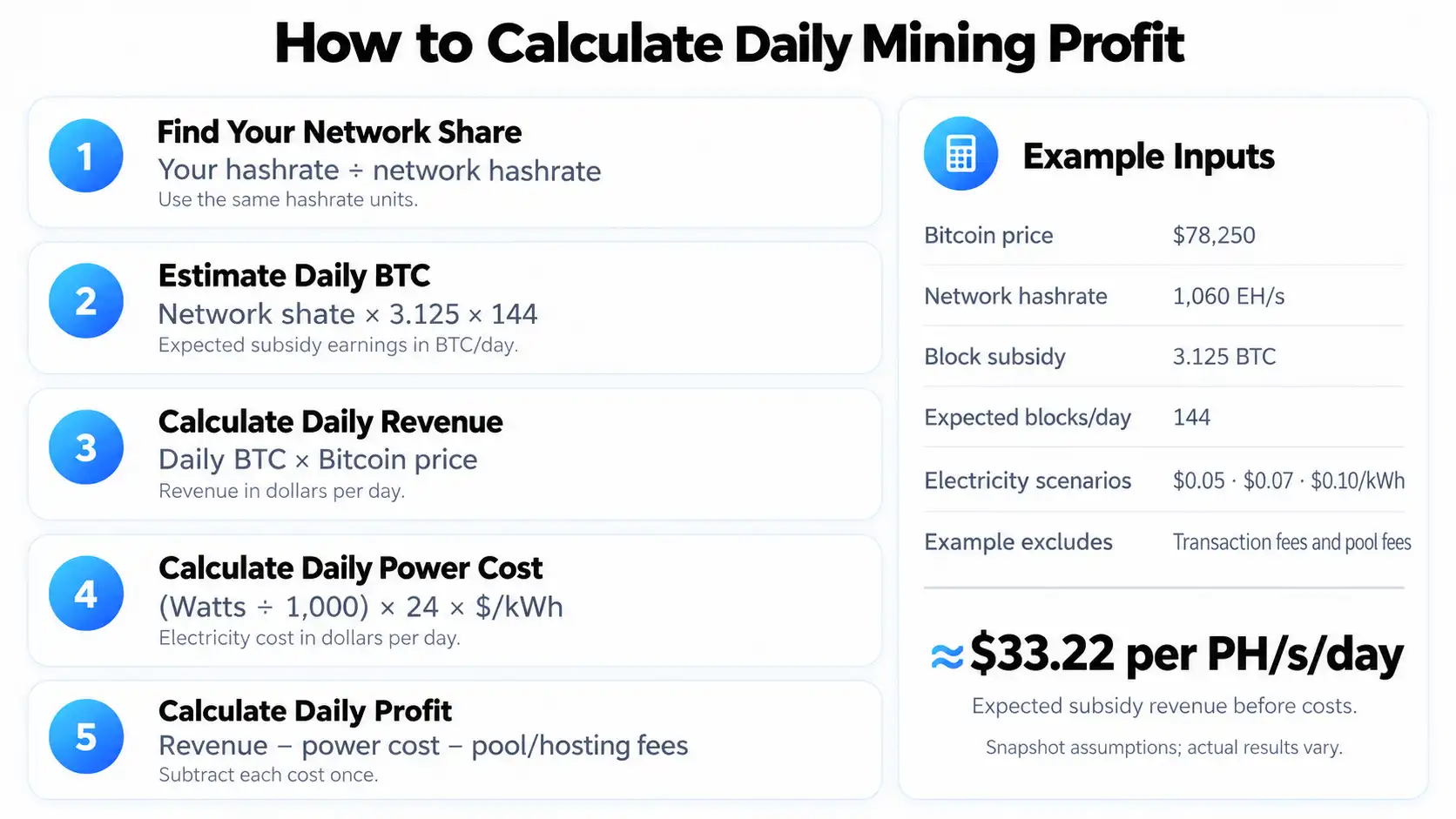
- Find your share of the network: your hash rate divided by the network hash rate.
- Multiply that share by 3.125 BTC and by 144 blocks to get your daily coins.
- Multiply the coins by the Bitcoin price to get daily revenue.
- Work out power cost: watts divided by 1,000, times 24, times your price per kWh.
- Subtract power cost, plus any pool or hosting fee, from revenue. That’s your profit.
Inputs used for every example in this post:
- Bitcoin price: $78,250 (trackers showed $78,000 to $78,500)
- Network hash rate: 1,060 EH/s
- Block reward: 3.125 BTC, with 144 blocks per day
- Transaction fees and pool fees: left out to keep the math clean
- Electricity: $0.05, $0.07, and $0.10 per kWh
With those inputs, the network pays out about $35.2 million a day. Divide that by 1,060 million TH/s, and one TH/s earns about $0.03295 a day. That’s roughly $32.95 per PH/s. Results change with price, difficulty, and power cost, so treat every figure here as a snapshot, not a promise.
How Much Can Popular Machines Earn at Different Power Rates?
The table below applies that math to three Bitcoin machines. Want to compare more models? The ASIC miner profitability page lists hash rate, power draw, and daily earnings for hundreds of units.
Data as of November 2, 2026. Coin: $78,250 BTC, 1,060 EH/s network, 3.125 BTC reward, no fees. Figures are per day.
| Máquina | Hashrate | Potencia | Revenue | Profit at $0.05 | Profit at $0.07 | Profit at $0.10 |
|---|---|---|---|---|---|---|
| Antminer S21 XP | 270 TH/s | 3.645 W | $8.90 | $4.52 | $2.77 | $0.15 |
| Antminer S21 | 200 TH/s | 3.500 W | $6.59 | $2.39 | $0.71 | Below break-even by $1.81 |
| Antminer S19 XP | 140 TH/s | 3,010 W | $4.61 | $1.00 | Below break-even by $0.45 | Below break-even by $2.61 |
Specs are the rated figures from Mining Now. Real units can drift a few percent from the label.
Now the break-even point, which is the power rate where daily profit hits zero:
| Máquina | Break-even power rate |
|---|---|
| Antminer S21 XP | About $0.101 per kWh |
| Antminer S21 | About $0.078 per kWh |
| Antminer S19 XP | About $0.063 per kWh |
The S21 XP stays in the green even at $0.10, while the S19 XP needs power below seven cents just to break even. Hardware cost matters too. Rising difficulty stretches both numbers, so cheap power usually beats a cheap machine.
Which Efficiency Level Should You Look For?
Efficiency is measured in joules per terahash (J/TH). It tells you how much energy a machine burns to make one unit of hash power. Lower is better, because every extra joule shows up on your bill.
Data as of October 28, 2026. Cost shown for 100 TH/s running 24 hours at $0.07 per kWh.
| Máquina | Eficiencia | Power for 100 TH/s | Coste diario de electricidad |
|---|---|---|---|
| Antminer S19 XP | 21.5 J/TH | 2,150 W | $3.61 |
| Antminer S21 | 17,5 J/TH | 1,750 W | $2.94 |
| Antminer S21 Pro | 15,0 J/TH | 1,500 W | $2.52 |
| Antminer S21 XP | 13,5 J/TH | 1,350 W | $2.27 |
| Antminer S21 XP Hydro | 12,0 J/TH | 1,200 W | $2.02 |
Moving from the S19 XP to the S21 XP Hydro saves about $1.59 a day per 100 TH/s, or roughly $580 a year. That gap grows as power gets pricier. Keep in mind the Hydro model needs a water cooling loop, so it fits a farm better than a garage. For a home setup, the air-cooled S21 XP at 13.5 J/TH is the most efficient air-cooled option in Bitmain’s S21 line. The table is also a quick way to spot a bad deal: a low sticker price paired with a high J/TH usually costs more over a year than it saves up front.
How Can You Cut Your Electricity Cost?
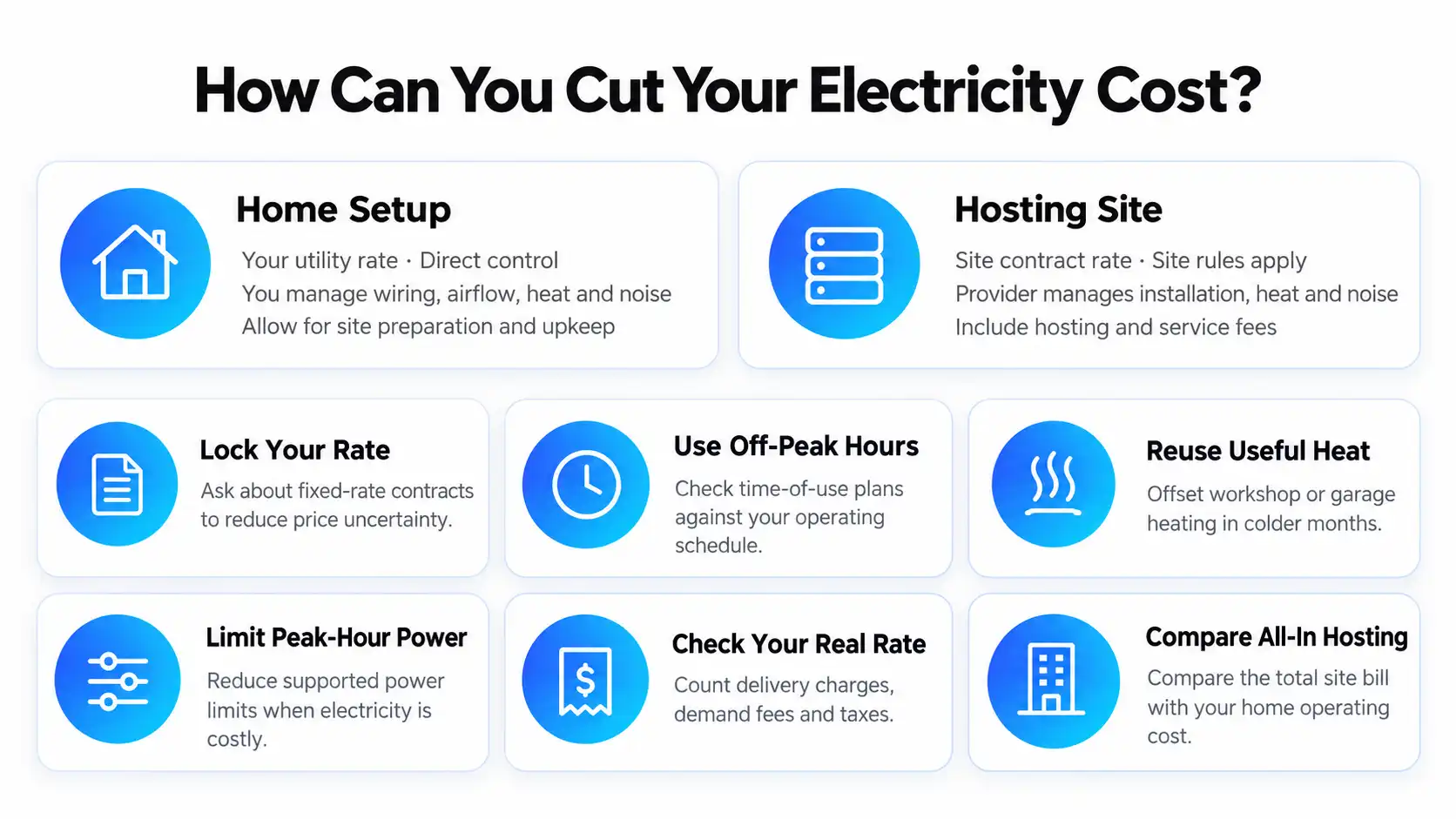
Power is the biggest line on your bill, so small wins here beat almost everything else. ASIC mining rewards the people who pay the least for each kilowatt-hour.
- Ask for a fixed rate. A contract that locks your price protects you when the market swings.
- Check time-of-use plans. If your machine can run in off-peak hours, the savings add up fast.
- Use the heat. In cold months, a miner can warm a workshop or garage and replace some heating costs.
- Cap your power when rates spike. Many machines let you lower the power limit during costly hours.
- Read your bill closely. Delivery charges, demand fees, and taxes can push your real rate above the number on the plan.
- Look at hosting. A site with cheap power and cool air can beat a spare room, even after fees.
If you’re weighing a spare room against a hosting site, this comparison helps:
| Factor | Home setup | Hosting site |
|---|---|---|
| Power rate | Your utility plan | Rate set by the site’s contract |
| Noise and heat | You deal with both | Handled on site |
| Setup work | Wiring, airflow, and network are on you | You ship the machine and plug it in |
| Control | Full control of settings | Limited by site rules |
| Extra fees | Ninguno | Monthly hosting fee |
Which Settings and Habits Keep a Machine Earning?
A minero cripto that runs hot or quietly loses hash rate costs you money every day, and you may not notice for weeks. A few habits stop that.
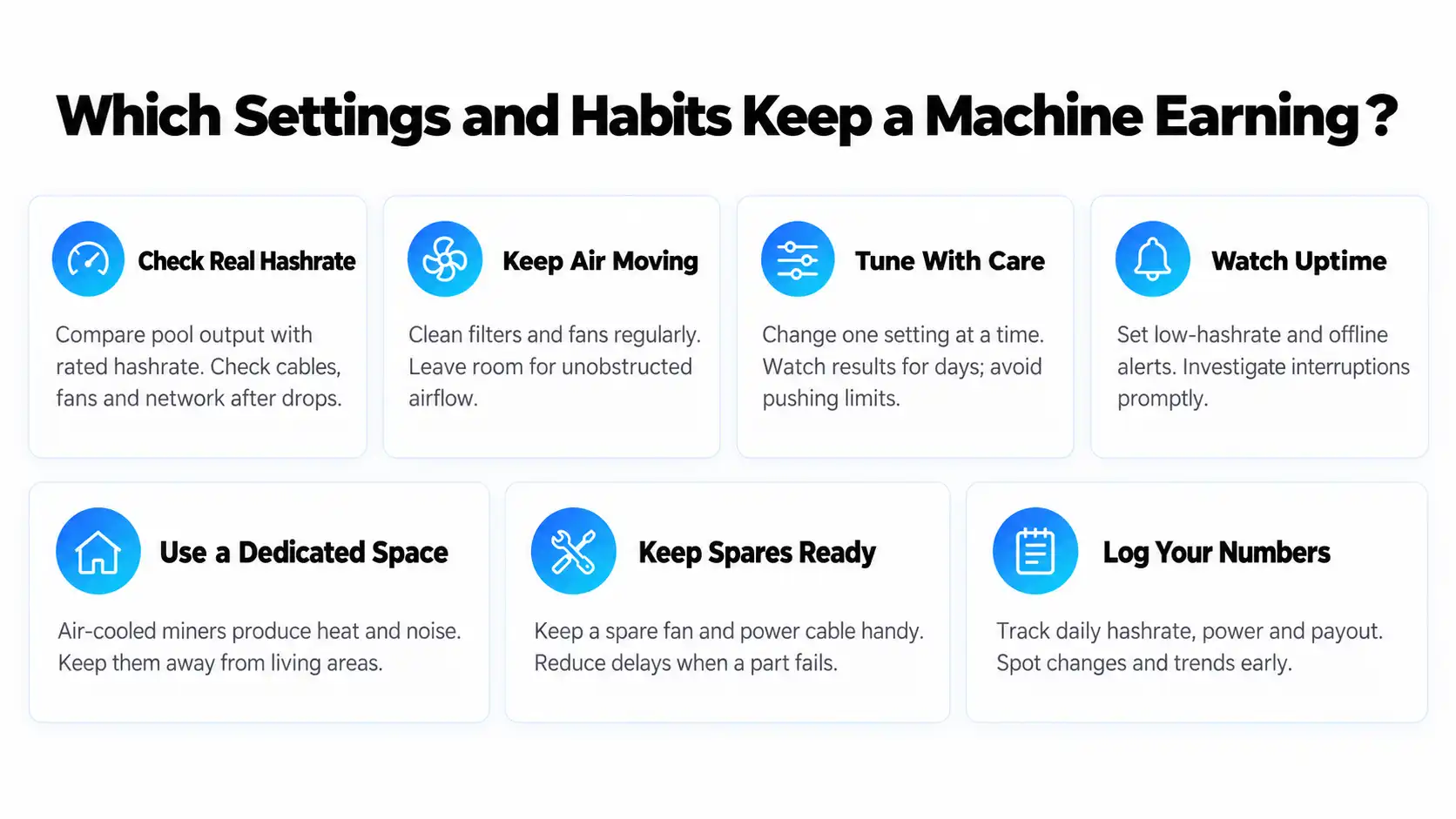
- Compare real hash rate to the label. Small drift is normal. A big drop on your pool dashboard means it’s time to check cables, fans, and the network.
- Keep air moving. Clean dust filters and fans on a schedule, and give the machine space to breathe.
- Tune with care. Custom firmware can cut power draw or raise hash rate, but push too far and you risk early wear. Change one setting at a time and watch results for a few days.
- Watch uptime. Every hour offline is revenue you never get back. Set alerts for low hash rate and offline workers.
- Give it its own space. Air-cooled units are loud and hot, so keep them away from living areas.
- Keep spare parts handy. A spare fan or power cable can save days of lost earnings.
- Log your numbers. A simple sheet with daily hash rate, power use, and payout shows trends early.
A recent solo Bitcoin mining success shows that independent miners can still participate in Bitcoin block discovery. However, such wins are rare, and consistent mining profitability still depends on hardware efficiency, electricity costs, and network difficulty.
How Does Network Difficulty Change What You Earn?
Bitcoin runs on prueba de trabajo, which means miners race to find a valid block hash, and the network sets how hard that race is. That setting is called mining difficulty. It resets every 2,016 blocks, about every two weeks, to keep blocks arriving near every ten minutes.
The recent move is worth a look. Difficulty stood at 132.7T on October 9, according to Cryptohall24, and it now sits at 148.36T, a cumulative rise of roughly 11.8%. If price stays flat, a jump cuts revenue per TH/s by about the same share.
A falling price and a rising difficulty at the same time is the toughest mix, and weaker machines are usually the first to shut down. This table shows what you control and what you don’t:
| Factor | Who controls it | Effect on your profit when it rises |
|---|---|---|
| Precio de Bitcoin | The market | Profit goes up |
| Dificultad de la red | The network | Profit goes down |
| Electricity rate | You, in part | Profit goes down |
| Machine J/TH | You, at purchase | Profit goes down |
| Tiempo de actividad | You | Profit goes up |
What Does a 30 Day View Look Like for Each Machine?
Daily numbers are hard to feel, so here is the same math stretched over 30 days. Nothing else changed: same $78,250 price, same 1,060 EH/s network, no fees.
Data as of November 2, 2026. Figures are per 30 days.
| Máquina | Profit at $0.05 | Profit at $0.07 | Profit at $0.10 |
|---|---|---|---|
| Antminer S21 XP | $135.60 | $83.10 | $4.50 |
| Antminer S21 | $71.70 | $21.30 | Below break-even by $54.30 |
| Antminer S19 XP | $30.00 | Loss of $13.50 | Below break-even by $78.30 |
Seen this way, the gap between a good setup and a bad one is easy to spot. The S21 XP earns about $83.10 a month at seven cents, while the S19 XP slips below zero. Before you buy, ask a plain question: after my power bill, what is left each month, and how long until the machine pays for itself?
How Do Your Earnings Hold Up If Bitcoin Dips?
A smart miner tests the bad case before buying. Say the price falls 20%, with everything else unchanged. This is a what-if, not a forecast.
So even the best machine in this guide gets thin on margin when price slips and power stays pricey. Run your own profitability test against a price drop before you commit money. ASIC mining margins can shrink fast, and a setup that survives a 20% dip is much safer than one that only works at today’s price.
How Do You Pick a Pool and Payout Setup?
Your pool decides how and when you get paid, so read the fine print before you point your machine at it.
- Payout type: Some pools pay a steady amount for each share of work. Others pay only when the pool finds a block. Steady payouts suit small setups.
- Fees: Compare the fee and what it covers. Some pools fold transaction fees into the payout, and others don’t.
- Minimum payout: A high minimum can leave your coins sitting for weeks.
- Server location: Pick a server near you to cut rejected shares.
- Wallet: Send payouts to a wallet you control, and test with a small first payment.
What Step-by-Step Plan Should You Follow?
- Get your real power rate. Find the all-in price per kWh from your bill, including delivery fees and taxes.
- Set a break-even target. Use the formula above to find the highest rate you can pay.
- Pull current numbers. Grab price, hash rate, and mining difficulty from two trackers.
- Compare models. Open an ASIC miner profitability calculator and test at least three machines at your rate.
- Look at cost per TH/s, not only the sticker. A cheap machine with poor efficiency can cost more over a year.
- Prepare the site. Plan power capacity, a proper circuit, airflow, and a network connection before the box arrives.
- Connect to a pool and test. Run for a few days and compare real hash rate and earnings to your estimate.
- Review every two weeks. After each difficulty change, rerun the numbers and decide whether to keep, tune, or sell the machine.
Which Habits Protect Your Profit the Most?

| Common habit | What to watch | Smart move |
|---|---|---|
| Choosing by hash rate alone | Power draw can offset the extra hash rate | Compare J/TH and break-even rate |
| Starting from a quoted power rate | Real bills include extra fees | Use the all-in rate from your bill |
| Checking difficulty only now and then | Revenue shifts at each adjustment | Recheck after every retarget |
| Cleaning on a loose schedule | Cooler machines keep a steadier hash rate and last longer | Clean filters and fans on a schedule |
| Running a crypto miner above its break-even rate | Daily revenue falls short of power cost | Sell it or move it to cheaper power |
Should You Sell, Hold, or Reinvest What You Mine?
A clear plan keeps you in control. Cover your power bill and fees first, then decide what to do with the rest. Many miners sell each month enough to pay their costs and hold the remainder. Others put part of the coins into better equipment to grow their earnings over time. Pick a rule, write it down, and follow it, so your plan stays steady when price moves. Keep a small reserve for repairs and spare parts, so your machine keeps running well.
CONCLUSIÓN
Your earnings come down to three things you can manage: what you pay for power, how efficient your machine is, and how often you check the numbers. Today’s data shows a market where an efficient machine on cheap power keeps earning well, while older machines fit best with very cheap power. Proof-of-work will keep rewarding the people who run lean. If you want to compare current models and run your own numbers, Cryptominerbros keeps a live list of machines with daily earnings. Price, difficulty, and power cost will keep moving, so rerun your math before you buy.
Preguntas frecuentes
-
¿Sigue siendo rentable la minería de Bitcoin?
Yes, for efficient machines on cheap power. In the November 2 data, an Antminer S21 XP earned about $2.77 a day at $0.07 per kWh, while an S19 XP lost money at that rate.
-
How much does it cost to run an ASIC miner per day?
Multiply watts by 24, divide by 1,000, then multiply by your rate per kWh. An S21 XP at 3,645 W uses about 87.5 kWh a day, which costs about $6.12 at $0.07 per kWh.
-
What is a good electricity rate for Bitcoin mining?
Lower is always better, and the break-even rate depends on the machine. Under $0.063 per kWh keeps all three machines tested here in the green.
-
Which ASIC miner is the most efficient?
In Bitmain’s S21 line, the S21 XP Hydro leads at 12.0 J/TH, and the air-cooled S21 XP follows at 13.5 J/TH. The Hydro model needs a water cooling loop.
-
How often does Bitcoin difficulty change?
It adjusts every 2,016 blocks, which is about every two weeks. Recheck your earnings after each change.

Únete a nuestro Newsletter
Recibe el mejor contenido de minería de la semana en tu bandeja de entrada.

Han su
Han Su es un analista técnico en CryptoMinerBros, un proveedor líder de hardware de minería de criptomonedas. Tiene más de 5 años de experiencia en la industria de las criptomonedas y es un experto en hardware de minería, software y análisis de rentabilidad.
Han es responsable del análisis técnico y la investigación sobre minería ASIC en Crypto Miner Bros. También escribe blogs en profundidad sobre minería ASIC y minería de criptomonedas, y tiene un profundo conocimiento de la tecnología. Sus blogs son informativos y entretenidos, y han ayudado a miles de personas a aprender sobre la minería de criptomonedas.
Siempre está buscando nuevas formas de educar a la gente sobre las criptomonedas, y está emocionado de ver cómo la tecnología sigue desarrollándose en los próximos años.
En su tiempo libre, a Han le gusta hacer senderismo, acampar y pasar tiempo con su familia. También es un ávido lector, y le encanta aprender sobre cosas nuevas.
Blogs similares
ASIC vs GPU Mining: Which Is More Profitable in 2026?
Specialized Bitcoin machines turn each watt into far more hashing than a graphics card can, so they ...
Best Bitcoin Miners Under $3,000 (2026): Top ASIC Picks for Home and Small-Scale Mining
The choice of a Bitcoin miner under $3000 will mostly depend on your budget, electricity cost, and s...
Goldshell SC5 Pro Review: Profitability and Buying Guide
Is the Goldshell SC5 Pro worth buying? Check its latest price, profitability, resale value, key risk... © 2018- Miner Bros Limited. Todos los derechos reservados


 EN EN
 ES