




RESUMEN
The choice of a Bitcoin miner under $3000 will mostly depend on your budget, electricity cost, and space. Some Bitcoin miners provide a higher hashrate but require decent power and cooling. Meanwhile, other crypto miners have a relatively low power consumption rate and can be a good fit for a small-scale mining rig. Thus, comparing the power consumption rate against the purchase price will be vital.
In this blog, we will go through 8 Bitcoin miners under $3000, namely their hashrate, power consumption, and some important features. Additionally, we will learn how to choose the right crypto miner, set up the mining rig, and calculate the electricity cost before the actual mining process. So without further ado, let’s get started!
What To Consider Before Buying A Bitcoin Miner
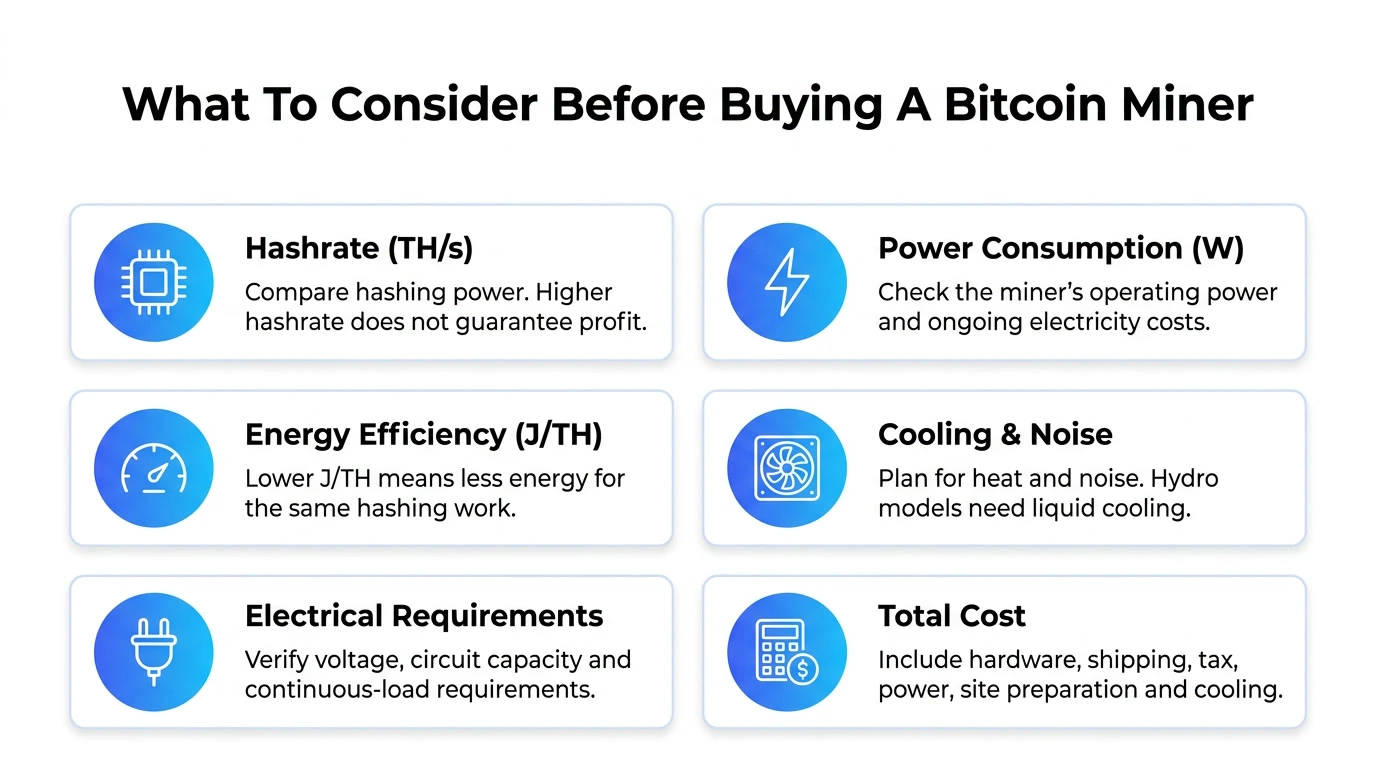
Selecting the appropriate miner is one of the most vital steps during the Minería de Bitcoin process. There are numerous options available on the market for ASIC miners. So, it is essential to consider several key aspects before making an actual purchase. Below, you will find the primary consideration factors when choosing a Bitcoin miner.
Tasa de hash
Hashrate represents the amount of work a miner can perform in a specific second. Therefore, Bitcoin miners normally indicate their performance in terahashes per second or TH/s. Basically, a higher hash rate means more computing power, so the chance to make more Bitcoins will increase. Although, this does not necessarily mean that a higher hash value will ensure higher profits due to the competition within the network.
Consumo de energía
Power consumption rate describes how much power a mining machine will consume while operating. The measurement unit for power consumption is normally in watts or W. It is a known fact that most crypto miners operate non-stop, so having a device that has a lower power consumption level might be more attractive.
Eficiencia energética
Energy efficiency is generally indicated in Joules per terahash or J/TH. This particular Bitcoin miner feature describes how much energy will be required to produce 1 TH of hashing. Therefore, it will be vital to consider this characteristic together with hashrate when comparing two crypto miners. Choosing the device with a higher value is not necessarily an indicator of a better choice.
Cooling and noise
Since ASIC cryptocurrency miners emit heat while operating, they require a proper cooling system. Normally, air-cooled machines include a fan that can make considerable noise. Meanwhile, hydro-cooled versions will require an appropriate liquid cooling system. Thus, it is vital to research the location for a crypto miner before purchasing. A device that suits everyone’s wallet size might not be compatible with the home’s interior.
Electrical requirements
It is essential to research the voltage and electricity needs before buying a Bitcoin miner. Most likely, a machine will require an appropriate high-voltage feed and a circuit breaker that can handle the continuous power of the miner. So, the next step will be to ensure the selected location can provide these requirements.
Total cost
The purchase price is not the only criterion when selecting a minero cripto. Therefore, it will be necessary to calculate the total cost that might be incurred during the Bitcoin mining process. Basically, the additional cost might include shipping, tax, electricity, site preparation, ventilation, and cooling. Hence, it will not be wise to spend the whole budget on a crypto miner itself.
Best Bitcoin Miners Under $3,000 in 2026
There are several different Bitcoin miners that fall within the specified budget. These can be divided into two broad categories: those that provide a higher hashrate, and machines that are more attractive to those seeking to limit the initial outlay or the electricity consumption. The options below are eight in total, and they are listed below for comparison purposes.
1. Canaan Avalon Q
Canaan’s Avalon Q is another option for anyone who doesn’t want to invest in a large bitcoin mining machine. The Avalon Q offers a hashrate that, while not as fast as other options on this list, will also draw a fraction of the watts.
Ventajas:
- Ethernet Connection
- SHA-256 hashing algorithm
Contras:
- 90 TH/s hashrate
- 45 to 65 dB sound
The Avalon Q uses the SHA-256 algorithm, which is used in Bitcoin. You’ll also want to determine the cost of electricity in your area before investing in this ASIC Bitcoin miner. At full power (1,674 W), running the Avalon Q for 24 hours would consume approximately 40.2 kWh. After calculating the cost of energy in your area, you’ll get a sense of how much (or how little) you’d be making with the Avalon Q.
The Canaan Avalon Q operates on 110 to 240V, making it more versatile than some of the other Bitcoin miners on this list. Still, you should double-check the outlet, breaker capacity, and your wiring before connecting your Canaan Avalon Q. While it isn’t as loud as some Bitcoin ASIC miners, the Canaan Avalon Q can still be noticeable if you leave it in a quiet space in your home.
2. Canaan Avalon Mini 3
The Canaan Avalon Mini 3 is another option for anyone who wants a compact, portable Bitcoin mining machine. The Avalon Mini 3 offers a hashrate of 37.5 TH/s and consumes 800 W.
Ventajas:
- Ethernet Connection
- SHA-256 hashing algorithm
- 37.5 TH/s hashrate
- PSU incluido
Contras:
- Uses approximately 800 W
- 55 dB sound
The Canaan Avalon Mini 3 uses the SHA-256 algorithm, which is used in Bitcoin. You’ll also want to determine the cost of electricity in your area before investing in this ASIC Bitcoin miner. At full power (800 W), running the Avalon Mini 3 for 24 hours would consume approximately 19.2 kWh. After calculating the cost of energy in your area, you’ll get a sense of how much (or how little) you’d be making with the Avalon Mini 3.
The Avalon Mini 3 has an efficiency of around 21.33 J/TH and operates on 110 to 240V input power. It weighs about 8.35 kg net and measures 760 x 104 x 214 mm, so it is easier to fit into a tight space than most air-cooled machines here. Still, you should check the outlet and breaker capacity before connecting the miner. While its 55 dB noise level is lower than that of the larger Antminer models, it can still be noticeable if you leave it in a quiet space in your home.
3. Bitmain Antminer S19 XP+ Hydro
La Antminer S19 XP+ Hydro is another powerhouse option on this list. If you’re interested in a high hashrate and have the appropriate hydro-cooling equipment, then this is an excellent option to consider.
Ventajas:
- Ethernet Connection
- SHA-256 hashing algorithm
- Impressive hashrate
Contras:
- Uses approximately 5.3 kW (as rated)
- Requires 380 to 415 V
The Bitmain Antminer S19 XP+ Hydro uses the SHA-256 algorithm, making it a top pick for Bitcoin mining. One of the primary features of hydro-cooling is that it removes heat via a liquid coolant as opposed to (or in addition to) moving air using powerful fans. To set up the Antminer S19 XP+ Hydro, you’ll need the appropriate cooling equipment that can provide 8 to 10 LPM and 380 to 415 V input power.
At full power (5,301 W as rated), the Antminer S19 XP+ Hydro would use approximately 127.2 kWh per day, excluding the equipment it takes to hydro-cool the Bitcoin miner. Depending on the cost of energy where you live, that can add up quickly.
For home use, this is the most demanding machine on the list. Its 5.3 kW draw, 380 to 415 V requirement, and liquid cooling loop mean it suits a small setup only if you already have a three-phase supply and room for the cooling equipment. It is usually a better fit for a garage, workshop, or dedicated mining space than for a living area.
4. Bitmain Antminer S21+
La Bitmain Antminer S21+ is another option for anyone who wants a higher hashrate than the Avalon Q. The S21+ offers 225 TH/s and 235 TH/s versions, with a power consumption of 3,564 W.
Ventajas:
- Ethernet Connection
- SHA-256 hashing algorithm
- 225 to 235 TH/s hashrate
Contras:
- Uses approximately 3.56 kW
- 76 dB sound
The Bitmain Antminer S21+ uses the SHA-256 algorithm, which is used in Bitcoin. You’ll also want to determine the cost of electricity in your area before investing in this ASIC Bitcoin miner. At full power (3,564 W), running the S21+ for 24 hours would consume approximately 85.5 kWh. After calculating the cost of energy in your area, you’ll get a sense of how much (or how little) you’d be making with the S21+.
The Bitmain Antminer S21+ uses four cooling fans and has Ethernet connectivity. Still, you should check the electrical supply before connecting the miner because it draws more than 3.5 kW during operation. While it can provide a higher hashrate than the Avalon Q, its noise level of 76 dB can make it difficult to use in a quiet space in your home.
5. Bitmain Antminer S19K Pro
La Antminer S19K Pro is another option for anyone who wants a Bitcoin mining machine at a lower purchase price. The S19K Pro offers a hashrate of 120 TH/s and consumes 2,760 W.
Ventajas:
- Ethernet Connection
- SHA-256 hashing algorithm
- 120 TH/s hashrate
Contras:
- Uses approximately 2.76 kW
- 75 dB sound
The Bitmain Antminer S19K Pro uses the SHA-256 algorithm, making it suitable for Bitcoin mining. You’ll also want to determine the cost of electricity in your area before investing in this ASIC Bitcoin miner. At full power (2,760 W), running the S19K Pro for 24 hours would consume approximately 66.2 kWh. After calculating the cost of energy in your area, you’ll get a sense of how much (or how little) you’d be making with the S19K Pro.
The S19K Pro has an efficiency of around 23 J/TH, which is higher than the S21 Pro’s 15 J/TH. This means the S19K Pro uses more energy for each unit of hashrate. Still, its lower purchase price may leave more of your budget available for electrical work and ventilation. While the S19K Pro offers a lower hashrate than some other Bitcoin ASIC miners, its 75 dB noise level means you’ll want to choose a suitable place to run it.
6. Bitmain Antminer S21 Pro
La Antminer S21 Pro is another option for anyone who wants a higher hashrate and better energy efficiency. The S21 Pro offers hashrate versions ranging from 234 to 245 TH/s, with a stated power consumption of 3,510 W.
Ventajas:
- Ethernet Connection
- SHA-256 hashing algorithm
- 234 to 245 TH/s hashrate
- Approximately 15 J/TH efficiency
Contras:
- Uses approximately 3.51 kW
- 76 dB sound
- Requires a suitable electrical supply
The Bitmain Antminer S21 Pro uses the SHA-256 algorithm, which is used in Bitcoin. You’ll also want to determine the cost of electricity in your area before investing in this ASIC Bitcoin miner. At full power (3,510 W), running the S21 Pro for 24 hours would consume approximately 84.2 kWh. After calculating the cost of energy in your area, you’ll get a sense of how much (or how little) you’d be making with the S21 Pro.
The S21 Pro has an efficiency of around 15 J/TH, which is lower than the S19K Pro’s 23 J/TH. It also uses four cooling fans and operates on 220 to 277 V input power. Still, you should check your electrical supply before connecting the miner. While its efficiency makes it worth considering, the noise level of 76 dB can be noticeable if you leave it in a quiet space in your home.
7. NerdMiner NerdOCTAxe Rev 3.1
The NerdMiner NerdOCTAxe Rev 3.1 is another option for anyone who wants a compact Bitcoin mining machine with lower power consumption. The NerdOCTAxe Rev 3.1 offers a hashrate of 12 TH/s and consumes 240 W.
Ventajas:
- Wi-Fi Connection
- SHA-256 hashing algorithm
- 12 TH/s hashrate
- Low power consumption
Contras:
- Lower hashrate than larger ASIC miners
- No service or replacement coverage
The NerdMiner NerdOCTAxe Rev 3.1 uses the SHA-256 algorithm, which is used in Bitcoin. You’ll also want to consider the cost of electricity in your area before investing in this compact ASIC Bitcoin miner. At full power (240 W), running the NerdOCTAxe Rev 3.1 for 24 hours would consume approximately 5.76 kWh. After calculating the cost of energy in your area, you’ll get a sense of how much (or how little) you’d be making with the NerdOCTAxe Rev 3.1.
The NerdOCTAxe Rev 3.1 uses a BM1370 chip, supports Wi-Fi connectivity, and has a noise level of 40 dB. Its lower power consumption can make it easier to fit into a small hobby mining setup. Still, you should keep in mind that its 12 TH/s hashrate is much lower than that of larger Bitcoin ASIC miners. The specifications also state that service or replacement coverage is not included, so consider this when comparing the purchase price with other options.
8. NerdMiner NerdQaxe++ Rev 7
The NerdMiner NerdQaxe++ Rev 7 is another option for anyone who wants a compact, low-power Bitcoin mining machine for a home or desk setup. The NerdQaxe++ Rev 7 offers a hashrate of 4.8 TH/s and consumes 69.5 W.
Ventajas:
- Wi-Fi Connection
- SHA-256 hashing algorithm
- 4.8 TH/s hashrate
- Low power consumption
- PSU incluido
Contras:
- Lower hashrate than larger ASIC miners
- No service or replacement coverage
The NerdMiner NerdQaxe++ Rev 7 uses the SHA-256 algorithm, which is used in Bitcoin. You’ll also want to consider the cost of electricity in your area before investing in this compact ASIC Bitcoin miner. At full power (69.5 W), running the NerdQaxe++ Rev 7 for 24 hours would consume approximately 1.67 kWh. After calculating the cost of energy in your area, you’ll get a sense of how much (or how little) you’d be making with the NerdQaxe++ Rev 7.
The NerdQaxe++ Rev 7 uses a 12V power supply, has two cooling fans, supports 2.4 GHz Wi-Fi connectivity, and has a noise level of 40 dB. Its very low power draw means it can run on a normal household outlet and fit into almost any space. Still, you should keep in mind that its 4.8 TH/s hashrate is much lower than that of larger Bitcoin ASIC miners. The specifications also state that service or replacement coverage is not included, so consider this when comparing the purchase price with other options.
Comparing the Bitcoin Miners
Here is a quick comparison of the eight machines, including their price, hashrate, power consumption, and cooling type. Use it to narrow down your choices before checking the full installation requirements.
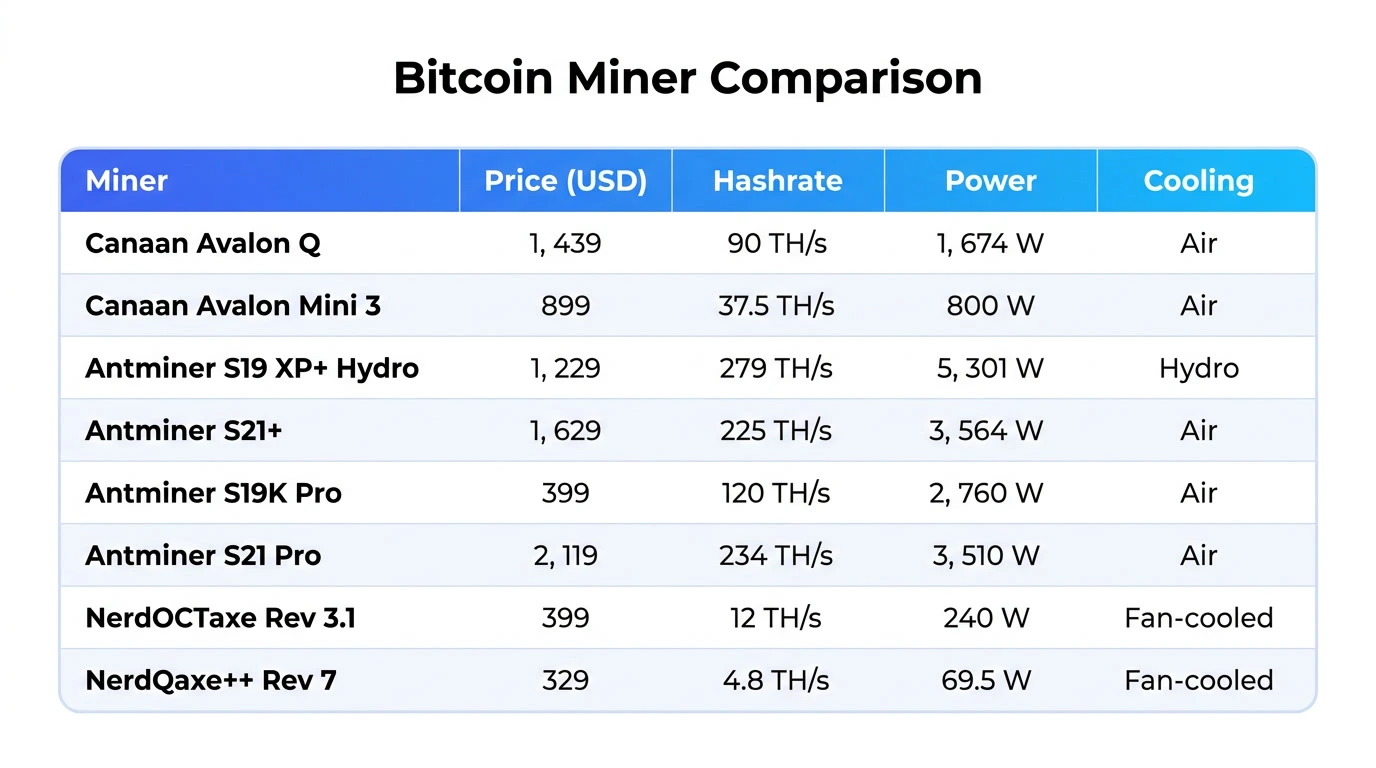
The highest hashrate does not automatically make a miner the best choice for you. The S19 XP+ Hydro offers the most hashing power in this group, while the NerdQaxe++ Rev 7 uses the least electricity. What matters here is how much computing power you need and whether your setup can support the machine.
Which Bitcoin Miner Is Right for Your Setup?
Before you choose what Bitcoin miner to buy, you should think about where you plan to set it up. Some machines use less power, and others require more electricity and proper cooling. Noise is also something to consider if you plan to set your rig in your apartment.
Compact home setup: The Canaan Avalon Q offers 90 TH/s with 1,674 W electricity consumption. Its energy consumption is lower than that of the larger Antminer models on this list. Its noise is between 45-65 dB, so you might want to think about the place you will install it.
Portable, mid-range home setup: The Canaan Avalon Mini 3 provides 37.5 TH/s with 800 W electricity consumption. It is compact, weighs about 8.35 kg, and runs on 110 to 240V. Its 55 dB noise level is manageable, but you should still pick a spot away from quiet living areas.
Lower purchase price: The Antminer S19K Pro provides 120 TH/s with 2,760 W. This device may be a good choice if you want to spend less on the miner. However, you should evaluate the daily electricity consumption and 75 dB noise level before buying this product.
Hobby mining: The NerdMiner NerdOCTAxe Rev 3.1 provides 12 TH/s with 240 W electricity consumption. This miner’s energy consumption is low, which makes it a great solution for a small-scale operation. However, its hashrate is much lower than that of other ASIC Bitcoin miners on this list, so it is not the best value.
Quiet, low-power desk mining: The NerdMiner NerdQaxe++ Rev 7 provides 4.8 TH/s with 69.5 W electricity consumption and a 40 dB noise level. It is the easiest machine on this list to run in a bedroom or office. However, its hashrate is the lowest of the eight, so it suits learning and hobby mining better than serious income.
Air-cooled mining: The Antminer S21 Pro and S21+ are two good choices for air-cooled mining. The first one provides 234-245 TH/s with 3,510 W electricity consumption. The second one provides 225-235 TH/s with 3,564 W energy consumption. The S21 Pro’s efficiency is stated as approximately 15 J/TH. Both these miners have about the same noise level: 76 dB. So, you should have a proper place to install them.
Hydro-cooled mining: The Antminer S19 XP+ Hydro requires compatible equipment to be set up. It provides 279-293 TH/s with 5,301 W electricity consumption. You should think about how much the cooling equipment and electricity will cost you before buying this miner. If you have enough space for the machine, you may want to consider it as a great mining option.
You should always calculate the electricity cost before buying any of these Bitcoin miners. A higher hash rate usually means significantly higher energy consumption. The price you pay for electricity every month will affect your mining profits. Take into account the purchase price, power consumption, and equipment needed to cool down the machines when you make your choice.
How Much Electricity Are Bitcoin Miners Using?
A bitcoin miner can work non-stop for the whole day, so even minor differences in power consumption can add up to a significant monthly electricity bill. The easiest way to estimate the potential costs is to calculate the amount of energy the machine is rated to consume over a particular period of time.
Use this formula:
Daily electricity use (kWh) = Power consumption (W) × running hours ÷ 1,000
Take the Antminer S21 Pro, for instance; its power consumption is 3,510 W. With continuous use during 24 hours, it will be equal to
3,510 × 24 ÷ 1,000 = 84.24 kWh
o
$0.10 per kWh, that works out to about $8.42 per day, or $252.72 over 30 days, which covers only the electricity the miner consumes. Not the additional equipment required to cool the machinery down.
The same calculation method can be used to compare the machines. The Avalon Q is rated at approximately 40.2 kWh per day, and 127.2 kWh for the S19 XP+ Hydro, which is more than three times higher. The difference is explained by the dissimilar continuous power consumption stated by manufacturers, assuming 24-hour operation.
Hydro-cooled machines, however, require a more profound calculation to be done. Pumps and other equipment, responsible for circulation and cooling of water, might be needed, and the electricity they consume should also be considered in the final bill. Make sure to use the information provided by the manufacturer for the particular model and hashrate version you are going to purchase.
¿Qué necesitas para empezar a minar Bitcoin?
Before switching on a Bitcoin miner, prepare the electrical supply, cooling arrangement, network connection, and wallet. The requirements depend on the machine. A compact 240 W miner has different needs from a hydro-cooled unit drawing more than 5 kW.
- Prepare the electrical supply: Check the miner’s rated voltage and power consumption first. Machines that draw several thousand watts need a suitable circuit, breaker, and wiring for continuous operation. A qualified electrician can check whether your existing electrical supply is suitable for the selected model.
- Set up cooling and ventilation: Air-cooled miners need enough space for air to enter the machine and carry heat away. Avoid blocking the intakes or placing the unit somewhere that traps hot air. Hydro-cooled models require compatible cooling equipment. Check the specified coolant flow rate and installation requirements before connecting the miner. For example, the flow requirement for the hydro model discussed above is 8 to 10 litres per minute.
- Connect the miner to your network: The Avalon Q, the Avalon Mini 3, and several other models use Ethernet, while the NerdOCTAxe Rev 3.1 and the NerdQaxe++ Rev 7 support Wi-Fi. Connect the miner using its supported network method, then follow the manufacturer’s instructions to access the settings and configure the connection.
- Prepare a Bitcoin wallet: You’ll need a Bitcoin wallet address to receive mining payouts. Set up the wallet before configuring the mining pool, and keep its recovery phrase somewhere secure. Anyone who gets access to that phrase may be able to access your funds, so don’t share it with someone claiming they need it to send your rewards.
- Choose a mining pool: A pool de minería combines the computing power of multiple miners and distributes rewards according to its payout rules. Before joining one, compare the fees, payout threshold, and payment method. Solo mining is also possible, but finding a block can take a long time when you’re working with a small amount of hashrate. CoinMarketCap shared an example of a miner renting computing power for a solo attempt and earning a Bitcoin block reward. It was an unusual result, rather than a reliable estimate of what a small miner can expect.
- Check the machine after starting it: Once the miner is running, check its hashrate, temperature, fan operation, and network connection. Compare the readings with the manufacturer’s operating specifications. When the hashrate drops or temperatures rise unexpectedly, use the official troubleshooting instructions to identify the cause.
Is Bitcoin Mining Profitable in 2026?
The profitability of a Bitcoin miner depends on the cost of electricity, the Bitcoin price, the network difficulty, and block rewards in the cryptocurrency market. The primary determinant influencing the profit of a Bitcoin miner is the cost of electricity, since the Bitcoin mining machine needs a constant power supply.
To calculate the profitability of a Bitcoin mining machine, cross-check the results on a calculadora de rentabilidad minera and the given statistics. Start by entering the hashrate and power consumption of your mining rig on the mining calculator. Add your electricity rates to determine if the bitcoin miner can offset the running costs.
For instance, the electricity cost for the S21 Pro bitcoin miner is $0.10 per kWh, which is approximately $8.42 per day. The expected revenue from the bitcoin miner should exceed the operating costs, excluding the initial purchase and maintenance costs. However, the purchase cost of the mining machine is not included in the above calculation.
The operating costs also entail maintenance and labor costs, which are incurred when repairing the machine, and downtime costs. Therefore, the running costs should be compared to the revenue to determine if the miner should be bought.
The profitability of a bitcoin mining machine is dependent on various factors, such as the bitcoin price, network difficulty, electricity costs, and maintenance costs. The calculators above should be used to cross-check results and monitor the changes in these statistics over time.
The price of Bitcoin and network difficulty change over time, and hence it is important to utilize the calculators when making long-term investments. One should use the results of Bitcoin mining profitability calculators to compare the various machines based on their hash rates, power consumption, and efficiency instead of relying on projected profits.
What Should You Know Before Ordering a Bitcoin Miner?
The listed price is only part of what you pay. Check shipping, warranty, and returns before you order.
How Much Does Shipping Cost?
Shipping is not included in the listed price. It depends on your location and the weight of the miner, and the exact amount is shown at checkout. Heavier air-cooled Antminer units cost far more to ship than the compact Nerd miners. The table below shows the cart totals for one unit shipped to the United States by DHL/UPS Express.
| Minero | Precio (USD) | Shipping (USD) | Total (USD) |
|---|---|---|---|
| Canaan Avalon Q | 1,439.00 | 248.00 | 1,687.00 |
| Canaan Avalon Mini 3 | 899.00 | 198.00 | 1,097.00 |
| Antminer S19 XP+ Hydro (279 TH/s) | 1,229.00 | 261.00 | 1,490.00 |
| Antminer S21+ (225 TH/s) | 1,629.00 | 283.50 | 1,912.50 |
| Antminer S19K Pro (120 TH/s) | 399.00 | 275.50 | 674.50 |
| Antminer S21 Pro (234 TH/s) | 2,119.00 | 261.00 | 2,380.00 |
| NerdOCTAxe Rev 3.1 | 399.00 | 58.50 | 457.50 |
| NerdQaxe++ Rev 7 | 329.00 | 43.00 | 372.00 |
Shipping to other countries will differ. VAT and customs duties are not included and may be charged by your country on delivery.
Orders ship from our Hong Kong warehouse within 48 hours of verified payment. International delivery usually takes 4 to 7 business days after dispatch, so most orders arrive within 8 to 10 days.
What Does the Warranty Cover?
Warranty length depends on the manufacturer and model, from 180 to 365 days. The exact period is listed on each product page. The NerdOCTAxe Rev 3.1 and the NerdQaxe++ Rev 7 have no service or replacement coverage.
What Is the Return Policy?
- Contact support within 30 days of delivery and describe the issue.
- Returns need approval first. A $30 return charge applies.
- Send the miner back intact, with the bill and all parts.
- Once it passes a quality check, the return is processed.
- Orders cannot be cancelled after payment, so confirm your model and address before paying.
About Crypto Miner Bros
We are a Hong Kong-based crypto mining hardware distributor, founded in 2018. We ship globally to more than 100 countries and have completed many deliveries for home and commercial miners. Orders are shipped through trusted carriers including DHL, UPS, FedEx, ARAMEX, and TNT, with tracking provided. Our support team is available 24/7 through live chat, WhatsApp, phone, and email.
CONCLUSIÓN
Bitcoin miners under $3,000 differ from each other in terms of efficiency, maintenance costs, electricity needs, cooling methods, and overall noise levels. From the comparison above, one can select the most appropriate Bitcoin miner for their mining farm based on their budget, electricity costs, mining operations’ efficiency, and space.
The Avalon Q and the Avalon Mini 3 are suitable for individuals with mid-range budgets who want a compact machine, while the NerdOCTAxe Rev 3.1 and the NerdQaxe++ Rev 7 are the best mining machines for individuals who mine as a hobby due to their low electricity needs. On the other hand, the S21 Pro and S21+ bitcoin miners offer high hash rates, excellent performance, and require advanced-level setup.
CryptoMinerBros sells the best-performing Bitcoin miners suitable for both small-scale and large-scale mining operations. Individuals with different budgets looking to start Bitcoin mining should compare the features, versions, and overall costs of the different miners above before selecting the most appropriate machine based on their mining farm’s efficiency and scale.
Preguntas frecuentes
-
Is BTC mining profitable in 2026?
It can be, but it depends on your electricity cost, the Bitcoin price, network difficulty, and the miner’s efficiency, so check a profitability calculator with your own rate before buying.
-
Who are the top 5 Bitcoin miners?
From the machines in this guide, the top picks are the Antminer S21 Pro, Antminer S21+, Antminer S19K Pro, Avalon Q, and Avalon Mini 3, covering a range of budgets and home setups.
-
Can I mine BTC for free?
Not really, because you need a miner and electricity, though free or very cheap power cuts your costs a lot, and “free mining” apps rarely pay out anything meaningful.
-
Are Bitcoin miners still profitable?
Efficient miners with low electricity costs can still earn a profit, but returns shrink as network difficulty rises or the Bitcoin price falls, so run the numbers before you buy.

Únete a nuestro Newsletter
Recibe el mejor contenido de minería de la semana en tu bandeja de entrada.

Han su
Han Su es un analista técnico en CryptoMinerBros, un proveedor líder de hardware de minería de criptomonedas. Tiene más de 5 años de experiencia en la industria de las criptomonedas y es un experto en hardware de minería, software y análisis de rentabilidad.
Han es responsable del análisis técnico y la investigación sobre minería ASIC en Crypto Miner Bros. También escribe blogs en profundidad sobre minería ASIC y minería de criptomonedas, y tiene un profundo conocimiento de la tecnología. Sus blogs son informativos y entretenidos, y han ayudado a miles de personas a aprender sobre la minería de criptomonedas.
Siempre está buscando nuevas formas de educar a la gente sobre las criptomonedas, y está emocionado de ver cómo la tecnología sigue desarrollándose en los próximos años.
En su tiempo libre, a Han le gusta hacer senderismo, acampar y pasar tiempo con su familia. También es un ávido lector, y le encanta aprender sobre cosas nuevas.
Blogs similares
Goldshell SC5 Pro Review: Profitability and Buying Guide
Is the Goldshell SC5 Pro worth buying? Check its latest price, profitability, resale value, key risk...
Why Is Zcash Mining Getting More Competitive?
Zcash Mining: Why Is It Getting More Attention? Zcash mining has turned into one of the more talked-...
BTCB2 Mining and Profitability: What Current Data Suggests
What Is BTCB2 Mining? Mining BTCB2 involves using Blake2b-compatible ASIC hardware for the BTCB2 cha... © 2018- Miner Bros Limited. Todos los derechos reservados


 EN EN
 ES