



SUMMARY
SHA-3X Algorithm is a niche Proof-of-Work mining method developed by Tari Labs for the Tari Network, also known as Minotari. It uses three consecutive Keccak SHA3-256 operations to produce a mining result and help secure the network. The method is designed for Tari’s XTM mining lane and has dedicated hardware options, including the Goldshell XT Box and BYTE with an XT Card.
- SHA-3X is a custom Proof-of-Work algorithm used to mine Minotari (XTM).
- Its triple-hash process runs Keccak SHA3-256 three times in sequence.
- The input contains an 8-byte nonce, a 32-byte Tari mining hash, and a 1-byte Proof-of-Work record.
- Tari has four mining lanes, each targeting 25% of block rewards.
- Goldshell’s XT Box offers 580 GH/s at 400 W, while the BYTE XT Card offers up to 100 GH/s at 65 W.
What Is the SHA-3X Algorithm and Why Does Tari Use It?
Tari Labs developed this custom Proof-of-Work algorithm for the Minotari Layer 1 blockchain. It is used to mine XTM, the network’s native Layer 1 token. Its main feature is a triple-hash sequence: the output of one SHA3-256 operation becomes the input to the next, and the process runs three times.
This design gives Tari a mining lane with its own hashing requirements. It also makes the work less directly interchangeable with computing resources set up for some other networks. That matters when miners compare hardware, because a machine must support the exact algorithm rather than simply advertise general SHA3 compatibility.
How Does Tari’s Four-Lane Mining System Work?
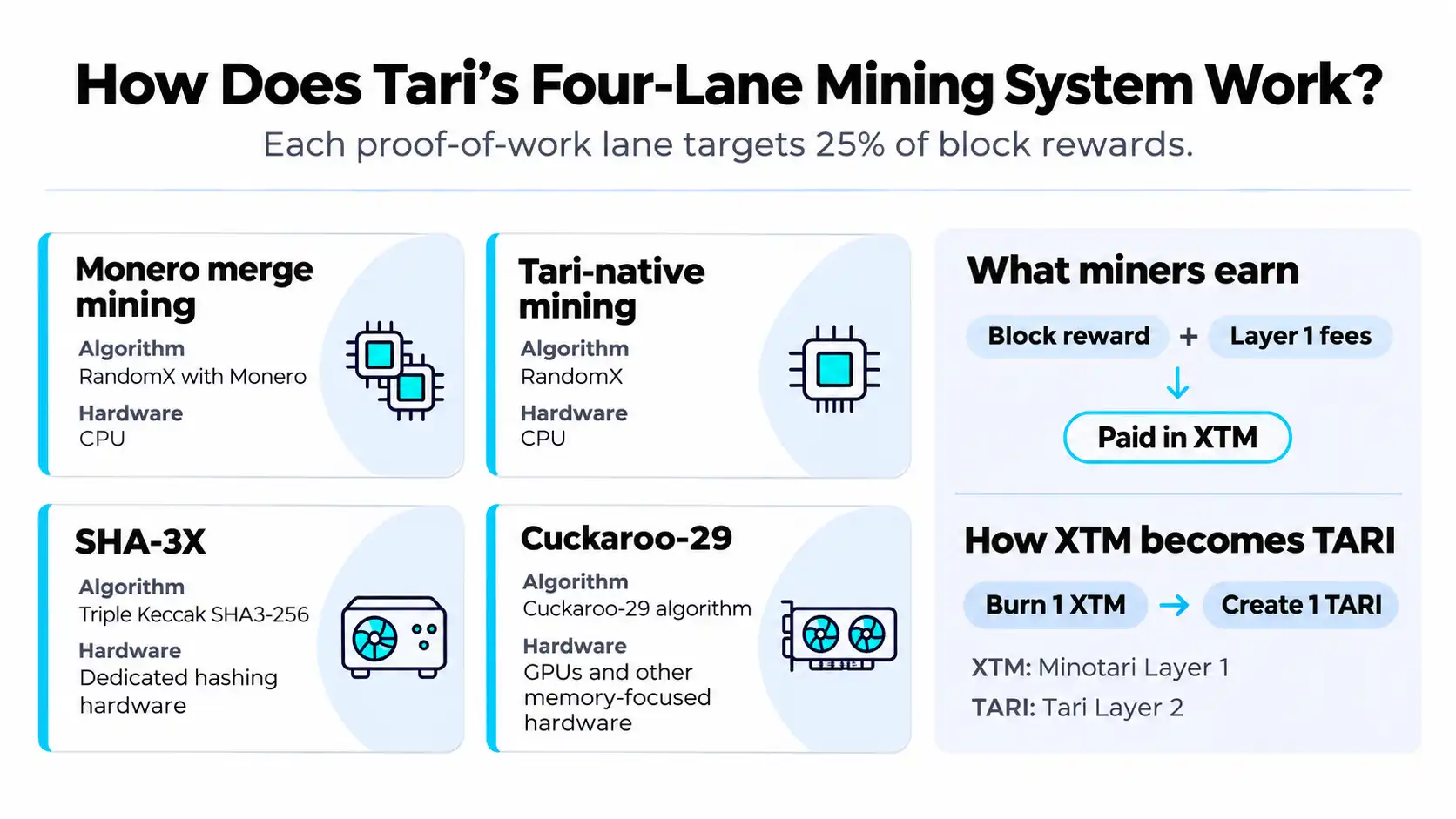
Tari does not rely on a single Proof-of-Work algorithm. Its hybrid design has four lanes that use different mining methods and hardware types.
| Mining lane | Algorithm | Typical hardware |
|---|---|---|
| Monero merge mining | RandomX with Monero | CPUs |
| Tari-native mining | RandomX | CPUs |
| SHA-3X | Triple Keccak SHA3-256 | Dedicated hashing hardware |
| Cuckaroo-29 | Cuckaroo-29 | Memory-focused hardware, including GPUs |
Tari’s tokenomics documentation describes an equal reward allocation across the four lanes. Each lane targets 25% of the network’s block rewards. This allows different forms of computing power to take part in block production rather than placing all mining activity in one lane.
Tari’s emissions also work differently from Bitcoin’s fixed halving cycle. Its block reward follows an emission schedule that decreases over time. Miners can receive block rewards and applicable Layer 1 transaction fees.
It is useful to distinguish XTM from TARI. XTM is the native token of Minotari Layer 1, while TARI is used on the Tari Layer 2 network. The tokenomics model includes a 1:1 XTM burn mechanism for creating TARI. See the official Tari tokenomics information.
How Does SHA-3X Work Step by Step?
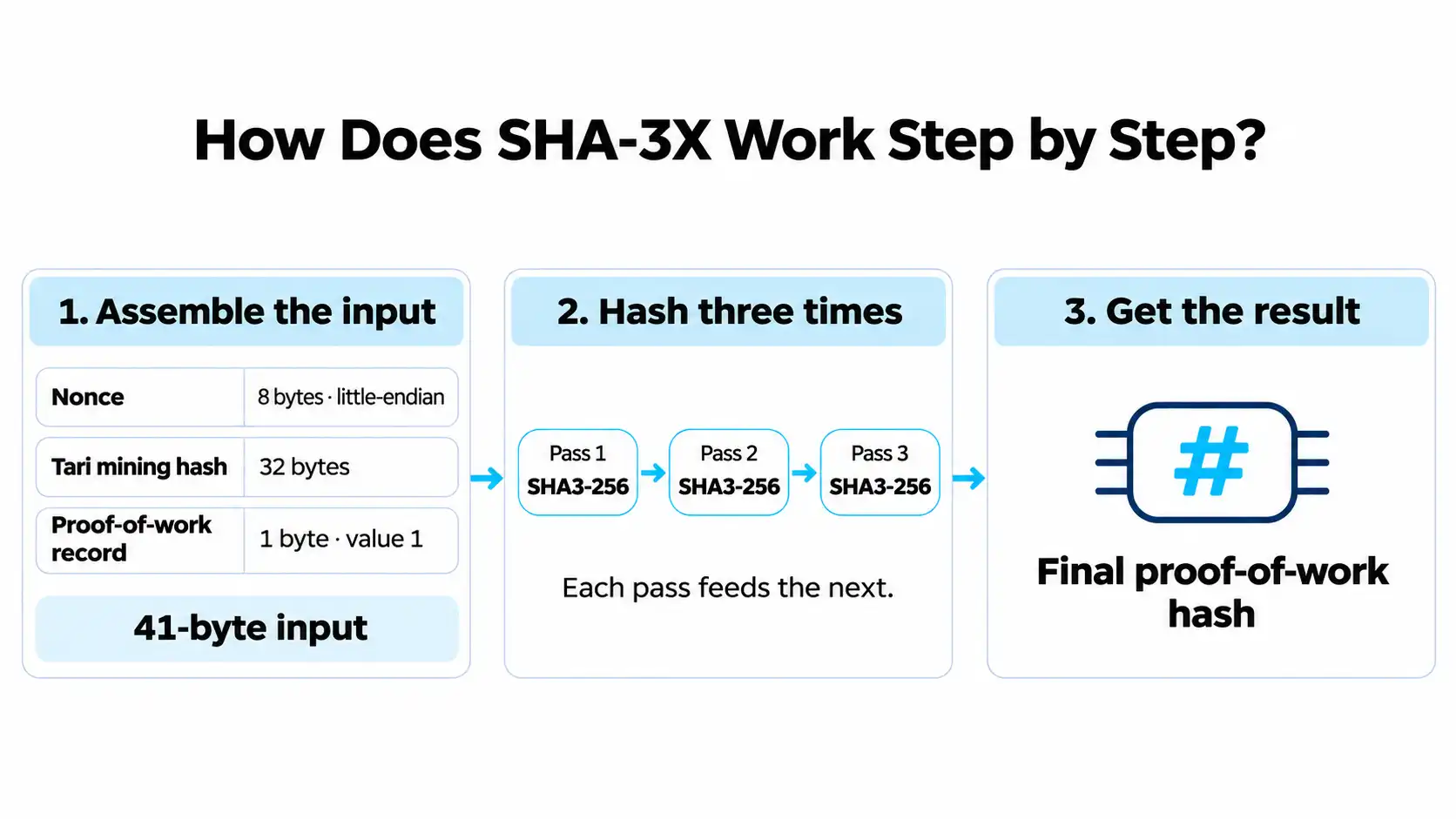
The SHA-3X process starts with three pieces of data defined in Tari’s RFC-0131 mining specification:
- Nonce (8 bytes): A value the miner changes to test new hash inputs.
- Tari mining hash (32 bytes): The mining hash supplied from the block data.
- Proof-of-Work record (1 byte): A byte set to 1 for this proof-of-work type.
The nonce is encoded in little-endian format. The miner concatenates the nonce, mining hash, and Proof-of-Work record in the specified order. The miner passes this combined input to Keccak SHA3-256.
What Happens During the Three Hashing Rounds?

| Stage | Input | Operation | Output |
|---|---|---|---|
| 1. Prepare | 8-byte nonce + 32-byte mining hash + 1-byte PoW record | Concatenate the data | Combined input |
| 2. First hash | Combined input | Keccak SHA3-256 | First 256-bit hash |
| 3. Second hash | First hash | Keccak SHA3-256 | Second 256-bit hash |
| 4. Third hash | Second hash | Keccak SHA3-256 | Final 256-bit hash |
| 5. Target check | Final hash | Compare with network target | Valid or invalid result |
The second round hashes the first round’s output. The third round hashes the second round’s output. It does not restart with the original nonce and block data each time. The miner changes the nonce and repeats the chain until it finds a result that meets the current difficulty target.
A nonce is a 64-bit value, so it has a finite range. When the available nonce range is exhausted, the mining software needs fresh mining work from the base node before continuing. Tari’s RFC describes the exact input and chained process in its mining specification.
What Is Sponge Construction in SHA-3?
Keccak uses a design called sponge construction. A simple way to picture it is a sponge taking in and releasing water. The hash function has three broad stages:

- Absorbing: It takes the input and loads it into an internal state.
- Mixing: It applies mathematical operations that mix the data.
- Squeezing: It produces the hash output.
SHA3-256 returns a 256-bit result. SHA-3X takes that result into a second SHA3-256 round and then takes the second output into a third round. The final hash is checked against the target set by the network difficulty. A result that meets the target can be submitted as a valid proof.
Changing the nonce changes the input and normally produces a different hash. That is how a mining device tests many possible results. Tari has also discussed its mining hardware through its Goldshell hardware announcement.
Why Did Tari Develop the Third Hash Round?
Tari designed the additional hashing layer partly to make its mining work less directly reusable through existing NiceHash-style rental markets. Some other networks use one or two SHA3 passes. Computing resources configured for those networks may not be directly suited to Tari’s three-pass process.
The extra round adds a separate requirement for hardware and rented computing resources. It is intended to make generic hashing power less convenient to redirect toward the Tari lane.
Tari’s four-lane design also spreads block production across different algorithms. These measures can make certain attacks more difficult, but they do not make a 51% attack impossible or guarantee complete network safety. They are parts of the network’s broader security design, not a promise that attacks cannot happen.
What Are the Current Tari Mining Statistics?
Mining estimates depend on the network hashrate, block reward, coin price, and electricity rate. The explorer and market figures below are dated snapshots, not fixed values.
Network and market data checked November 14, 2026
| Metric | Figure |
|---|---|
| Estimated SHA-3X network hashrate | 605.056 TH/s |
| Target time per mining lane | 480 seconds |
| Expected blocks per lane per day | 180 |
| Observed SHA-3X block reward | 9,929.199684 XTM |
| Recorded block | 387058 |
| Block time | November 14, 2026, 00:09:09 UTC |
| XTM price snapshot | $0.00085973 |
Sources: Tari Text Explorer and CoinPaprika XTM market data. The explorer estimate uses a recent 180-block window; the market price source was updated on November 14, 2026.
The observed reward is taken from a recorded SHA-3X block. It should not be treated as a permanent reward because Tari’s emissions decrease over time. The 9,970.63 XTM figure sometimes quoted in older material should not be presented as the current observed reward without a matching block record.
Each mining lane targets a block every 480 seconds, or eight minutes. The four lanes together give the network an overall target interval of about 120 seconds, or two minutes. Actual block intervals vary.
Which Goldshell Miners Support SHA-3X?
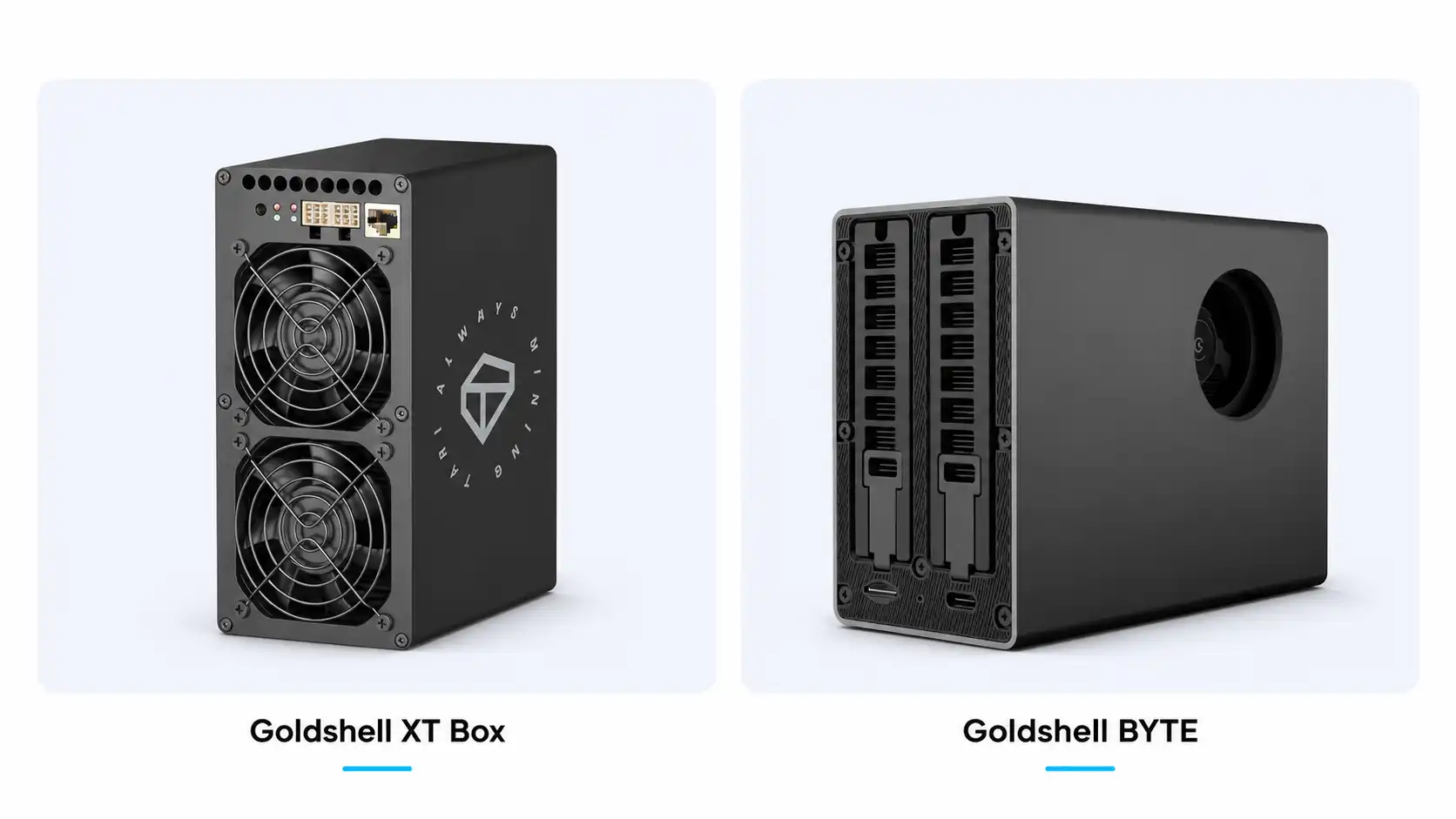
Goldshell offers two options for this workload: the XT Box and the BYTE with an XT Card. The XT Box is a complete miner with a higher hashrate. BYTE is a modular base unit that needs a compatible card for the selected algorithm.
What Are the Goldshell XT Box Specifications?
The Goldshell XT Box XTM Miner is designed for SHA-3X mining. Goldshell lists it at 580 GH/s and 400 W, with an efficiency rating of 0.69 J/GH.
| Specification | XT Box |
|---|---|
| Algorithm/coin | SHA-3X / XTM |
| Hashrate | 580 GH/s ±5% |
| Power consumption | 400 W ±5% |
| Efficiency | 0.69 J/GH |
| Noise level | Up to 35 dB |
| Connection | Ethernet / Wi-Fi |
| Dimensions | 150 × 198 × 96 mm |
| Weight | 2.43 kg |
Operating temperature
0 to 35°C
Its compact size makes placement easier than with many large mining machines. However, the 400 W power draw creates heat during continuous operation. Leave clear space around the air intake and exhaust, and avoid placing the machine in a closed cabinet. The listed noise level is up to 35 dB, but actual sound can depend on the room and operating conditions.
What Are the BYTE and XT Card Specifications?
The Goldshell BYTE uses replaceable algorithm cards. For XTM mining, buyers need the XT Card. The card cannot operate by itself; it needs the BYTE main unit.
Goldshell lists two XT Card modes:
| Mode | Hashrate | Power | Efficiency |
|---|---|---|---|
| High power | 100 GH/s ±5% | 65 W ±5% | 0.65 J/GH |
| Default | 80 GH/s ±5% | 45 W ±5% | 0.56 J/GH |
High-power mode requires Goldshell’s 140 W wall charger. The BYTE main unit measures 135 × 63 × 106 mm, weighs about 0.4 kg, uses Wi-Fi, and has a listed noise level of around 45 dB. Check the product bundle before ordering so the BYTE, XT Card, and required charger are included.
How Do the XT Box and BYTE Compare?
Hardware specifications checked November 14, 2026
| Feature | XT Box | BYTE XT Card (High) | BYTE XT Card (Default) |
|---|---|---|---|
| Hashrate | 580 GH/s | 100 GH/s | 80 GH/s |
| Power | 400 W | 65 W | 45 W |
| Efficiency | 0.69 J/GH | 0.65 J/GH | 0.56 J/GH |
| Noise | Up to 35 dB | Around 45 dB | Around 45 dB |
| Design | Complete miner | Modular | Modular |
The XT Box offers 5.8 times the hashrate of BYTE’s high-power mode, but it uses more electricity. BYTE is smaller and draws less power, while its replaceable card gives the system flexibility for other supported algorithms. Goldshell also describes the XT Box in its product announcement.
How Do You Estimate SHA-3X Mining Profitability?
A hashrate figure on its own does not show what a miner may earn. Compare the device’s hashrate with the network total, then include the block reward, coin price, and electricity cost.
Use this estimate:
Daily XTM = (Miner hashrate ÷ Network hashrate) × Expected blocks per day × Block reward
The example below uses the dated inputs shown above and an assumed electricity rate of $0.10 per kWh.
| Input | Value |
|---|---|
| Network hashrate | 546.839 TH/s |
| XT Box hashrate | 0.580 TH/s |
| BYTE high-power hashrate | 0.100 TH/s |
| BYTE default hashrate | 0.080 TH/s |
| Block reward | 9,929.199684 XTM |
| Expected blocks per day | 180 |
| XTM price | $0.00086926 |
| Electricity rate | $0.10/kWh |
For the XT Box:
(0.580 ÷ 546.839) × 180 × 9,929.199684 = about 1,895.64 XTM per day.
At the selected coin price, that is approximately $1.65 in gross daily revenue.
How Much Could Each Miner Earn Per Day?
Illustrative estimates using November 14 data
| Machine | Estimated XTM/day | Gross revenue/day | Electricity/day | After electricity |
|---|---|---|---|---|
| XT Box 580 GH/s | 1,895.64 | $1.65 | $0.96 | $0.69 |
| BYTE 100 GH/s | 326.83 | $0.28 | $0.16 | $0.13 |
| BYTE 80 GH/s | 261.47 | $0.23 | $0.11 | $0.12 |
Electricity use is calculated from rated power:
- XT Box: 0.4 kW × 24 hours = 9.6 kWh per day.
- BYTE high-power: 0.065 kW × 24 hours = 1.56 kWh per day.
- BYTE default: 0.045 kW × 24 hours = 1.08 kWh per day.
At $0.10/kWh, those loads cost $0.96, $0.156, and $0.108 per day. The balance shown is gross revenue minus electricity only. It excludes the miner’s purchase price, shipping, taxes, cooling, downtime, pool fees, maintenance, and exchange costs.
These figures are estimates, not guaranteed payouts. Coin price, network hashrate, difficulty, block reward, and electricity rates change. A solo miner may receive no block reward for an extended period, even when its long-term expected output matches the calculation. Pool payouts are usually more frequent but follow the pool’s fee and reward rules.
How Long Could a Solo Miner Take to Find a Block?
Using the same network hashrate and a target of 180 blocks per day for this lane gives these statistical averages:
| Miner | Estimated average time |
|---|---|
| XT Box 580 GH/s | 5.2 days |
| BYTE XT Card 100 GH/s | 30.4 days |
| BYTE XT Card 80 GH/s | 38.0 days |
These are probability-based estimates, not schedules. A machine may find a block sooner or take much longer. More hashrate improves the expected chance of finding a block, but it does not guarantee one.
How Can You Set Up a Tari Miner at Home?
A basic setup involves a wallet, compatible hardware, a network connection, and valid mining settings.
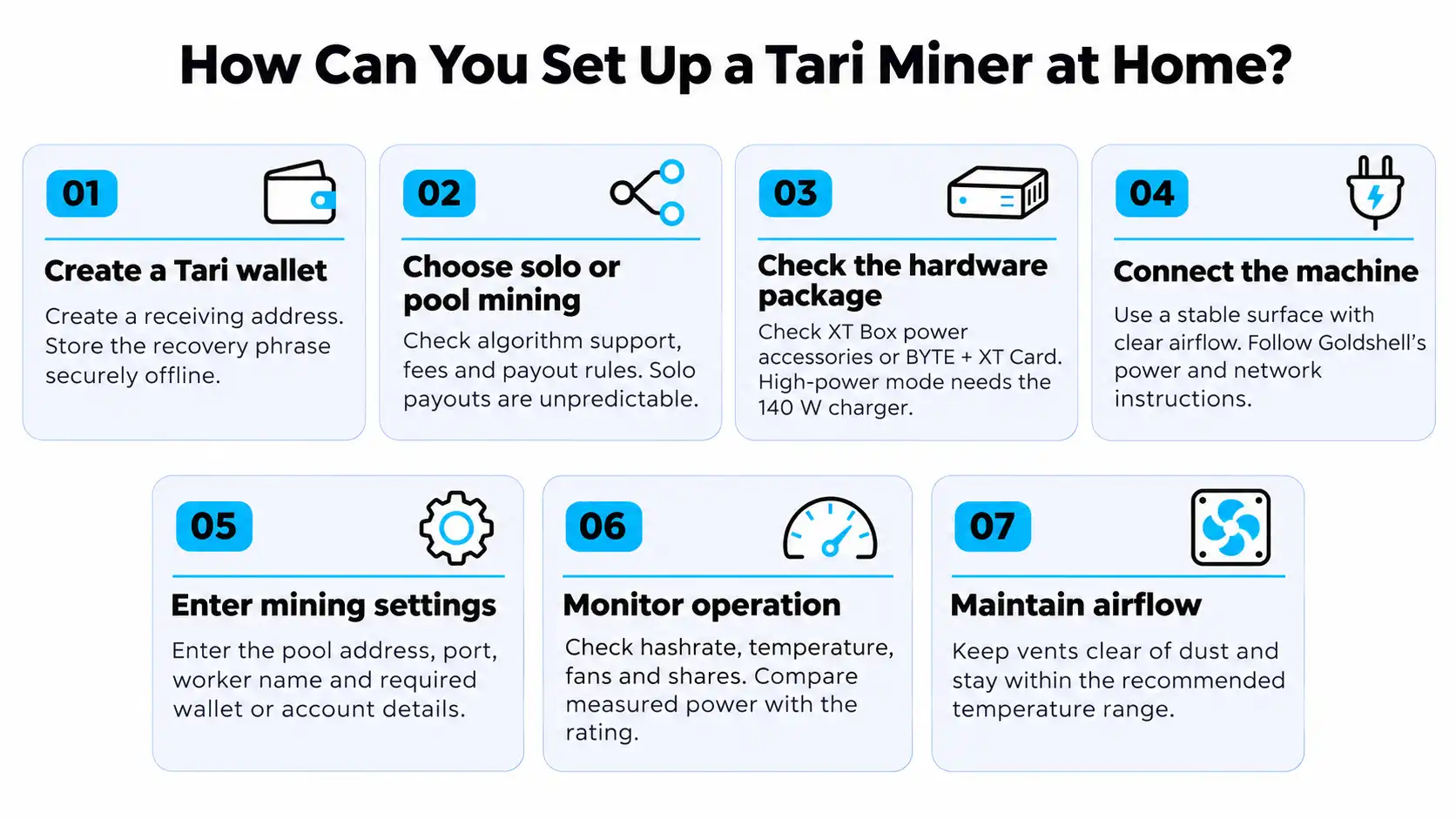
- Create a Tari wallet. Generate a receiving address and keep the recovery phrase somewhere secure and offline.
- Choose solo or pool mining. Check the service’s supported algorithm, fees, payout rules, and minimum payout. Solo mining offers the full block reward if your miner finds a block, but payouts are unpredictable.
- Check the hardware package. For the XT Box, confirm the power accessories. For BYTE, confirm the main unit and XT Card are included. High-power mode needs the 140 W charger.
- Connect the machine. Place it on a stable surface with clear airflow. Connect the power and network as directed by Goldshell.
- Enter mining settings. Add the pool address, port, worker name, and wallet or account details required by the chosen service.
- Monitor operation. Check hashrate, temperature, fan speed, accepted shares, and rejected shares. Compare actual power use with the rated figure.
- Maintain airflow. Remove dust from vents and keep the machine within its recommended operating temperature.
Monitoring the miner during its first few days helps you understand its normal power use, temperature, and connection stability.
CONCLUSION
SHA-3X gives Tari a dedicated Proof-of-Work lane built around three consecutive Keccak SHA3-256 operations. Its input structure uses an 8-byte nonce, a 32-byte mining hash, and a 1-byte Proof-of-Work record. Combined with Tari’s four-lane reward design, it creates a distinct mining process for the Minotari network.
The Goldshell XT Box is the higher-hashrate option, while BYTE with an XT Card offers a compact modular alternative with lower power use. Compare the hardware specifications and electricity cost before choosing a machine.
Cryptominerbros offers both products with worldwide courier shipping through DHL, UPS, FedEx, ARAMEX, and TNT. The store lists bank-wire and cryptocurrency payment options, along with 24/7 live chat assistance. Buyers can review its Trustpilot profile and ASIC Miner Value vendor listing before ordering.
For eligible purchases, use coupon code SOLO70 at checkout for a $70 discount, subject to the promotion’s current terms. Check the latest network figures and your electricity rate before making a purchase.
Frequently Asked Questions
-
Can I Mine SHA-3X With a Standard Computer or GPU?
The protocol accepts valid mining proofs; it does not require a specific brand of ASIC. However, dedicated hardware is more practical for competing with commercial hashrates. A standard computer or GPU is unlikely to match the performance of the Goldshell machines discussed above.
-
What Is the Block Time for SHA-3X?
The target interval for this mining lane is 480 seconds, or eight minutes. Tari’s four lanes together target an overall network block interval of about 120 seconds, or two minutes. Actual block times can vary.
-
Is SHA-3X Mining Suitable for a Quiet Home Setup?
The XT Box is listed at up to 35 dB, while BYTE is listed around 45 dB. Both are compact, but they still produce fan noise and heat. The XT Box draws 400 W continuously, so allow for ventilation and check that the electrical circuit is suitable.
-
Should I Choose Solo Mining or Pool Mining?
Pool mining generally provides more regular payouts based on your share of the work. Solo mining gives you the chance to receive a full block reward if your machine finds a valid block, but the wait can be long and unpredictable. Choose based on your hashrate and comfort with variable rewards.

Join our Newsletter
Get the week’s best cryptomining content in your inbox.

Han su
Han Su is a technical analyst at CryptoMinerBros, a leading provider of cryptocurrency mining hardware. He has over 5 years of experience in the cryptocurrency industry and is an expert in mining hardware, software, and profitability analysis.
Han is responsible for the technical analysis and research on ASIC Mining at Crypto Miner Bros. He also writes in-depth blogs on ASIC mining and cryptocurrency mining, and he has a deep understanding of the technology. His blogs are informative and engaging, and they have helped thousands of people learn about cryptocurrency mining.
He is always looking for new ways to educate people about cryptocurrency, and he is excited to see how the technology continues to develop in the years to come.
In spare time, Han enjoys hiking, camping, and spending time with his family. He is also an avid reader, and he loves to learn about new things.
Similar Blogs
Hydro Mining Containers: Complete Setup Guide for Crypto Mining Farms
What Are Water-Cooled Mining Containers and How Do They Work? Hydro mining containers are steel unit...
Best Practices to Maximize ASIC Mining Profitability
Power cost decides how much you earn. At $0.10 per kWh, only the most efficient of the three machine...
ASIC vs GPU Mining: Which Is More Profitable in 2026?
Specialized Bitcoin machines turn each watt into far more hashing than a graphics card can, so they ... © 2018- Miner Bros Limited. All rights reserved

 EN EN
 ES