


SUMMARY
A large crypto mining farm needs more than high-performance mining machines. It also needs a reliable power supply, a well-designed cooling system, organized equipment placement, and a way to monitor every part of the operation. A container-based setup brings these systems together in one facility. Operators can use it to manage several mining machines, control heat, distribute electricity, and make maintenance easier. This guide covers the main equipment, site requirements, installation process, cooling design, operating expenses, and important checks before buying a complete mining container.
What Are Water-Cooled Mining Containers and How Do They Work?
Hydro mining containers are steel units built to hold water-cooled Bitcoin machines, plus the pumps, pipes, power gear and outdoor cooler those machines need. Instead of pushing air over hot chips, the system sends liquid through a cold plate inside each machine and carries the heat outside. A farm gets one planned package in place of a custom building with its own fans and ducts.
Margins are tight right now. Bitcoin trades near $75,792, difficulty is 148.36 trillion, and gross hashprice is about $32.44 per petahash per day, down from $40.24 on October 1. Efficiency and uptime matter more when margins shrink.
What Is Inside a Water-Cooled Mining Container?
Think of it as a small data center with plumbing. Each part has one job, and one weak part can hold back the rest.
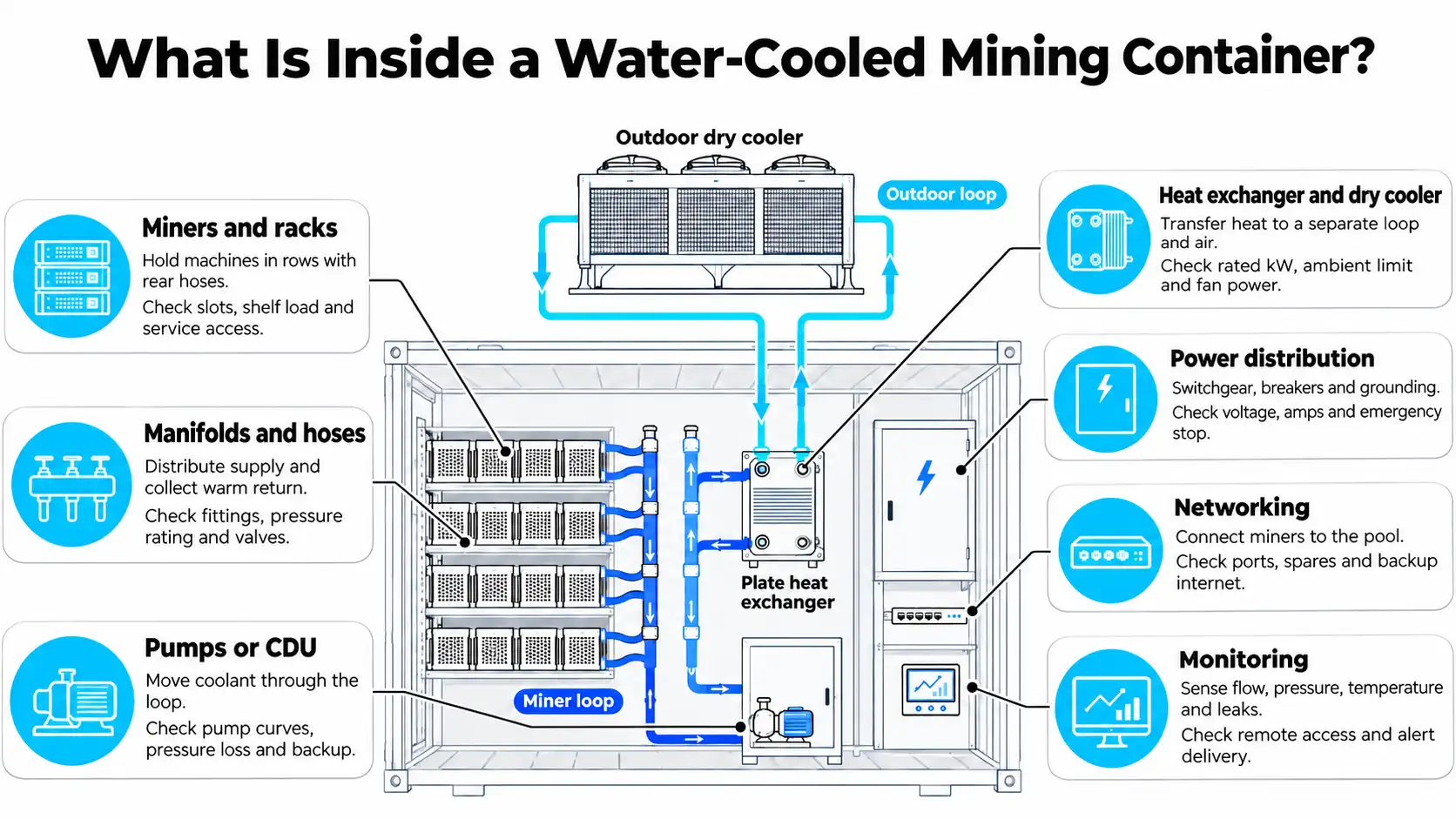
| Part | What it does | What to check |
|---|---|---|
| Miners and racks | Hold the machines in rows, hoses at the back | Slot count, shelf weight, room to pull one unit |
| Manifolds and hoses | Split the supply into one branch per machine and collect the warm return | Fitting match, 3.5 bar rating, shut-off valve per branch |
| Pumps or CDU (Coolant Distribution Unit) | Move the coolant and hold pressure | Flow at real pressure, spare pump, dual-loop option |
| Heat exchanger and dry cooler | Pass the heat to outside air or a second loop | Rated kW, ambient limit, fan power |
| Power distribution | Main switch, breakers, cabinets, grounding | Voltage, total amps, emergency stop |
| Networking | Switches and cables to the pool | Port count, spare ports, backup internet |
| Monitoring | Sensors for flow, pressure, temperature, leaks | Alerts by email or text, remote access |
A word on pumps. Do not choose one from its top advertised flow. Ask for its pump curve and add up the pressure loss across the whole loop: pipes, filters, valves, the heat exchanger and the miner channels. A pump that looks big on paper can still starve the last row.
A plate heat exchanger is the usual link between the miner loop and the outdoor loop. Heat crosses thin metal plates without the two liquids mixing. The dry cooler then moves that heat into the air with fans and a coil, much like a car radiator.
Container sizes and loads vary by maker.
- Bitmain ANTSPACE HD5: Up to 308 slots | About 1,500 kW | Dry cooling tower
- Bitmain ANTSPACE HW5: Up to 210 slots | 1.2 MW | Dry-wet hybrid tower
- Datacubes 20 ft: 96 to 100 slots | Up to 800 kW | CDU inside
- Datacubes 40 ft: 240 slots | Up to 1,950 kW | CDU inside, external dry coolers
A 40-foot unit measures 12,192 by 2,438 by 2,896 mm. One HD5 cooling unit listing gives a shipping weight of 12 tonnes and an operating weight of 13.5 tonnes. That weight matters when you design the pad.
How Does the Cooling Loop Move and Heat Out of the Container?
The loop is a closed circle. The coolant never meets outside air, so dust and humidity stay away from the machines.
- Coolant enters each miner and flows through a cold plate on the hash boards.
- It picks up chip heat and leaves the machine warm.
- The warm return runs through the manifold to the heat exchanger or dry cooler.
- Outside air, or a second water loop, pulls the heat away.
- The cooled coolant goes back to the pumps and the circle repeats.
Do not confuse this with immersion cooling. Immersion puts special hardware inside a tank of oil-like fluid. A water-cooled machine keeps the liquid inside its own cold plate, so the containers and the upkeep are different.
The Antminer hydro models used in this guide list the same loop limits:
- Flow per machine: 8.0 to 10.0 liters per minute
- Pressure: 3.5 bar or lower
- Coolant temperature: 20 to 50 °C
- Fluid and pH: antifreeze (7.0 to 9.0), pure water (6.5 to 7.5) or deionized water (8.5 to 9.5)
Here is how that scales. A 210-slot container needs 1,680 to 2,100 liters per minute, or about 101 to 126 cubic meters per hour. A heat-balance check agrees. At the low end of the range, a 5.6 kW machine warms its coolant by about 10 °C. With a 35 °C supply, the return is near 45 °C, inside the 50 °C limit. One reseller guide plans HK3-class containers around 85 cubic meters per hour, so use the loop figure from your own container maker.
Climate picks the outdoor cooler. One HD5 listing gives an outlet of 35 °C, plus or minus 1 °C, when the air outside is 30 °C. A cooling-equipment maker says a dry cooler suits sites where summer highs stay under about 30 °C. Hotter sites need a dry-wet tower, which sprays a thin water film over the coils on extreme days. That keeps the coolant cool but uses water, so check your supply and local rules.
A well-designed hydro mining container uses a closed-loop cooling system to carry heat away from the miners through coolant pipes, manifolds, and heat exchangers. BITMAIN’s ANTSPACE cooling solutions also highlight how dedicated cooling infrastructure helps large mining farms manage heat and maintain stable operating conditions.
https://x.com/BITMAINtech/status/2110339848435569098
Why Do Large Farms Choose Hydro Mining Containers?
High-power machines make a lot of heat in a small space, and room air alone struggles to carry it away. Farms pick these containers for four reasons:

- Direct heat control: Liquid carries heat from the chips to the outdoor cooler, so the container’s own fans have less work.
- High density: Racks can sit closer because nobody has to push air through the rows. The final count still depends on power, cooling and maker limits.
- One planned package: Power, pipes, network and service access are laid out together instead of piece by piece.
- Visible conditions: Sensors track coolant temperature, pressure and pump status, so a cooling fault shows up early.
What Changes When a Hydro Bitcoin Miner Replaces Fan Cooling?
A water-cooled machine has no fans. A water block sits on the hash boards and passes the heat to the loop. The S21+ Hydro page lists 50 dB, though pumps and outdoor cooler fans still make noise, so judge the whole site. The price is plumbing. A leak, an air pocket or a dead pump can stop a whole row, so the loop needs more care than a fan wall.
Here is how the two container types compare.
| Factor | Water-cooled container | Air-cooled container |
|---|---|---|
| Heat removal | Liquid loop to an outdoor cooler | Fans move air through the shell |
| Noise | Quieter machines, but pumps and cooler fans run | High, from many fans at once |
| Density | High, for example 308 slots in an HD5 | Lower, since air needs space |
| Dust and humidity | Sealed loop keeps both off the chips | Filters needed, cleaning is frequent |
| Hot climates | Needs a dry-wet tower above roughly 30 °C summers | Hot air limits speed and chip life |
| Setup effort | Higher: piping, pressure test, coolant fill | Lower: power, air path, network |
| Ongoing care | Coolant checks, pump and cooler service, leak checks | Filter and fan swaps |
| Machine cost | Often higher per unit | Usually lower per unit |
The claims on water cooling lift efficiency 15 to 20 percent over air. Treat that as a seller claim, not a lab result. The fair summary is that a water-cooled container costs more to set up and returns density, quiet and thermal control. A small site or a short lease may do better with air. Neither type guarantees profit. Power price, machine efficiency and uptime still decide the result.
Which Hydro ASIC Miner Models Can the Container Support?
The machines must match the container’s loop, voltage, rack size and controls. Four Bitmain models suit a high-density Bitcoin build.
| Model | Hashrate | Power | Efficiency | Listed Price |
|---|---|---|---|---|
| Antminer S21j XP Hydro 495Th | 495 TH/s | 5,940 W | 12 J/TH | $5,849 |
| Antminer S21e XP Hydro 430Th | 430 TH/s | 5,590 W | 13 J/TH | $3,949 |
| Antminer S21+ Hydro | 319 TH/s (358 TH/s & 395 TH/s batches available) | 4,785 W | 15 J/TH | 2,969 |
| Antminer S21e Hydro | 310 TH/s (332 TH/s batch available) | 5,270 W | 17 J/TH | 1,769 |
All four take 380 to 415 V input, connect by Ethernet and carry a 365-day warranty. Every hydro Bitmain miner in this table asks for the same loop limits, which keeps piping and manifolds simple when you mix models. Higher efficiency means more hashrate per slot and per liter of coolant, so the S21j XP suits tight sites. This hydro Bitcoin miner family also spreads across price points, so your power rate can guide the pick.
How Many Machines Can One Container Really Hold?
Slot counts on a listing can mislead, because the power budget often caps you first. This table divides each container’s load by the machine’s power draw. It counts miner load only, so ask the maker how much the pumps, fans and lights add.
| Miner | HD5 (1,500 kW, 308 slots) | HW5 (1,200 kW, 210 slots) |
|---|---|---|
| S21+ Hydro (4,785 W) | 308 (slot limit) | 210 (slot limit) |
| S21e Hydro (5,270 W) | 284 | 210 (slot limit) |
| S21e XP Hydro (5,590 W) | 268 | 210 (slot limit) |
| S21j XP Hydro (5,940 W) | 252 | 202 |
The strongest machines draw the most power each, so a container can reach its electrical limit before its shelves fill. A container planned for 210 older 5 kW-class machines may not hold the same count of newer machines near 6 kW. Confirm the real number with your supplier.
How Do You Work Out Power and Coolant Needs?
Do these sums before you order. Take 100 S21j XP Hydro machines.
- Electrical load: 100 times 5.94 kW is 594 kW. At 400 V three-phase and a power factor of 0.95, that is about 902 amps. This counts miners only. Pumps, cooler fans, lights and controls come on top, and a qualified electrical engineer should size the transformer, cables and breakers with local rules and a safety margin.
- Coolant flow: At 8 to 10 liters per minute each, 100 machines need 800 to 1,000 liters per minute, or 48 to 60 cubic meters per hour. A heat-balance check of 594 kW at a 10 °C rise gives about 51 cubic meters per hour, inside that range.
- Cooling duty: Almost every watt the miners draw becomes heat, so the 594 kW is also the heat your cooler must remove. Size it for your hottest day, not mild weather, and check its output at your real design temperature.
Plan the power feed early. One HW5 listing gives its supply as 400 V, plus or minus 5%, at 50 or 60 Hz.
- Utility feed and transformer: Confirm the site can deliver the full load and get the connection date in writing.
- Main switch and breakers: Size them for continuous load.
- Grounding: A water loop beside high-power gear needs a clean ground plan.
- Pump backup: If power drops, pumps stop and chips heat fast. Some makers offer dual loops so one side can keep running.
- Room to grow: Any hydro ASIC miner you add later changes the load, so leave spare capacity.
How Should You Prepare the Site?

- Location: Pick ground with truck and crane access. Check noise rules, security, drainage and distance from dusty areas.
- Pad: Build a level, drained, hardened foundation that carries the operating weight with margin. Follow the maker’s drawings and local structural rules.
- Cooler placement: Leave open air around the dry cooler, and keep its hot exhaust away from its own intake. One maker pairs each container with one dry cooler.
- Power: Arrange the transformer, incoming cable and protection gear before delivery.
- Coolant handling: Plan where you will mix and store it. The HW5 listing gives an inner volume of 1.6 cubic meters. In cold places, check whether you need antifreeze.
- Runs: Keep pipe and cable runs short. Long pipes add pressure loss, and long cables add voltage drop.
- Internet: Order the line early and add a backup link.
- Safety: Add a fence, lighting, lightning protection, fire gear and clear exits.
How Do You Install and Start the Container, Step by Step?
This is a general order based on the listings and common practice. Your maker’s manual comes first, so use it to confirm each step.

- Confirm the electrical feed: Test voltage and phase balance before delivery.
- Set the pad and place the container and cooler: Level and anchor them as directed, and keep service panels and exits clear.
- Connect the pipes: Join supply and return between the container and cooler, then fit valves, filters, gauges and flow meters.
- Pressure-test with plain water: Hold the test pressure and check every joint for drips before any coolant goes in.
- Flush the loop: Clear debris, since small particles can block a cold plate.
- Fill with approved coolant: Use one of the three fluids listed in the pH ranges above, then bleed air from every high point.
- Run the pumps with no miners powered: Check flow and pressure at each manifold and look for alarms.
- Power the electrical system: Test breakers, sensors and the network switch.
- Mount the machines: Hang each hydro miner on its shelf, connect couplings, and confirm each machine sees flow before you switch it on.
- Bring machines up in batches: Start one row and watch temperature and pressure before adding the next. This also avoids a sudden spike on the feed.
- Set pool and firmware settings: Name each machine by shelf position so alerts point to a real place.
- Test the alarms and the emergency stop: Force low-flow, high-temperature and leak alerts and see who gets the message.
A first-time team should ask the supplier for a startup call or an on-site visit.
How Do You Monitor and Maintain the Loop?
Track these points all day: supply and return temperature, flow rate, supply and return pressure, coolant pH and conductivity, leak sensors, pump and cooler fan status, power draw, and hashrate per machine. Send alerts to more than one person, and keep the miners on their own network segment where you can, so management traffic stays apart from office traffic.
Routine care is simple. Check coolant pH on a schedule, clean the strainers, clear the cooler coils, and inspect hoses and couplings for wear. Keep spare pumps, hoses and couplings on site, because one small part can idle a full row.
How Much Does a Container Setup Cost?
Container and cooler prices come from quotes, and they change with size, climate and shipping. The cost list is the same for every build.

- Miners: Model and quantity
- Container and heat-rejection unit: Size, dry or dry-wet design, single or dual loop
- Electrical work: Transformer, switchgear, cabling, grounding
- Site work: Pad, access road, fence, drainage
- Shipping and customs: Distance, duties, crane hire
- Coolant and spares: Loop volume and your spares plan
- Installation and startup: Crew time, testing, supplier support
- Running costs: Electricity, pump and cooler power, repairs, pool fees, staff
Electricity is the largest running cost, and the pumps and cooler fans add to it. A result that counts only miner power will look better than the real facility result.
Is a Full Container Profitable at Today’s Numbers?
Use real inputs and show them.
| Input | Value |
|---|---|
| Bitcoin price | $75,792 |
| Network difficulty | 148.36 trillion |
| Block reward | 3.125 BTC |
| Electricity | $0.06 per kWh |
Data as of November 8, 2026.
At these inputs, one terahash per second earns about 0.000000427 BTC a day, or about $0.0324. That is roughly $32.44 per petahash per day, matching what spot market trackers report. Here is a full HW5-size container (1.2 MW, 210 slots) filled with each model.
| Containers fill | Hashrate | Miner load | Revenue per day | Power cost per day | Net per day | Break-even rate |
|---|---|---|---|---|---|---|
| 210 × S21+ Hydro | 67.0 PH/s | 1,005 kW | $2,173 | $1,447 | $726 | $0.090/kWh |
| 210 × S21e Hydro | 65.1 PH/s | 1,107 kW | $2,112 | $1,594 | $518 | $0.079/kWh |
| 210 × S21e XP Hydro | 90.3 PH/s | 1,174 kW | $2,929 | $1,691 | $1,239 | $0.104/kWh |
| 202 × S21j XP Hydro | 100.0 PH/s | 1,200 kW | $3,244 | $1,728 | $1,516 | $0.113/kWh |
Data as of November 8, 2026, at $0.06 per kWh, calculated on miner power draw only. The S21+ row uses the 319 TH/s batch variant.
The 202-machine row leaves no electrical room for pumps and fans, so a real build would hold fewer. Every 40 kW of pump and fan load adds about $58 a day at $0.06.
Price and power cost move the result significantly. Here is the 210 × S21e XP container’s net per day relative to macro price movements.
| Net per day | Bitcoin at $65,000 | Bitcoin at $75,792 | Bitcoin at $90,000 |
|---|---|---|---|
| Power at $0.04/kWh | $1,385 | $1,802 | $2,351 |
| Power at $0.06/kWh | $822 | $1,239 | $1,788 |
| Power at $0.08/kWh | $258 | $675 | $1,224 |
A 5% rise in difficulty cuts revenue about 4.8%, which trims the middle case down to about $1,180 a day. Now add the equipment. At listed prices, 210 S21e XP machines cost $829,290 and 202 S21j XP machines cost $1,181,498. The container, cooler, power gear and site work come on top of the quote. At the nets above, the machines alone pay back in about 669 days and 779 days, before those infrastructure extras.
Results change dynamically with coin price, difficulty, and power cost. Recheck them with a live calculator before you sign any order.
What Should You Check Before You Buy Hydro Miners?
Container and layout
- The real machine count for your model, with pump and fan load included
- Rack spacing and room to swap one machine
- Operating weight and pad needs
- Service access and emergency exits
Cooling
- Heat rejection in kW, and its output on your hottest local day
- Flow in cubic meters per hour at real operating pressure
- Coolant type, supply and return limits, single or dual loop
- Manifold layout, filters, valves and leak detection
- Backup pump arrangement
Electrical
- Voltage, frequency and phase
- Miner load plus pump, fan and lighting load
- Transformer, cable sizes, breakers and grounding
- Emergency shutdown
Network and monitoring
- Ethernet port count and a backup uplink
- Sensors for temperature, pressure, flow and leaks
- Automatic alerts and secure remote access
Supplier
- Written confirmation that the container supports the exact Hydro Bitmain miner model you plan to buy, including fittings and flow
- Full spec sheet and installation drawings
- What is included, and who handles shipping, startup, and customs
- Container warranty terms, compared with the 365-day machine warranty
- Spare parts list and a named repair contact
- Room to add more containers on the same feed later
CONCLUSION
A water-cooled container fits an operator with low-cost three-phase power, enough capacity to feed a full unit, and a team that can watch a cooling loop every day. Mid-size farms can start with one unit and add more as power and cooling allow. Large farms gain from the repeatable layout. It is a weaker fit for a small site, a short lease, or a team without plumbing and electrical support, where air cooling is simpler.
If you decide to build, pick the machine model early, since it sets the load, the flow and the break-even rate for the whole container. CryptoMinerBros lists all four models covered here. The Antminer S21j XP Hydro suits farms that want the most hashrate per slot, and the S21e XP Hydro balances price and efficiency. The S21+ Hydro and S21e Hydro fit sites with cheaper power. Match the model to your container plan, and confirm every number with the supplier before you order.
Frequently Asked Questions
-
Can I run a water-cooled miner without a container?
Only if you build a matching cooling loop first. Bitmain warns that starting one without heat removal can destroy the hash board for good.
-
Why won't my machine start in cold weather?
A low-temperature protection blocks startup when the coolant is under 20 °C. In cold areas, warm the loop with a heater or the container’s internal circulation mode, as the maker’s guide describes.
-
Can I use tap water as coolant?
No. Use deionized water or antifreeze within the pH ranges listed above. If the pipes turn yellow, power down at once, then flush and refill the loop.
-
Do these machines need three-phase power?
Yes. The four Bitmain models here run on three-phase power in the 380 to 415 V range. Confirm your site feed is three-phase before you pick a container.

Join our Newsletter
Get the week’s best cryptomining content in your inbox.

Han su
Han Su is a technical analyst at CryptoMinerBros, a leading provider of cryptocurrency mining hardware. He has over 5 years of experience in the cryptocurrency industry and is an expert in mining hardware, software, and profitability analysis.
Han is responsible for the technical analysis and research on ASIC Mining at Crypto Miner Bros. He also writes in-depth blogs on ASIC mining and cryptocurrency mining, and he has a deep understanding of the technology. His blogs are informative and engaging, and they have helped thousands of people learn about cryptocurrency mining.
He is always looking for new ways to educate people about cryptocurrency, and he is excited to see how the technology continues to develop in the years to come.
In spare time, Han enjoys hiking, camping, and spending time with his family. He is also an avid reader, and he loves to learn about new things.
Similar Blogs
Best Practices to Maximize ASIC Mining Profitability
Power cost decides how much you earn. At $0.10 per kWh, only the most efficient of the three machine...
ASIC vs GPU Mining: Which Is More Profitable in 2026?
Specialized Bitcoin machines turn each watt into far more hashing than a graphics card can, so they ...
Best Bitcoin Miners Under $3,000 (2026): Top ASIC Picks for Home and Small-Scale Mining
The choice of a Bitcoin miner under $3000 will mostly depend on your budget, electricity cost, and s... © 2018- Miner Bros Limited. All rights reserved

 EN EN
 ES