


If you’ve been spending any time in crypto communities lately, you’ve probably heard people talking about Alephium (ALPH). And honestly, it makes a lot of sense why. While most of the mainstream conversation still circles Bitcoin and Ethereum, a growing community of crypto miners has started paying serious attention to ALPH, and for good reason.
Alephium is a layer-1 blockchain that’s genuinely different from most others. The system combines established concepts from Bitcoin, including proof-of-work and the UTXO model, while adding new capabilities through sharding, a new virtual machine, and a unique Proof of Less Work (PoLW) consensus system. The terms used in this statement are not simple promotional phrases. The terms used here create actual effects that miners will experience through their energy usage, benefits that bring substantial value.
Mining beginners should choose Alephium as their first mining platform for 2026. The system operates via its Blake3 algorithm, which enables ASIC machines to operate while providing GPU miners with user-friendly access. Alephium provides new users with equal opportunities to succeed because they can start mining using either a mid-range GPU rig or an affordable ASIC device, which costs less than Bitcoin’s ASIC machines that require tens of thousands of dollars for operation, and dedicated solo miners spend months searching for blocks.
The complete ALPH mining guide provides all the essential information necessary for immediate mining operations. The process begins with an explanation of Alephium, followed by the requirements for hardware and wallet software installation, mining pool access, and profit optimization strategies for your setup. The study will present actual data, which includes ongoing network performance metrics, block reward information, nd hardware benchmarks, to assist you in making educated selections instead of relying on assumptions.
What Is Alephium?
You need to understand your mining activities before you begin mining operations. Alephium is a blockchain project that launched in November 2021, and it offers more than just an alternative cryptocurrency. The following elements create the project’s unique identity.
Core Technology
Alephium is the first live layer-1 sharded blockchain that builds directly on Bitcoin’s core principles. The system operates with a sharded structure that implements BlockFlow to enable the simultaneous execution of 16 blockchain networks that function as a 4×4 grid system. The system handles more transactions than a single-chain network because it maintains complete decentralization and security.
A few key technical terms you should know:
- Blake3 Algorithm: The cryptographic hashing algorithm Alephium uses for mining. It’s fast, energy-efficient, and currently supports both GPU and ASIC mining.
- Proof of Less Work (PoLW): Alephium’s evolution of Bitcoin’s Proof of Work. It uses token economics alongside computational work to reduce energy consumption as the network matures.
- UTXO Model: Similar to Bitcoin’s approach, Alephium tracks coin ownership through unspent transaction outputs, which is generally more secure than account-based models.
- sUTXO: Alephium’s enhanced version of UTXO, which also supports smart contracts and DeFi applications.
Why Miners Care About ALPH
The big reason crypto miners are drawn to Alephium right now comes down to a few practical factors:
- Lower competition than coins like Ethereum Classic or Kaspa (though the network is growing)
- ASIC and GPU are mineable; you have hardware flexibility
- Relatively low energy consumption thanks to PoLW design principles
- Active development team and growing ecosystem
- Mined coins are locked for 500 minutes after mining, which is worth knowing for cash flow planning
Current Network Stats (May 2026)
| Metric | Value |
| Algorithm | Blake3 |
| Network Hashrate | ~9.4–14 PH/s |
| Block Reward | ~0.1147 ALPH per block |
| Block Time | ~64 seconds (16 chains) |
| Network Difficulty | ~307 TH |
| Mined Coins Lockup | 500 minutes after the block |
ALPH vs. Other Mineable Coins in 2026
Here is a brief comparison between Alephium and some of the most interesting GPU-minable coins for you, which should give you a better idea of where Alephium stands in the domain of modern mining.
| Coin | Algorithm | ASIC Available | GPU Friendly | Energy Efficiency | Beginner Friendly |
| Alephium (ALPH) | Blake3 | Yes | Yes | Yes | Yes |
| Ethereum Classic (ETC) | Etchash | Limited | Yes | Moderate | Yes |
| Kaspa (KAS) | kHeavyHash | Yes | Yes | Yes | Yes |
| Ravencoin (RVN) | KawPoW | Resistant | Yes | Moderate | Yes |
| Ergo (ERG) | Autolykos v2 | Resistant | Yes | Moderate | Moderate |
Alephium achieves strong results across nearly all assessment criteria. The system demonstrates special value because it enables users to begin with GPU mining and later transition to ASIC equipment when they need to expand their operations. The system provides beginners with mining equipment and the ability to work from their current setup.
Mining Hardware Options: GPU vs. ASIC for Alephium
Now, let’s discuss the necessary equipment for your requirements. The two actual methods for mining ALPH in 2026 include using GPUs and dedicated ASIC miners. The two options have advantages and disadvantages that should be evaluated to determine which option matches your financial capacity and anticipated achievements, and your planned level of commitment.
Option 1: GPU Mining
GPU mining is the most accessible way to get started. If you already have a gaming PC with a decent graphics card, you might literally be able to start mining today with minimal extra investment. GPU mining ultimately allows users to switch to mining another coin in case profitability for Alephium changes.
Here are the best GPUs for mining Alephium in 2026:
| GPU | Approx. Hashrate (ALPH) | Power Draw | Efficiency | Est. Cost (Used) |
| NVIDIA RTX 4090 | ~3.5–4.0 GH/s | ~320W | High | ~$900–1,100 |
| NVIDIA RTX 4080 | ~2.8–3.2 GH/s | ~250W | High | ~$700–850 |
| NVIDIA RTX 4070 Ti | ~2.2–2.6 GH/s | ~200W | Very High | ~$500–650 |
| NVIDIA RTX 4070 | ~1.8–2.1 GH/s | ~120W | Excellent | ~$400–550 |
| NVIDIA RTX 3080 | ~1.4–1.7 GH/s | ~220W | Good | ~$300–400 |
| AMD RX 7900 XTX | ~2.5–3.0 GH/s | ~280W | Good | ~$600–750 |
The RTX 4070 functions as the most cost-effective mining GPU according to market assessment in 2026. The system provides excellent power efficiency because it achieves high hashrate output at an affordable price.
Tips for GPU Miners:
- Always use MSI Afterburner or similar tools to tune your GPU. Reducing the power limit by 20–30% can cut electricity costs with minimal hashrate loss.
- The system requires sufficient cooling because GPUs will produce high heat levels when they operate at full capacity throughout the day.
- A 6-GPU system requires a total investment of $3,500 to $4,500 for its GPUs, together with approximately $500 needed to purchase essential components, which include the motherboard, power supply unit, frame, and risers.
- AMD GPUs can mine ALPH, but NVIDIA generally performs better on Blake3.
Option 2: ASIC Mining
ASIC miners are specialized mining equipment that operate exclusively on one particular mining algorithm. The system delivers superior mining performance through enhanced energy efficiency compared to graphics processing units (GPUs), yet it requires higher initial costs and limited operational flexibility (users can mine only coins that utilize the Blake3 algorithm).
Here are the top Alephium ASICs available in 2026:
| ASIC Miner | Hashrate | Power Consumption | Noise Level | Approx. Price |
| Bitmain Antminer AL1 Pro | 16.6 TH/s | 3,730W | 75 dB | ~$5,000–7,000 |
| IceRiver AL3 | 15 TH/s | 3,500W | 75 dB | ~$4,500–6,500 |
| IceRiver AL2 Lite | ~8 TH/s | ~1,800W | 70 dB | ~$2,500–3,500 |
| IceRiver AL0 | ~4 TH/s | ~900W | 65 dB | ~$1,200–1,800 |
| Goldshell E-AL1M | ~2 TH/s | ~600W | 50 dB | ~$800–1,200 |
Pros of ASIC Mining:
- Massively higher hashrate per unit
- Better long-term efficiency at scale
- Less management overhead once set up
Cons of ASIC Mining:
- High upfront cost
- Loud, typically 70-75 dB, not suitable for home use without soundproofing
- No flexibility to switch to other algorithms
If you’re a complete beginner, start with a GPU setup. If you’re serious about mining as a business and can handle the noise and upfront costs, an ASIC like the Bitmain Antminer AL1 Pro or IceRiver AL3 is going to be more profitable in the long run.
Setting Up Your Alephium Wallet

You need a wallet address to receive mining rewards before you can begin any other activities. The requirement for a mining wallet remains mandatory because this non-negotiable rule functions the same as a bank account requirement for employment.
Step 1: Download the Official Alephium Wallet
Visit alephium.org to obtain the official Alephium desktop wallet, which supports Windows, macOS, and Linux operating systems. The wallet also provides a browser extension option for users who want that feature.
Step 2: Create Your Wallet
- Open the wallet and click “New Wallet”.
- Users must create a secure password, which they must write down for safe storage.
- The seed phrase must be written down using 12 or 24 words because it serves as your essential backup, which you must never disclose to anyone.
- Confirm your seed phrase when prompted.
Step 3: Get Your Mining Addresses
This is where Alephium is a little different from most blockchains. Because of its 16-chain sharded architecture, Alephium requires 4 separate wallet addresses for mining, one for each group (Groups 0, 1, 2, and 3). Your wallet software will generate these automatically.
You’ll need all 4 addresses when setting up your mining software. They need to be added in the correct order corresponding to their groups.
Step 4: Fund Your Wallet (Optional)
You don’t need to fund your wallet to mine. Your mining rewards will come directly to your wallet addresses. However, you’ll need a small amount of ALPH to pay transaction fees if you want to move your earnings around.
Installing and Configuring Mining Software
You need to install your mining software after you complete your wallet setup. The installation process requires different steps based on your choice between GPU and ASIC mining equipment.
For GPU Miners: Recommended Software
There are a few solid options for GPU mining ALPH in 2026:
| Software | Supported Hardware | Dev Fee | Notes |
| SRBMiner | AMD + NVIDIA | 0.85% | Recommended for most users |
| BzMiner | NVIDIA + AMD | 1.0% | Good alternative, frequent updates |
| lolMiner | AMD + NVIDIA | 1.0% | Excellent AMD support |
| Official GPU Miner | NVIDIA (CUDA) | 0% | From the Alephium team, requires setup |
Installing SRBMiner
Step 1: Go to the GitHub link and download SRBMiner. It’s better always to use official websites for downloads; never use suspicious download sites from forums.
Step 2: Unzip or extract the files into a separate directory in your system, e.g., C:\Mining\SRBMiner for Windows computers.
Step 3: Create a batch file for running the miner. Create an empty notepad file inside the above directory.
Replace [POOL_ADDRESS], [PORT], [YOUR_WALLET_ADDRESS], and [WORKER_NAME] with the actual values from your chosen mining pool (covered in the next section).
Step 4: Save the file with a .bat extension (e.g., start_mining.bat).
Step 5: Double-click to launch the miner. You should see your GPU hash rate appear in the terminal window after a few seconds.
For ASIC Miners
- Connect the ASIC to a power supply.
- Use an Ethernet cable to connect the ASIC to the router.
- Determine the IP address of the ASIC from the web page of the router or with software such as Angry IP Scanner.
- Enter the IP address in your web browser to have access to the miner’s website.
- Select “Miner Configuration” or “Pool Settings.”
- Enter your pool address, port, and wallet address.
- Save and restart the miner.
Joining a Mining Pool
When you lack a warehouse full of ASICs, your ability to mine Alephium becomes impractical for solo mining. The network hashrate reaches such high levels that single GPU systems and small ASIC devices need to wait between weeks and months before they can independently discover a block. You can mine through pools, which allow you to share your mining power with other crypto miners while receiving regular payments that match your combined hashrate.
How Pool Mining Works
When you mine in a pool:
- All miners contribute their hashrate to finding blocks
- When the pool finds a block, the reward is split among all contributors based on their share of the total hashrate
- You receive small, regular payouts instead of infrequent large ones
- The pool charges a small fee (typically 1–2%) for this service
Top Alephium Mining Pools in 2026
| Pool | Fee | Payment Method | Min. Payout | Notes |
| HeroMiners | 1% | PPS+/PROPX | Configurable | Supports GPU, ASIC, FPGA |
| 2Miners | 1% | PPS | 1 ALPH | Beginner-friendly |
| WoolyPooly | 1% | PPLNS | 1 ALPH | Solid uptime |
| K1Pool | 1% | PPLNS | 10 ALPH | Good for SOLO too |
| Kryptex Pool | 1% | PPLNS | 0.5 ALPH | Low threshold |
What to Look for in a Pool:
- Fee: It’s believed that the lower the better, but anything is no big deal between 0.5% and 1%.
- The pool hashrate: Larger pools can find blocks more consistently with higher payouts, but still, the smaller pools can generate a profit.
- Payment System: PPS will yield a slightly more predictable outcome, while PPLNS will offer higher rewards over time.
- Minimum payout: The availability of lower thresholds enables you to access your earnings sooner.
- Uptime and reliability: Check the reviews left by the community before committing to anything drastic.
Connecting to a Pool
Each pool will provide you with connection details on its website, typically in a format like:
Pool URL: alph.herominers.com
Port: 1199 (standard) or 11199 (TLS/SSL)
Wallet: YOUR_ALEPHIUM_ADDRESS
Worker: YOUR_RIG_NAME (optional but helpful for tracking)
Simply plug these values into your mining software’s configuration, and you’re good to go.
Running the Alephium Full Node
If you want to pursue solo mining, you need to have sufficient mining hardware, or you need to work as a complete independent miner. You must operate an Alephium full node on your computer.
What Is a Full Node?
A full node operates as your personal replica of the complete Alephium blockchain. Your mining system connects to your full node during solo mining because you want to mine without joining a pool, and you submit your blocks to the network. Your block discovery will result in you receiving all rewards because you will not have to pay any pool fees.
Setting Up the Full Node (Quick Overview)
Requirements:
- A computer with at least 8 GB RAM (16 GB recommended)
- At least 50 GB of free disk space (SSD preferred)
- Stable internet connection
- Java 11 or later installed
Steps:
- Download the latest Alephium full node release from the official GitHub repository
- Run the node using the command: java -jar alephium-x.x.x.jar
- Wait for the node to fully sync with the network. This can take several hours the first time
- Once synced, you should see “synced”: true when you check the node status
- Configure your mining addresses for the user.conf file:
alephium.mining.miner-addresses = [
“YOUR_GROUP_0_ADDRESS”,
“YOUR_GROUP_1_ADDRESS”,
“YOUR_GROUP_2_ADDRESS”,
“YOUR_GROUP_3_ADDRESS”]
Then connect your GPU or ASIC miner to your local full node’s mining API (default: localhost:10973)
Important: The full node’s API is bound to localhost by default. If you expose it to a public IP, make sure to set up API key authentication to prevent unauthorized access.
Understanding Alephium Mining Rewards
Let’s talk about the numbers, because at the end of the day, profitability is what most miners care about most.
How Block Rewards Work
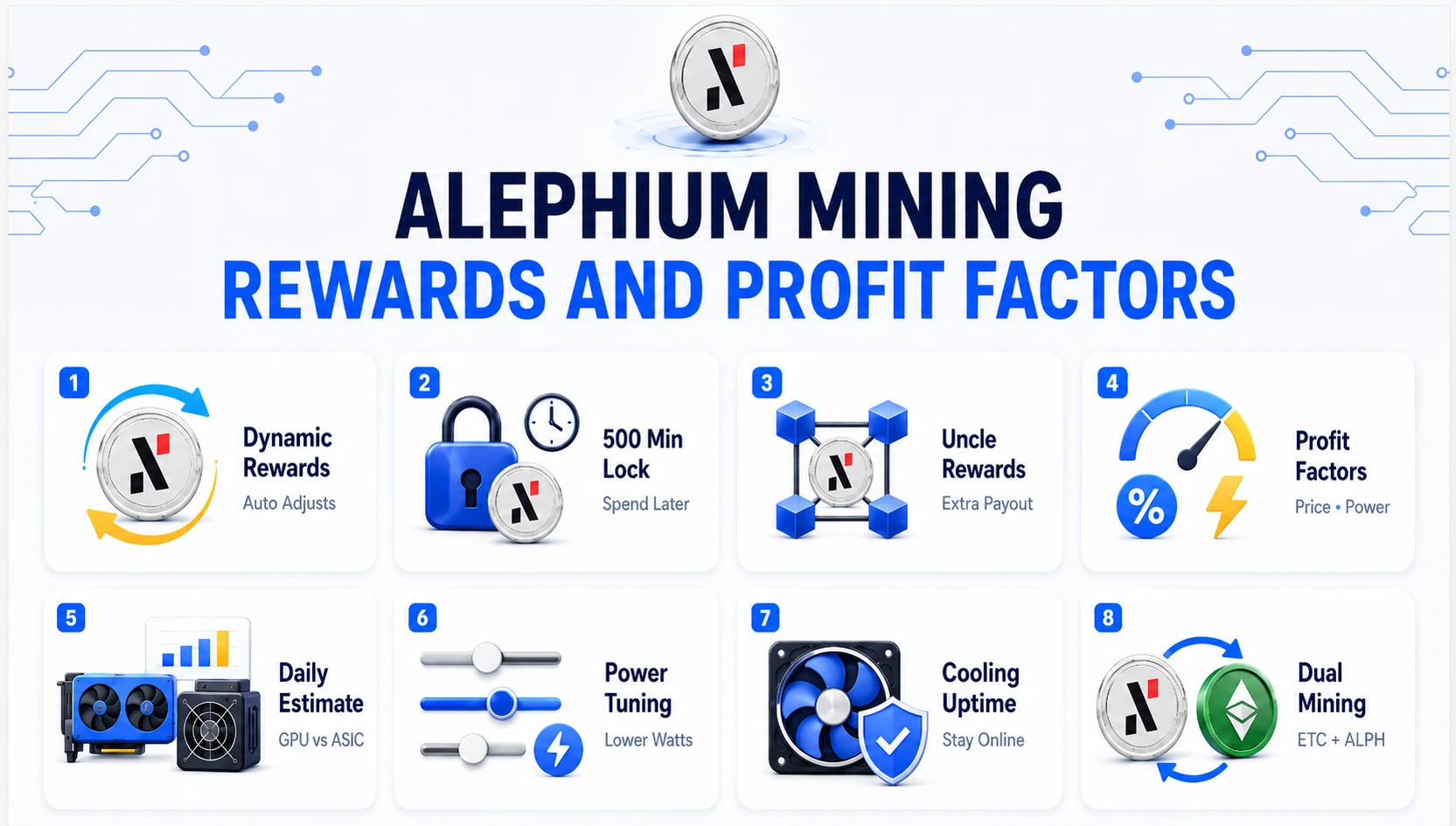
Alephium’s reward system is dynamic. The block mining reward isn’t fixed; it adjusts based on network conditions. As of early 2026, the block reward sits at approximately 0.1147 ALPH per block. With a target block time of 64 seconds across 16 parallel chains, the network produces blocks rapidly.
Key things to know about rewards:
- Mined ALPH is locked for 500 minutes, roughly 8.3 hours, before you can spend or transfer it
- Uncle blocks (blocks that don’t make it into the main chain) can also earn rewards, similar to Ethereum’s old system
- The reward calculation is tied to network difficulty and hashrate, so rewards adjust as more miners join
Profitability Factors
Your actual daily earnings depend on several variables:
| Factor | Impact |
| Your hashrate | Higher hashrate = more shares = more rewards |
| Network hashrate | Higher network hashrate = more competition |
| ALPH price | Higher price = more USD value per ALPH earned |
| Electricity cost | Lower cost = more profit |
| Pool fee | Lower fee = more profit |
| Hardware efficiency | Lower watts per GH/s = lower electricity costs |
Rough Daily Earnings Estimate (May 2026)
| Hardware | Daily ALPH (Est.) | Daily Revenue (Est. @ $0.07/ALPH) | Daily Electricity Cost (@ $0.10/kWh) |
| RTX 4070 (single GPU) | ~0.02–0.05 ALPH | ~$0.001–0.004 | ~$0.29 |
| 6x RTX 4070 rig | ~0.12–0.30 ALPH | ~$0.008–0.02 | ~$1.73 |
| IceRiver AL0 (4 TH/s) | ~0.8–1.5 ALPH | ~$0.06–0.11 | ~$2.16 |
| Antminer AL1 Pro (16.6 TH/s) | ~3.5–6 ALPH | ~$0.25–0.42 | ~$8.95 |
At current ALPH prices (~$0.07), mining profitability is tight for GPU miners. Profitability improves significantly if the ALPH price rises, electricity costs are low, or you’re using highly efficient ASIC hardware. Always calculate your break-even price before investing.
Optimizing Your Mining Setup for Better Profits
Getting your rig up and running is just the beginning. Smart miners don’t just plug in and forget; they continuously optimize. Here are the most impactful things you can do to improve your profitability.
Power Optimization (Most Important)
Electricity is your highest ongoing cost. Reducing your power draw is the single biggest lever you can pull.
For GPU miners:
- Open MSI Afterburner or NVIDIA-smi
- Reduce your GPU’s power limit to 70–80% of max
- Most GPUs lose less than 5% hashrate but 20–30% power consumption at this setting
- For the RTX 4070, dropping to ~100W from 120W while maintaining 90%+ hashrate is very achievable
For ASIC miners:
- Use eco/low-power mode if your firmware supports it
- Consider underclocking during periods of low ALPH price
- Some ASIC firmware modifications allow custom power/frequency profiles
Cooling and Uptime
Your mining hardware is only making money when it’s actually running. Downtime is lost revenue.
- Keep GPUs below 70°C ideally 60–65°C for long-term health
- Use open-air frames rather than closed cases for better airflow
- Clean dust filters every 2–4 weeks
- For ASICs, ensure you have adequate fresh air intake, ideally 25–30°C ambient temperature
- Set up monitoring software (like HiveOS, minerstat, or ASIC monitoring tools) to alert you if a rig goes offline
Mining Software Tuning
Beyond power settings, the mining software itself has tunable parameters:
- Experiment with different intensity settings in SRBMiner (–gpu-intensity)
- For NVIDIA cards, playing with memory overclock can sometimes boost the hashrate on memory-intensive workloads
- Monitor your share acceptance rate. If you’re getting lots of rejected shares, your overclock settings may be too aggressive.
Dual Mining
One underrated strategy: Alephium can be dual mined with Ethereum Classic (ETC). This means your GPU works on both algorithms simultaneously, earning rewards from both coins with minimal additional power consumption. Tools like BzMiner support dual mining and can noticeably improve your overall earnings per watt.
Common Mistakes Beginners Make And How to Avoid Them
Learning from other people’s mistakes is a lot cheaper than making your own. Here are the most common pitfalls new miners run into:
- Not calculating profitability before buying hardware: This is probably the #1 mistake. Always run the numbers on WhatToMine or Minerstat with YOUR actual electricity rate before spending money on hardware.
- Downloading miner software from unofficial sources: Malware disguised as mining software is a real threat. Only download from official GitHub repositories or pool websites. Always verify file hashes if provided.
- Ignoring electricity costs: Bitcoin miners learned this lesson the hard way during the 2022–2023 bear market. Electricity costs are fixed; crypto prices are not. Make sure you’re profitable even at lower coin prices.
- Not backing up your wallet seed phrase: If you lose your seed phrase and your wallet gets corrupted or your PC dies, your ALPH is gone forever. Store your seed phrase offline in at least two physical locations.
- Solo mining with insufficient hashrate: Solo mining sounds appealing (keeping all the reward), but with a small operation, you might not find a block for months. Join a pool until you have a significant hashrate.
- Setting up mining in a hot, poorly ventilated space: High temperatures kill hardware prematurely and can be a fire hazard. Proper ventilation is non-negotiable.
- Not monitoring your rigs: Set up remote monitoring from day one. Mining rigs can crash, overheat, or encounter issues at any time. Catching problems early saves money.
Tax and Legal Considerations for Miners
This section isn’t meant to be legal or financial advice; always consult a tax professional in your jurisdiction. But here are some general things crypto miners need to be aware of:
- In most countries, mining income is treated as ordinary income at the fair market value of the coin at the time it’s received
- When you later sell your mined ALPH, the difference between your cost basis (value at mining) and the sale price may be subject to capital gains tax.
- Keep detailed records of your mining income, including dates and ALPH values.
- Electricity costs used for mining may be deductible in some jurisdictions as a business expense.
- Several countries have specific rules about crypto mining. Check your local regulations
CONCLUSION
Mining Alephium in 2026 is genuinely interesting. It’s not the easiest money in crypto, nothing in this space ever is, but it’s one of the more technically sound and community-driven projects available to mine right now. The Blake3 algorithm is efficient, the network is growing, and the combination of GPU and ASIC support means there’s an entry point for almost every budget level.
For miners just getting started, join a pool, start with hardware you already own or can afford to use, and focus on learning before scaling up. For crypto miners who are more experienced and looking to expand, Alephium’s ASIC market is worth serious consideration, especially as ALPH’s ecosystem and DeFi applications continue to mature.
If you’re looking for quality mining hardware, community resources, and expert guidance on building your mining operation, be sure to check out Cryptominerbros. They’ve built a solid reputation as a trusted destination for both beginner and veteran miners looking for hardware, advice, and support. Whether you’re sourcing your first GPU rig or scaling up to industrial ASICs, Cryptominerbros is a resource worth bookmarking.
Mining is never a guaranteed income; the market will always have volatility, difficulty will keep climbing, and hardware will become obsolete. But for those who approach it thoughtfully and stay informed, Alephium remains one of the most compelling mining opportunities in the current landscape.
Frequently Asked Questions
-
Is Alephium still profitable to mine in 2026?
Profitability depends heavily on your electricity costs and ALPH’s market price. With very low electricity costs (under $0.06/kWh), ASIC mining can be profitable even at current prices. GPU mining is tighter but can still be viable as part of a multi-coin strategy.
-
Can I mine Alephium with just one GPU?
Yes, but your daily earnings will be very small. A single RTX 4070 contributes a tiny fraction of the network hashrate. Pool mining ensures you still get consistent micro-payouts.
-
Do I need to run a full node to mine ALPH?
No. When pool mining, your miner connects to the pool’s infrastructure. You only need to run a full node if you’re solo mining.
-
How long does it take for mining rewards to arrive?
Mined ALPH is locked for 500 minutes (~8.3 hours) before it’s spendable. Pool payouts then depend on your pool’s payment schedule, most pools pay within 24 hours of reaching the minimum threshold.
-
What wallets are supported for mining payouts?
You can mine directly to the official Alephium desktop wallet, the Alephium browser extension wallet, or even some exchange wallets that support ALPH deposits.

Join our Newsletter
Get the week’s best cryptomining content in your inbox.

Han su
Han Su is a technical analyst at CryptoMinerBros, a leading provider of cryptocurrency mining hardware. He has over 5 years of experience in the cryptocurrency industry and is an expert in mining hardware, software, and profitability analysis.
Han is responsible for the technical analysis and research on ASIC Mining at Crypto Miner Bros. He also writes in-depth blogs on ASIC mining and cryptocurrency mining, and he has a deep understanding of the technology. His blogs are informative and engaging, and they have helped thousands of people learn about cryptocurrency mining.
He is always looking for new ways to educate people about cryptocurrency, and he is excited to see how the technology continues to develop in the years to come.
In spare time, Han enjoys hiking, camping, and spending time with his family. He is also an avid reader, and he loves to learn about new things.
Similar Blogs
BTCB2 Mining and Profitability: What Current Data Suggests
What Is BTCB2 Mining? Mining BTCB2 involves using Blake2b-compatible ASIC hardware for the BTCB2 cha...
Top Profitable Blake2b Miners in 2026
Blake2b Miners Worth a Closer Look? Blake2b Miners have become the go-to choice for anyone who wants...
Bitmain Antminer Z15K Guide: Everything You Need to Know
Bitmain Antminer Z15K Worth Considering? Bitmain Antminer Z15K is one of those newer things added to... © 2018- Miner Bros Limited. All rights reserved

 EN EN
EN EN  ES
ES