



You want to mine Dogecoin, which is a smart decision. Dogecoin mining remains one of the easiest cryptocurrencies to mine, and it does not require industrial-scale equipment to start operations in 2026. Dogecoin started as a meme in 2013. Today, it has evolved into a real digital currency that people use in their daily lives, and that has attracted a dedicated international community and maintains an active mining operation. DOGE mining provides a unique opportunity because DOGE mining generates stable mining rewards through its constant block reward system, which delivers 10,000 DOGE for each block mined, and its quick block generation rate that surpasses Bitcoin’s speed.
This guide teaches complete beginners about Dogecoin mining through its explanation of mining operations, required equipment, mining pool membership, and profit optimization methods. This guide provides complete mining knowledge, which enables both newcomers and people with basic research experience to start mining operations.
What Is Dogecoin Mining?
Dogecoin mining involves people using computer systems to verify Dogecoin blockchain transactions, which results in them receiving newly minted DOGE coins as their reward. Each time a user sends 500 DOGE to a friend on the Dogecoin network, the system must authenticate that transaction and create an unchangeable record of it on the blockchain, which serves as a public database.
The process of verification work involves human miners and their machine counterparts who execute this task. Miners receive Dogecoin payments because they use their machines and power to sustain network operations. The network pays you in cryptocurrency when you deliver computing capacity to fulfill their requirements.
Why does it matter in 2026?
Dogecoin has established constant user adoption since its 2013 launch. The project began as a humorous parody of the famous Shiba Inu meme, which now operates as one of the most valuable cryptocurrencies in terms of market value. The ongoing integration of DOGE into payment systems and merchant networks results in actual operational value for the currency, which mining allows users to obtain without purchasing it through an exchange.
What makes Dogecoin mining particularly appealing for beginners:
- No maximum supply cap: The Dogecoin network maintains an unrestricted supply because it prohibits any maximum threshold, which results in perpetual Dogecoin creation and miner rewards.
- Faster block times: Dogecoin creates new blocks every 1 minute, which leads to faster reward distribution compared to Bitcoin’s 10-minute block generation time. The system provides users with immediate access to their rewards.
- Lower hardware barrier: You can begin mining operations without needing extensive ASIC equipment because the process requires only basic equipment.
- Merged mining with Litecoin: Dogecoin uses the same mining technology as Litecoin because it employs the Scrypt hashing algorithm, which enables simultaneous mining of both cryptocurrencies without additional expenses or labor requirements.
The first step to understanding crypto mining requires beginners to learn essential information about the process, according to both casual and dedicated miners.
How Dogecoin Mining Works?
Dogecoin operates through the Proof of Work system, which uses mining to validate its transactions. The system requires miners to compete against each other in solving a mathematical puzzle, which serves as the system’s security measure. The first one to solve it gets to add the next block of transactions to the blockchain and collects the block reward.
The Scrypt Algorithm
Dogecoin uses Scrypt as its algorithm, whereas Bitcoin uses the SHA-256 algorithm. Scrypt was originally designed to require more memory resources, which created difficulties for specialized chips (ASICs) to achieve dominance in the early stages of its development. Scrypt-specific ASICs have been developed as the new standard in serious mining.
Block Rewards in 2026
The block reward for Dogecoin mining will provide 10,000 DOGE per block, which will begin from 2026. Since a new block is mined roughly every minute, the following results appear:
- 600,000 DOGE are mined every hour
- 14,400,000 DOGE are mined every day
- ~5.26 billion DOGE are added to the supply every year
This is by design. Dogecoin’s annual inflation is fixed at around 5 billion DOGE per year, a feature (not a bug) that keeps mining incentives alive indefinitely, unlike Bitcoin, which halves its rewards every four years.
The Mining Process at a Glance:
- Transactions are broadcast to the Dogecoin network
- Miners bundle these transactions into a candidate block
- Miners race to solve the Scrypt puzzle
- The winner adds the block to the blockchain
- The winner receives 10,000 DOGE as a block reward
- The cycle repeats every ~60 seconds
The main point of this statement shows that both speed and hash rate measurement can affect system performance. The block reward system depends on your computational power because your chances of winning increase with higher hash rate contributions. Most beginners should use resource pooling with other crypto miners because it provides better mining results.
Dogecoin vs. Bitcoin Mining: Key Differences
Many people who enter Dogecoin mining have previous knowledge about Bitcoin. The two systems use Proof of Work mining, but they function in different ways. The following comparison will help to clarify the situation by presenting information in two separate columns.
| Feature | Dogecoin | Bitcoin |
| Algorithm | Scrypt | SHA-256 |
| Block Time | ~1 minute | ~10 minutes |
| Block Reward (2026) | 10,000 DOGE | 3.125 BTC (post-2024 halving) |
| Supply Cap | No cap (infinite) | 21 million BTC hard cap |
| Annual New Supply | ~5 billion DOGE | ~164,250 BTC |
| Mining Hardware | Scrypt ASICs / GPUs | SHA-256 ASICs |
| Merged Mining | Yes (with Litecoin) | No |
| Mining Difficulty | Lower | Extremely high |
| Entry Cost | Moderate | Very high |
| Network Hashrate | Lower | Much higher |
What Does This Mean for You?
Bitcoin miners need industrial-scale operations to be competitive. The SHA-256 ASICs, which Bitcoin miners use for their operations, become unfeasible because of their high costs, their extreme power requirements, and their strong competition from large-scale mining operations. Dogecoin demonstrates an alternative path.
The Scrypt algorithm requires less electricity because its hardware components are less expensive, yet the network operates with lower difficulty levels, which allows smaller mining operations to obtain substantial rewards through mining pools.
The most significant operational distinction exists in the fact that Bitcoin miners must compete at an industrial level for total market control. Since, as a new miner, you do not need to invest hundreds of thousands of dollars to start mining, prospectively falling victim to not knowing what creates the perfect setting of Dogecoin mining, these recent miners are bound to have high hopes of succeeding consistently.
What Do You Need to Start Mining Dogecoin?
Before you start mining Dogecoin, you must understand the required mining requirements. The procedure requires you to obtain four necessary elements, which serve as essential materials for your work.
Mining Hardware
This is your single biggest investment. Your two actual choices for 2026 are:
- ASIC Miners: Application Specific Integrated Circuits designed specifically for Scrypt mining. These mining systems deliver superior operational efficiency and power output capabilities.
- GPUs: Graphics Processing Units from your gaming PC or a dedicated rig. The systems remain operational for hobbyist mining purposes yet exhibit lower operational efficiency compared to ASIC systems.
Mining Software
You’ll need software to connect your hardware to the network or to a mining pool. Popular choices include:
- CGMiner: The software provides open-source support, which allows users to mine using ASIC hardware.
- EasyMiner: The software provides an interface that makes it easier for beginners to use.
- MultiMiner: The software offers an easy-to-use interface that assists beginners in operating various mining devices.
- CudaMiner: The software has been designed to work efficiently with NVIDIA GPU mining systems.
A Dogecoin Wallet
You need somewhere to receive your mining rewards. Options include:
- Dogecoin Core Wallet: The official full-node wallet requires users to download the complete blockchain data.
- Exodus: provides a desktop and mobile wallet solution that is easy for users to operate.
- Atomic Wallet: enables users to store various cryptocurrencies.
- Hardware wallets (Ledger and Trezor): present the most secure method for holding substantial cryptocurrency assets.
A Reliable Internet Connection and Power Supply
Mining requires a stable internet connection. Even brief outages can cause you to miss block rewards. You’ll also want:
- A reliable power supply unit (PSU) rated for your hardware’s wattage
- Adequate cooling (fans, ventilation, or even air conditioning)
- A dedicated circuit in your home if running multiple machines
A Mining Pool Account (Recommended)
Solo mining operates like a lottery system, which requires advanced hardware equipment. A mining pool allows you to share your hash rate with other cryptocurrency miners, which results in more stable but smaller earnings.
Best Hardware for Dogecoin Mining in 2026
The most significant choice new miners face requires them to select their mining equipment. The wrong choice results in higher electricity expenses, which exceed your total earnings. The following list presents the best available options at this time.
Top ASIC Miners for Dogecoin (Scrypt) in 2026
| Miner | Hash Rate | Power Consumption | Efficiency | Approx. Price |
| Bitmain Antminer L9 | 16 GH/s | 3,360W | 210 J/GH | ~$3,500 |
| Goldshell LT6 | 3.35 GH/s | 3,200W | 955 J/GH | ~$800–$1,200 |
| Bitmain Antminer L7 | 9.5 GH/s | 3,425W | 360 J/GH | ~$2,000–$2,800 |
| iPollo V1 Mini SE Plus | 400 MH/s | 240W | 600 J/GH | ~$300–$500 |
| Goldshell Mini DOGE Pro | 205 MH/s | 220W | 1,073 J/GH | ~$200–$350 |
GPU Options (Hobbyist Level)
GPUs that have lower Scrypt mining capacity than ASICs serve as a suitable starting option for users who possess a gaming PC and wish to explore mining before they purchase dedicated equipment.
| GPU | Approximate Scrypt Hash Rate | Power Draw |
| NVIDIA RTX 4070 | ~600 KH/s | ~200W |
| NVIDIA RTX 3080 | ~520 KH/s | ~320W |
| AMD RX 7900 XTX | ~580 KH/s | ~355W |
| NVIDIA RTX 4090 | ~700 KH/s | ~450W |
People who want to mine Dogecoin in 2026 should use more than GPUs because ASIC machines offer better mining profits. They serve as basic equipment for learning purposes and for people who want to mine at home, yet the Goldshell Mini DOGE Pro and iPollo V1 Mini SE Plus entry-level ASIC machines will provide users with superior energy efficiency returns.
What to Look For When Buying
- Hash Rate (GH/s or MH/s) functions as a measure of computing power, which increases with higher hash rates.
- Power Efficiency (J/GH) operates as a cost metric because lower values reduce operational expenses.
- Noise Level requires assessment for home mining operations because ASICs generate high sound levels, which typically reach 70 to 80 decibels.
- The system needs verification from authorized resellers, while third-party listings without warranty should be avoided.
Solo Mining vs. Pool Mining: Which Should You Choose?

One of the first things that generally comes up when beginners ask is about possible pools to join.
Solo Mining
Solo mining means that you conduct your mining activities without any assistance from others. Your device competes with the complete Dogecoin network in its attempt to discover the upcoming block. The complete 10,000 DOGE block reward becomes yours if you succeed in winning. If you don’t achieve success, you will receive nothing.
Pros of Solo Mining:
- Keep 100% of the block reward
- No pool fees
- Full independence
Cons of Solo Mining:
- Extremely unlikely to win unless you have an enormous hash rate
- Highly inconsistent income could go weeks or months without a reward
- Not practical for 99% of individual miners
Pool Mining
Mining pools combine the hash rate of thousands of crypto miners worldwide, dramatically increasing the collective chance of winning blocks. When the pool wins a block, the reward is split among all participants proportional to their contributed hash rate.
Pros of Pool Mining:
- Consistent, predictable earnings
- Lower variance earns small amounts regularly
- Easy to get started
- Most pools offer real-time dashboards
Cons of Pool Mining:
- Pool fees (typically 1–2%)
- You split the reward
- Is trust required in the pool operator
The Math Makes It Clear
Your mining equipment consists of one Antminer L7, which operates at a processing power of 9.5 GH/s. The Dogecoin network hash rate for 2026 is estimated to reach 1,500 TH/s, which converts to 1,500,000 GH/s. Your share of the network amounts to close to 0.00063%. The process of solo mining would lead you to discover a block after approximately 170000 minutes, which equals around 4.5 months.
In a pool, you’d earn your proportional share every single day. The math strongly favors pool mining for anyone without industrial-scale infrastructure.
Top Dogecoin Mining Pools in 2026
The correct choice of pool functions is a crucial decision for the upcoming task. The list below contains the most dependable and commonly used mining pools that Dogecoin miners will use in 2026.
| Pool Name | Fee | Min. Payout | Merged Mining | Server Locations |
| Litecoinpool.org | 0% | 0.02 LTC equivalent | Yes (LTC + DOGE) | Global |
| F2Pool | 1% | 100 DOGE | Yes | Global |
| ViaBTC | 1–4% | 100 DOGE | Yes | Global |
| Prohashing | ~2.5% | 1 DOGE | Yes | USA, Europe |
| Zpool | 0.5–2% | Variable | Yes | Global |
| AikaPool | 1% | 5 DOGE | Yes | Europe |
What to Look for in a Mining Pool:
- Fee structure: Lower fees mean more of your earnings stay with you
- Payout method: Most use PPLNS (Pay Per Last N Shares) or PPS (Pay Per Share); PPS is more predictable
- Pool hash rate: Larger pools find blocks more often, but smaller pools offer bigger individual shares per block
- Uptime and reliability: Look for pools with 99.9%+ uptime
- Merged mining: Pools that support merged mining let you earn both DOGE and LTC simultaneously
Users should begin their practice with F2Pool or Litecoinpool.org because those platforms provide excellent documentation, their interfaces are easy to navigate, and they have built a positive reputation within their user base.
Step-by-Step: How to Start Mining Dogecoin
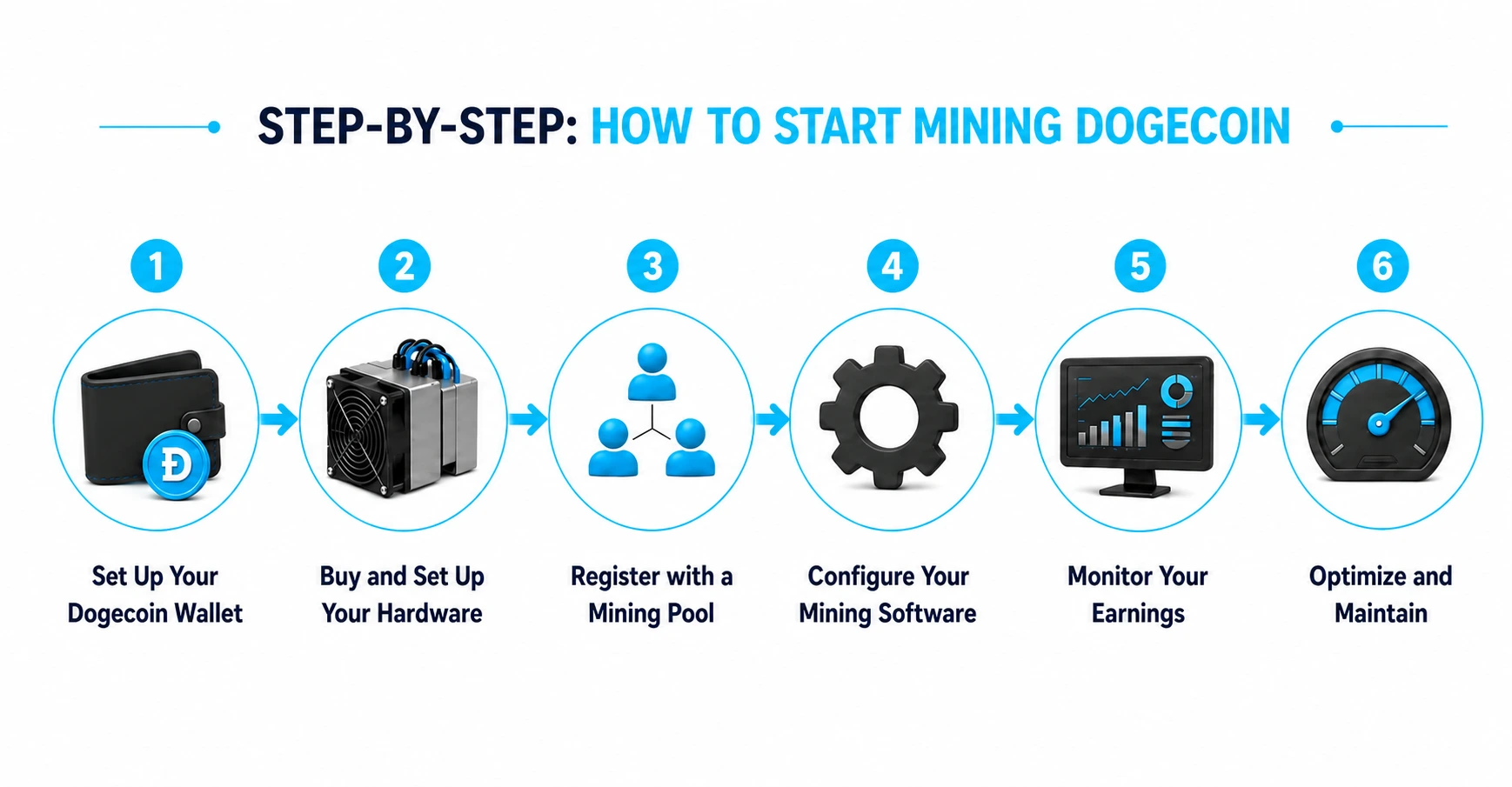
Alright, let’s get into the actual how-to. Follow these steps, and you’ll be mining Dogecoin in under an hour.
Step 1: Set Up Your Dogecoin Wallet
Before anything else, you need a wallet address to receive your mining rewards.
- Go to dogecoin.com or download Exodus or Atomic Wallet
- Create a new wallet and write down your seed phrase. Store it somewhere safe and offline
- Copy your DOGE receiving address (it starts with “D” and is case-sensitive)
Step 2: Buy and Set Up Your Hardware
If using an ASIC:
- Purchase from a verified retailer (check the manufacturer’s official website)
- Connect the miner to your router via an Ethernet cable (not Wi-Fi)
- Plug into your power supply and switch on
- Access the miner’s web interface (usually via its local IP address, check your router admin panel)
If using a GPU rig:
- Install your GPU(s) and ensure drivers are up to date
- Download your chosen mining software (e.g., CGMiner or EasyMiner)
Step 3: Register with a Mining Pool
- Go to your chosen pool (e.g., f2pool.com)
- Create an account with your email
- Navigate to the Dogecoin (or Litecoin/Scrypt) section
- Note the pool’s stratum address and port number (e.g., stratum+tcp://doge.f2pool.com:3333)
Step 4: Configure Your Mining Software
For ASIC miners (via web interface):
- Log in to the miner’s local dashboard
- Go to the “Miner Configuration” or “Pool Settings” section
- Enter:
- Pool URL: e.g., stratum+tcp://doge.f2pool.com:3333
- Worker Username: your pool username + worker name (e.g., YourUsername.worker1)
- Password: usually just x or 123
- Save and restart the miner
For CGMiner (GPU):
cgminer -o stratum+tcp://doge.f2pool.com:3333 -u YourUsername.worker1 -p x –scrypt
Step 5: Monitor Your Earnings
- Log in to your pool dashboard
- Check your hash rate, shares submitted, and estimated earnings
- Set your payout address to your DOGE wallet address from Step 1
- Set a minimum payout threshold (lower = more frequent, smaller payments)
Step 6: Optimize and Maintain
- Monitor temperatures, keep ASICs below 85°C, and GPUs below 80°C
- Check earnings daily for the first week
- Join the pool’s community forums or Discord for tips
- Consider overclocking cautiously once you’re comfortable with the basics
Dogecoin Mining Profitability: What to Expect
Let’s talk numbers. Profitability depends on four key variables: your hash rate, your hardware’s power consumption, your electricity cost, and the current price of DOGE.
Key Variables
| Variable | Impact |
| Hash Rate | Higher = more earnings |
| Electricity Cost (per kWh) | Lower = more profit |
| DOGE Price | Higher = more USD value per mined DOGE |
| Pool Fee | Lower = more of your earnings stay with you |
| Mining Difficulty | Changes daily based on the total network hash rate |
Sample Profitability Estimates (2026)
Assuming DOGE price of approximately $0.35, electricity cost of $0.08/kWh:
| Hardware | Daily DOGE Earned | Daily Revenue (USD) | Daily Power Cost | Daily Profit |
| Antminer L9 (16 GH/s) | ~850 DOGE | ~$297 | ~$6.45 | ~$290 |
| Antminer L7 (9.5 GH/s) | ~500 DOGE | ~$175 | ~$6.57 | ~$168 |
| Goldshell LT6 (3.35 GH/s) | ~175 DOGE | ~$61 | ~$6.14 | ~$55 |
| iPollo V1 Mini SE Plus (400 MH/s) | ~21 DOGE | ~$7.35 | ~$0.46 | ~$6.89 |
| GPU Rig (3x RTX 4070) | ~3 DOGE | ~$1.05 | ~$1.15 | ~-$0.10 |
Important Disclaimer: These are estimates. DOGE price is volatile, mining difficulty changes daily, and electricity rates vary widely. Always run your own numbers using a current mining calculator like WhatToMine.com or CoinWarz before purchasing hardware.
Break-Even Analysis
The big question: how long until your hardware pays itself off?
| Hardware | Approx. Cost | Daily Profit | Est. Break-Even |
| Antminer L9 | $3,500 | ~$290 | ~12 days |
| Antminer L7 | $2,400 | ~$168 | ~14 days |
| Goldshell LT6 | $1,000 | ~$55 | ~18 days |
| iPollo V1 Mini SE | $400 | ~$6.89 | ~58 days |
These numbers look attractive, but always factor in market volatility. If DOGE drops 50%, those daily profits drop proportionally, too.
Common Mistakes Beginners Make
Learning from other people’s mistakes is always smarter than learning from your own. Here are the most common pitfalls new Dogecoin miners run into.
Mistake 1: Buying Hardware Without Calculating Profitability First
Too many beginners buy a shiny new ASIC without running the numbers. Always use a profitability calculator and factor in your specific electricity cost, not a generic rate.
Mistake 2: Using Wi-Fi Instead of Ethernet
ASICs need a stable, low-latency connection. Wi-Fi introduces packet loss and latency, both of which hurt your submitted shares. Always use a wired Ethernet connection.
Mistake 3: Ignoring Heat and Ventilation
Heat is the enemy of hardware longevity. Running your miner in a hot, enclosed space will degrade components quickly. Invest in proper ventilation from day one.
Mistake 4: Not Securing Their Wallet
Losing your seed phrase means losing your DOGE permanently. No one can recover it for you, not the wallet provider, not the Dogecoin foundation, not anyone. Write it down. Store it offline. Keep a backup.
Mistake 5: Choosing a Pool Based Only on Size
Bigger pools find blocks more often, but they also split rewards among more participants. A medium-sized pool can sometimes offer better payout consistency for smaller miners. Compare pool fees and payout structures carefully.
Mistake 6: Not Accounting for Hardware Depreciation
Mining hardware loses value over time. The resale value of your ASIC 18 months from now will be significantly lower than what you paid. Factor this into your profitability projections.
Mistake 7: Mining Solo with Low Hash Rate
This is essentially buying lottery tickets. Unless your hash rate represents at least 0.1% of the total network, you will almost certainly do better in a pool.
Tips to Maximize Your Mining Earnings
Now for the good stuff: practical strategies to squeeze more DOGE out of your setup.
Tip 1: Enable Merged Mining
Since Dogecoin uses the Scrypt algorithm, you can mine it simultaneously with Litecoin at no extra cost. Most major pools support merged mining. Enabling it means you’re earning LTC on top of your DOGE rewards, essentially free extra income.
Tip 2: Time Your Electricity Usage
If you’re in a region with time-of-use electricity pricing, schedule your most intensive mining during off-peak hours when rates are lower. In some markets, this can reduce your power costs by 30–40%.
Tip 3: Keep Firmware Updated
Mining hardware manufacturers regularly release firmware updates that improve efficiency and stability. Check for updates monthly and apply them during low-activity periods.
Tip 4: Join the Mining Community
Forums like Reddit’s r/dogecoinmining, Discord servers, and dedicated Telegram groups are goldmines of real-world advice. Experienced miners share pool performance data, hardware tips, and early warnings about network changes.
Tip 5: Reinvest Strategically
Consider a strategy where you sell a portion of mined DOGE to cover electricity costs and reinvest the remainder either by buying more hardware or holding DOGE for potential price appreciation.
Tip 6: Use a Mining Profitability Tracker
Set up regular profitability check-ins using tools like:
- WhatToMine.com: Enter your hardware specs and electricity cost for real-time estimates
- CoinWarz: Compares profitability across multiple coins
- NiceHash Calculator: Good for estimating GPU mining returns
Tip 7: Underclock for Efficiency (GPUs)
If you’re using GPUs, experiment with underclocking. Reducing GPU clock speed by 10–15% while maintaining most of the hash rate can dramatically lower power consumption and heat output, improving your profit margin.
Tip 8: Keep Detailed Records
For tax purposes and personal tracking, keep a record of every payout, its date, and the DOGE price at the time. In most jurisdictions, mined cryptocurrency is considered taxable income at fair market value on the date received.
Is Dogecoin Mining Still Worth It in 2026?
Fair question, and the answer depends on your situation, your goals, and your risk tolerance.
The Case FOR Mining Dogecoin in 2026
- Consistent block rewards: 10,000 DOGE per block with no halving schedule means stable miner incentives
- Growing ecosystem: DOGE acceptance by merchants and platforms has grown significantly
- Lower entry barrier: Compared to Bitcoin miners, who need industrial infrastructure, Dogecoin is accessible
- Merged mining bonus: Earning LTC simultaneously makes the economics more attractive
- Community and longevity: Dogecoin has survived and thrived for over a decade; it’s not going away
The Case AGAINST Mining Dogecoin in 2026
- Electricity costs: High energy prices in some regions can make mining unprofitable
- Market volatility: A 40% drop in DOGE price turns profitable operations into money losers
- Increasing difficulty: As more miners join the network, individual shares get smaller.
- Hardware depreciation: Your ASIC will be worth less in 18 months than it is today
The Bottom Line
For people with access to cheap electricity (under $0.07/kWh), mid-range ASIC hardware, and a reasonable risk tolerance, Dogecoin mining in 2026 remains a viable and potentially lucrative activity. For people in high-cost electricity regions relying only on GPU hardware, the math is tighter, but merged mining and smart pool selection can help.
The key is to go in with realistic expectations, do the math honestly, and treat mining as a long-term activity rather than a get-rich-quick scheme.
Cloud Mining Dogecoin: Is It Worth It?
Not everyone wants to deal with hardware, heat, noise, and electricity bills. That’s where cloud mining comes in, and in 2026, it’s become a legitimate alternative worth understanding before you dismiss it or dive in headfirst.
What Is Cloud Mining?
Cloud mining lets you rent hashing power from a remote data center operated by a third-party company. Instead of buying and running your own ASIC miner, you pay a provider a fee either upfront or as a percentage of earnings, and they mine Dogecoin on your behalf. Your rewards get deposited directly into your wallet.
Think of it like renting a plot in a solar farm instead of putting panels on your own roof. You get the output without managing the infrastructure.
How Dogecoin Cloud Mining Works
- You sign up with a cloud mining provider
- You purchase a hashing power contract (e.g., 100 MH/s for 12 months)
- The provider points out that the rented hash rate at a Dogecoin mining pool
- DOGE earnings are credited to your account daily or weekly
- You withdraw to your personal wallet at any time
It sounds simple, and it can be. But it also comes with real risks that every beginner needs to understand.
Cloud Mining vs. Traditional Mining: A Comparison

| Factor | Cloud Mining | Traditional Mining |
| Upfront Cost | Low to moderate (contract fee) | High (hardware purchase) |
| Technical Knowledge Required | Minimal | Moderate to high |
| Hardware Maintenance | No provider handles it | Your responsibility |
| Electricity Costs | Included in contract | Paid separately |
| Profitability Control | Limited | Full control |
| Flexibility | Contract-bound | Can stop anytime |
| Risk of Scam | Higher | Lower (hardware is tangible) |
| Potential Returns | Lower | Higher (if managed well) |
Top Legitimate Cloud Mining Platforms for DOGE in 2026
The cloud mining space has historically been riddled with scams. However, a handful of platforms have built real reputations over time. Here are some that are worth researching:
- NiceHash: Primarily a hash rate marketplace; allows renting and selling Scrypt power
- ECOS: Offers Scrypt contracts with transparent calculator tools
- Hashflare (legacy): Check current operational status before committing
- StormGain: Cloud mining integrated into a trading platform
Important Warning: Always research any cloud mining provider thoroughly before paying. Look for verifiable physical data centers, transparent fee structures, independent reviews, and a proven withdrawal history. If a provider promises guaranteed profits with no risk, walk away. That’s a red flag every time.
Pros of Cloud Mining Dogecoin
- No noise or heat: Perfect for apartment dwellers or people without dedicated space
- No electricity overhead: Costs are baked into the contract
- No hardware sourcing headaches: No waiting on shipping or dealing with customs
- Accessible from anywhere: Manage your mining from a phone or laptop
- Good for testing: Want to understand how mining works without buying hardware? Cloud mining is a low-friction entry point
Cons of Cloud Mining Dogecoin
- Lower profit margins: Provider fees eat into your returns significantly
- Scam risk: The cloud mining industry has a long history of fraudulent operations and Ponzi schemes
- No hardware asset: If the provider shuts down, you have nothing to show for your investment
- Contract lock-in: Most contracts run 6–24 months; you can’t exit early if the DOGE price drops
- Limited transparency: You’re trusting the provider to actually mine on your behalf
Should You Choose Cloud Mining?
Cloud mining is best suited for people who want passive exposure to Dogecoin mining without the commitment of physical hardware. It’s not the most profitable path. Traditional ASIC mining almost always beats cloud mining on returns when managed well, but it’s a reasonable starting point if you’re cautious about upfront investment or simply lack the space and technical setup for physical miners.
The golden rule: only use platforms with a verifiable track record, never invest more than you can afford to lose, and always withdraw your earnings regularly rather than letting them accumulate on the provider’s platform.
For serious, long-term miners, physical hardware will always be the stronger choice. But for curious beginners testing the waters, cloud mining offers a low-barrier entry into the Dogecoin mining world.
CONCLUSION
Dogecoin mining in 2026 is one of the most accessible entry points into the world of cryptocurrency mining. With a fixed block reward of 10,000 DOGE, faster block times than Bitcoin, the ability to merge-mine with Litecoin, and a wide range of affordable ASIC hardware, DOGE has carved out a unique space in the mining ecosystem that genuinely works for individuals, not just mining conglomerates.
If you’re serious about building a Dogecoin mining operation, whether you’re setting up a single machine at home or scaling to a small farm, having the right hardware from a trusted source is everything. That’s where Cryptominerbros comes in. They specialize in sourcing, verifying, and supplying crypto mining hardware for all levels of miners, from first-time hobbyists to professional-scale operations. With expert guidance, competitive pricing, and a reputation built on reliability, Cryptominerbros is a go-to resource for anyone ready to take their mining journey seriously.
The Doge community is welcoming, the mining ecosystem is active, and the potential rewards are real. Do your homework, run your numbers, and get started.
Frequently Asked Questions
-
Is Dogecoin mining profitable in 2026?
Yes, Dogecoin mining can be profitable in 2026, especially with an efficient Scrypt ASIC and low electricity costs. Running your numbers through a profitability calculator before investing in hardware is strongly recommended.
-
What is the best hardware to mine Dogecoin in 2026?
The Bitmain Antminer L9 and Antminer L7 are currently the top-performing ASIC miners for Dogecoin in 2026. For beginners on a budget, the iPollo V1 Mini SE Plus offers a solid entry point with a lower upfront cost.
-
Can I mine Dogecoin and Litecoin at the same time?
Yes, since both coins use the Scrypt algorithm, you can merge-mine DOGE and LTC simultaneously without any extra hardware or electricity cost. Most major mining pools like F2Pool and Litecoinpool.org support merged mining by default.

Join our Newsletter
Get the week’s best cryptomining content in your inbox.

Han su
Han Su is a technical analyst at CryptoMinerBros, a leading provider of cryptocurrency mining hardware. He has over 5 years of experience in the cryptocurrency industry and is an expert in mining hardware, software, and profitability analysis.
Han is responsible for the technical analysis and research on ASIC Mining at Crypto Miner Bros. He also writes in-depth blogs on ASIC mining and cryptocurrency mining, and he has a deep understanding of the technology. His blogs are informative and engaging, and they have helped thousands of people learn about cryptocurrency mining.
He is always looking for new ways to educate people about cryptocurrency, and he is excited to see how the technology continues to develop in the years to come.
In spare time, Han enjoys hiking, camping, and spending time with his family. He is also an avid reader, and he loves to learn about new things.
Similar Blogs
Goldshell SC5 Pro Review: Profitability and Buying Guide
Is the Goldshell SC5 Pro worth buying? Check its latest price, profitability, resale value, key risk...
Why Is Zcash Mining Getting More Competitive?
Zcash Mining: Why Is It Getting More Attention? Zcash mining has turned into one of the more talked-...
BTCB2 Mining and Profitability: What Current Data Suggests
What Is BTCB2 Mining? Mining BTCB2 involves using Blake2b-compatible ASIC hardware for the BTCB2 cha... © 2018- Miner Bros Limited. All rights reserved

 EN EN
EN EN  ES
ES