


SUMMARY
If you’ve been keeping up with crypto news lately, you might’ve caught yourself wondering the same thing at least once, like how long does it really take to mine one Bitcoin in 2026? On the surface, it seems easy, but the truth is, it depends. And in a guide like this, we’re going to sort through that answer in a pretty detailed way, step by step, so it feels clearer.
Mining Bitcoin in 2026 really looks different from what it did a few years back. After the April 2024 halving, where the block rewards got chopped down, and the network hashrate started smashing through record highs earlier this year, the whole game has shifted a lot. So whether you’re thinking about running a home mining setup or building up something more commercial, you’ll want to understand the time and cost first, before you drop even a single dollar.
What Is Bitcoin Mining, and Why Does Time Matter?
Before we jump into the numbers, let’s get the basics straight. Bitcoin mining is basically how new Bitcoin transactions are checked and then added to the public ledger, which people call the blockchain. Miners use specialized computers, and they’re basically trying to crack hard mathematical puzzles, with no real shortcuts. The first miner who solves it gets to append the next block to the chain, and in return, they get a payout for that win.
As of 2026, that reward sits at 3.125 BTC per block, plus whatever transaction fees are bundled inside the block. In typical conditions, those fees usually account for something like 10–15% of the miner’s revenue, but they can jump up to 20–30% when the network gets congested, and everything starts stacking up.
Here’s the thing, though: the Bitcoin network is set up so that a new block is found roughly every 10 minutes. That’s not the time it takes you, personally, to “mine” one Bitcoin. It’s more like the time it takes the entire worldwide network with hundreds of thousands of machines, all pushing and racing at the same time, to manage to locate a single block. And the share of that reward you end up walking away with depends completely on how much computational power you’re bringing to the table, really on the table.
So when people ask, “How long does it take to mine one Bitcoin ?” What they’re kinda really asking is, with my setup, my power bill, and whatever the network is doing right now, how long before I end up with 1 BTC from mining rewards? Like, not just the time it runs, but the actual stretch until 1 Bitcoin shows up in my earnings, you know.
That’s the number we’re going to help you calculate.
The Short Answer: It Varies Wildly
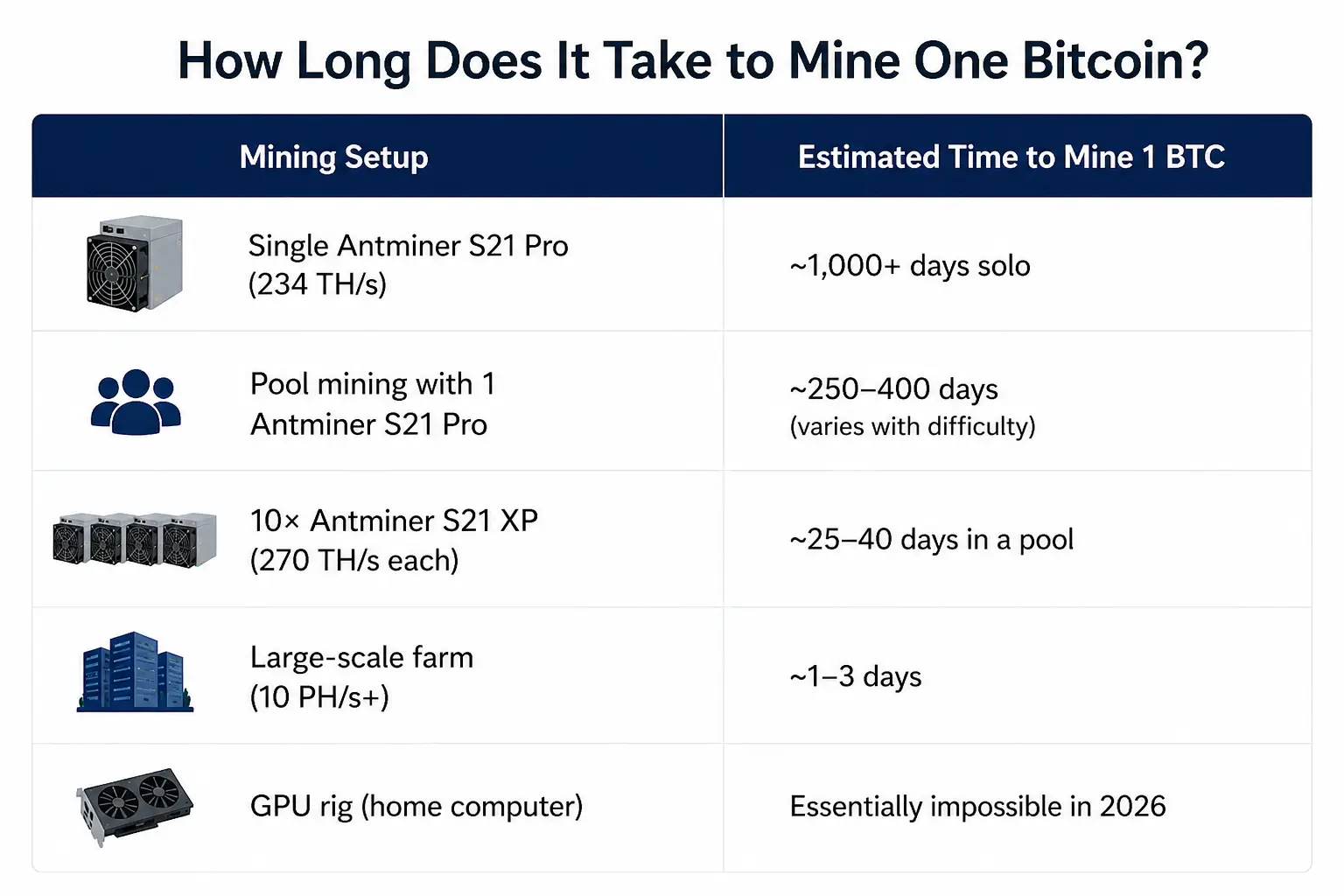
Here’s a quick snapshot before we dive deep:
| Mining Setup | Estimated Time to Mine 1 BTC |
| Single Antminer S21 Pro (234 TH/s) | ~1,000+ days solo |
| Pool mining with 1 Antminer S21 Pro | ~250–400 days (varies with difficulty) |
| 10× Antminer S21 XP (270 TH/s each) | ~25–40 days in a pool |
| Large-scale farm (10 PH/s+) | ~1–3 days |
| GPU rig (home computer) | Essentially impossible in 2026 |
As you can see, the range is enormous, like it really goes wide. A solo miner with just one ASIC could, in theory, sit around for years before they ever snag 1 full BTC. But a big commercial setup with petahashes of power could flip that, and do it in days. The main levers are basically your hashrate, your mining approach (solo versus pool), and also where the network difficulty is sitting at that exact moment, right then.
Understanding Bitcoin’s Network Difficulty in 2026
Network difficulty is probably the biggest thing, not only really great, but also the main factor in how long it takes to mine Bitcoin. It’s a number that adjusts automatically about every 2,016 blocks, roughly every two weeks, to keep the block time sitting near 10 minutes no matter what the current miner activity looks like.
When more miners jump in, blocks are found faster, right away. So the difficulty level climbs, to sort of slow the pace back down. If miners leave, or get shut off because of bad weather, as it happened with Texas miners in the 2026 winter storms, then blocks start dragging. After that, the difficulty drops, giving the miners who are still online a chance to breathe a bit.
Here’s where things stand right now in 2026:
- The present Bitcoin mining difficulty is approximately 136.61 T (as of May 2026, the day after).
- The next adjustment to the difficulty is expected to occur around 30 May 2026, with a slight upward shift to be expected.
- Network hashrate reached a peak of one Zettahash (ZH/s) in early 2026. Then, it hit all-time highs.
- There was a dramatic temporary decline in the winter of January 2026, when winter storms hit Texas, and then it recovered.
The difficulty number tells you how hard it is to track down the next block. When it’s higher, you end up with more computational labor, and yeah, so more time is required per block, too. For individual miners, a greater difficulty simply means fewer rewards per terahash, and this in turn stretches out the time needed to gather 1 full BTC.
How Difficulty Adjustments Work
The algorithm for adjusting difficulty is extremely simple. Every 2016 block, the internet reviews whether those blocks came in earlier or later than anticipated. If it’s faster (meaning that too many mining workers are online), the difficulty increases. If the speed is slower (meaning the miners left), then the difficulty drops. The goal will always be 10 mins per block.
This self-correcting mechanism is kind of what makes Bitcoin so resilient, right? It implies that even when major hashrate events roll in like a halving, a market crash, or that Texas ice storm situation, the network still ends up finding its equilibrium. For miners, it also means your anticipated earnings are moving all the time, so real-time tracking becomes essential.
Current Bitcoin Block Reward and What It Means for Your Earnings
So as said, the current block reward is 3.125 BTC per block, yeah. That situation has been going on since the April 2024 halving, when it got cut from 6.25 BTC. The subsequent halving is scheduled for around April 2028, and then the reward should fall to 1.5625 BTC.
Here’s the key thing to understand: when you mine in a pool (and most miners do that), you don’t just get 3.125 BTC right away, in one go. Instead, you receive a proportional part of that reward, kind of based on how much hashrate you personally contributed toward finding the block. So if your one little miner is only putting in 0.001% of the pool’s overall hashrate, then you’ll earn about 0.001% of every block reward that the pool finds.
Breaking down current block reward economics:
- Block subsidy: 3.125 BTC (fixed until 2028)
- Transaction fees: Variable; roughly 10–15% of total block value under normal conditions
- Total block value (estimated): Approximately 3.4–3.6 BTC at current fee levels
- Hashprice: About $27.89 for each PH/s per day, kinda near the all-time lows in early 2026
- Circulating supply: More than 20.01 million BTC out there already, it even crossed the 20M mark in March 2026
- Remaining supply: Under roughly 987,000 BTC still left to be mined
In the 2026 low hash price environment, it feels like one of the toughest profitability stretches on record. And that’s kinda the big reason why serious operators keep their heads down on energy costs and hardware efficiency, more than the whole raw expansion idea, you know.
Mining Hardware in 2026: What Are Miners Actually Using?
The hardware you use is the most controllable variable in how fast you can mine Bitcoin, honestly. Let’s look at what’s available right now, and what sort of performance you can expect in real life.
Top ASIC Miners in 2026
| Miner Model | Hashrate | Power Draw | Efficiency | Best For |
| Antminer S21 XP | 270 TH/s | 3,645 W | 13.5 J/TH | Large farms, efficiency-focused |
| Antminer S21 Pro | 234 TH/s | 3,510 W | 15.0 J/TH | Best all-around pick |
| Antminer S21 XP Hyd | 473 TH/s | 5,676 W | 12.0 J/TH | Hydro-cooled commercial setups |
| Antminer S21 XP+ Hyd (500T) | 500 TH/s | ~5,500 W | ~11.0 J/TH | Peak efficiency immersion setups |
| Antminer S21e XP Hyd 3U | 860 TH/s | N/A | N/A | Highest raw hashrate available |
| Antminer S21 (base) | 200 TH/s | 3,500 W | 17–18 J/TH | Budget-conscious operators |
| Fluminer T3 | 115 TH/s | ~1,700 W | 14.8 J/TH | Home/residential mining |
| Avalon A15 Pro | 221 TH/s | ~3,315 W | 15.0 J/TH | Alternative to the Bitmain lineup |
The most efficient air-cooled mining setup you can buy right now is the Antminer S21 XP, and it sits at about 13.5 J/TH. If you go with an immersion-cooled setup, the S21 XP+ Hyd takes things further, roughly landing at 11 J/TH, basically the cheapest power cost per terahash you’ll find on the market today.
Why Efficiency (J/TH) Matters More Than Hashrate Alone
Here’s a concept that kinda trips up a lot of new miners. A bigger hashrate feels like it should be better, right? Not always. The thing that really matters for profitability, and so also how long it takes to mine 1 BTC cost-effectively, is not just speed but the electricity you’re burning per terahash of work.
Think of it like this: your Bitcoin earnings tend to scale with hashrate, but your electricity bill scales with watts. If you’re paying around $0.07 per kWh and you run a 3,500W machine, then you’re basically spending about $5.88 per day just on the power. Whether that makes sense depends entirely on how much BTC that machine earns each day, which ties right back to network difficulty and hash price.
For home miners, efficiency is especially critical. A machine like the Fluminer T3 was purpose-built for residential use at just 40–55 dB noise and 14.8 J/TH. Not the fastest machine, but designed to survive in a home setting without melting your power bill or waking up your family at 3 am.
Solo Mining vs. Pool Mining: Which Is Faster?
This is one of the most common questions for basically anyone starting, so. Let’s break it down and be honest about it a bit.
Solo Mining
With solo mining, you kind of aim your hardware right at the Bitcoin network, and then you try to snag a block all by yourself. If you end up finding one, then yeah, you take the full 3.125 BTC payout. If you don’t, you get zero, nada, nothing really.
The numbers here are pretty harsh for smaller operators. Like, with one Antminer S21 Pro at about 234 TH/s, and the network sitting around 800–1,000 EH/s (so roughly 800,000,000–1,000,000,000 TH/s), your slice of the total hashrate is near 0.0000000234%. That share is so tiny that the chances of you landing a block in a single 10-minute window feel basically unreal.
So, in real-life terms, a solo miner running just that one S21 Pro might wait decades before a block shows up. It’s not just “somewhat random”, it’s more like a lottery ticket you keep buying, except the drawing never comes.
Pool Mining
Pool mining is a kind of mining where miners merge their computational power, also known as hashrate, so they can raise the odds as a group of landing a block. And when the pool actually wins one, the rewards get portioned out to each participant, roughly in line with how much hashrate they contributed, not just randomly.
This produces steady, predictable income rather than giant occasional payouts. For almost every miner in 2026, from home operators to commercial farms, pool mining is the standard approach.
Key things to know about pool mining in 2026:
- The two largest pools currently control roughly 50–55% of the total network hashrate
- Pool fees typically range from 1% to 2.5% of earnings
- Payout methods vary: PPS (Pay Per Share) gives consistent daily income; PPLNS (Pay Per Last N Shares) can yield higher returns in active mining periods
- Most miners monitor pool performance daily and switch if a pool’s luck runs consistently low
Comparison Table: Solo vs. Pool Mining
| Factor | Solo Mining | Pool Mining |
| Payout frequency | Rare (could be never) | Daily or weekly |
| Income predictability | Very low | High |
| Full block reward | Yes, if you find a block | Proportional share |
| Setup complexity | Lower | Slightly higher (requires pool account) |
| Best for | Lottery-style risk-takers | Serious miners wanting steady returns |
| Realistic for home miners? | No | Yes |
How Long Does It Actually Take? Real-World Calculations
Let’s do some real math. We’ll use current difficulty (~136 T), current block reward (3.125 BTC), and assume pool mining with a 1% fee.
Formula for Estimated Time to Mine 1 BTC
The rough formula is:
Days to mine 1 BTC = (1 BTC ÷ Daily BTC earnings)
And:
Daily BTC earnings = (Your Hashrate ÷ Network Hashrate) × Blocks per day × Block reward × (1 − pool fee)
Blocks per day = 144 (6 per hour × 24 hours)
Time Estimates by Setup (Pool Mining, May 2026)
| Setup | Hashrate | Est. Daily BTC Earnings | Est. Days to Mine 1 BTC |
| 1× Antminer S21 Pro | 234 TH/s | ~0.0022 BTC | ~455 days |
| 1× Antminer S21 XP | 270 TH/s | ~0.0025 BTC | ~400 days |
| 5× Antminer S21 Pro | 1,170 TH/s | ~0.011 BTC | ~91 days |
| 10× Antminer S21 XP | 2,700 TH/s | ~0.025 BTC | ~40 days |
| 100× Antminer S21 XP | 27 PH/s | ~0.25 BTC | ~4 days |
| 1,000× Antminer S21 XP | 270 PH/s | ~2.5 BTC | ~0.4 days |
Estimates are approximations based on current network conditions and are subject to change with difficulty adjustments and BTC price.
Keep in mind these are gross estimates. You also need to subtract electricity costs to get your actual net profitability. A machine earning 0.0025 BTC per day might be running at a loss if electricity costs exceed the dollar value of that Bitcoin.
The Role of Electricity Cost in Mining Time (and Profitability)
Here’s something a lot of guides skip over: the time it takes to profitably mine 1 BTC is longer than the time it takes to technically mine 1 BTC. Why? Because if your electricity costs exceed your earnings, you’re mining at a loss, meaning the real-world cost of acquiring 1 BTC through mining is actually higher than just buying it on an exchange.
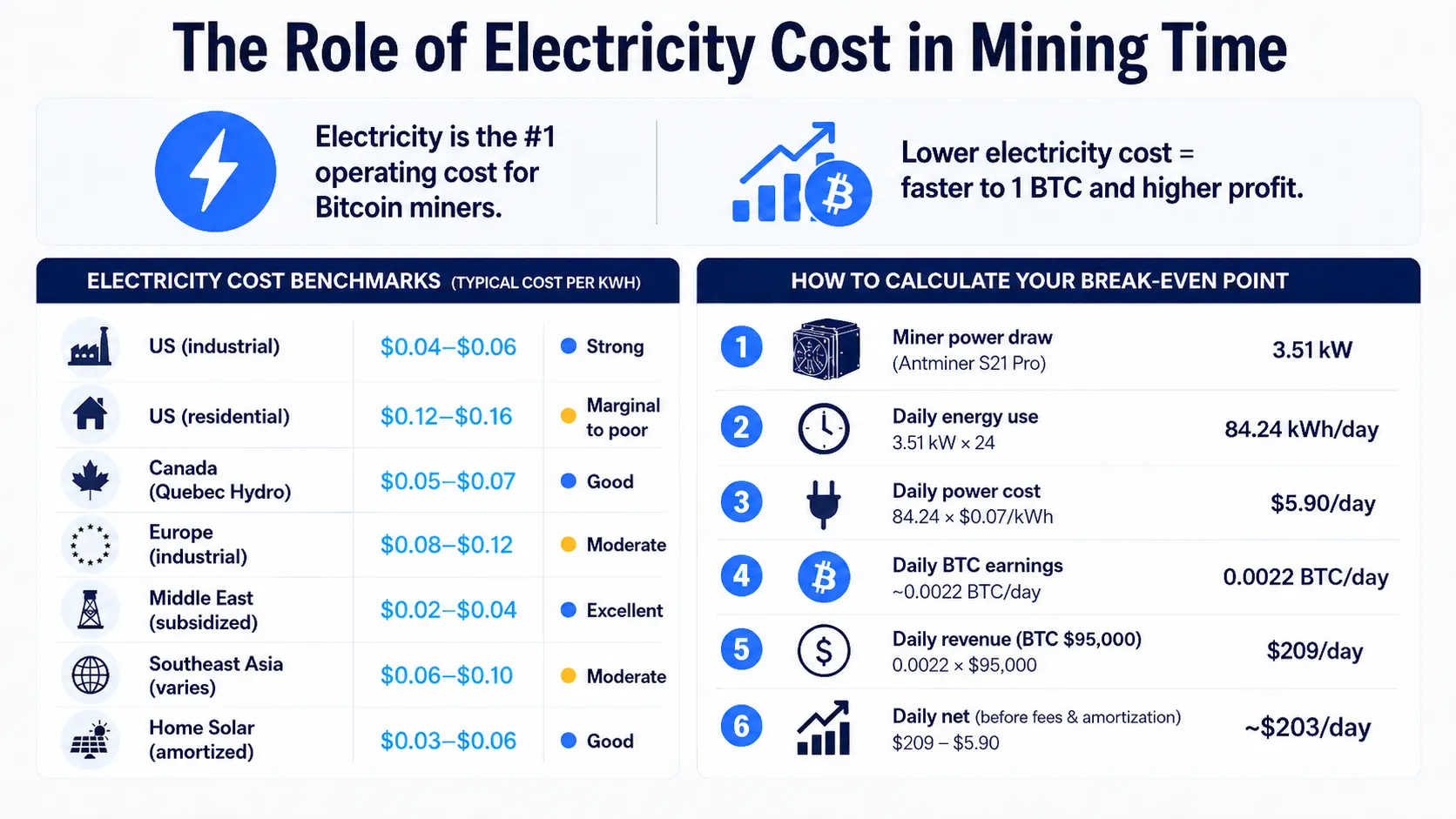
Electricity is the #1 operating cost for Bitcoin miners. In 2026, with hash price near all-time lows, energy sourcing has become the defining competitive advantage.
Electricity Cost Benchmarks
| Region / Source | Typical Cost per kWh | Mining Viability |
| US (industrial rate, Texas) | $0.04–$0.06 | Strong |
| US (residential average) | $0.12–$0.16 | Marginal to poor |
| Canada (Quebec Hydro) | $0.05–$0.07 | Good |
| Europe (industrial) | $0.08–$0.12 | Moderate |
| Middle East (subsidized) | $0.02–$0.04 | Excellent |
| Southeast Asia (varies) | $0.06–$0.10 | Moderate |
| Home solar (amortized) | $0.03–$0.06 | Good if managed well |
If you’re paying normal residential electricity rates in a lot of the US or Europe, trying to mine a full Bitcoin solo at home in 2026 will probably end up costing more for power than what the Bitcoin itself is worth. You’d need either really cheap electricity or gear that is very efficient (or honestly both) to be ahead in the end.
Step-by-Step: How to Calculate Your Break-Even Point
- Find your miner’s power draw (e.g., Antminer S21 Pro = 3,510 W = 3.51 kW)
- Multiply by 24 hours to get daily kWh: 3.51 × 24 = 84.24 kWh/day
- Multiply by your electricity rate (e.g., $0.07/kWh): 84.24 × $0.07 = $5.90/day in power costs
- Estimate your daily BTC earnings (from the table above): ~0.0022 BTC/day
- Convert to USD at current BTC price (say, $95,000): 0.0022 × $95,000 = $209/day in gross revenue
- Subtract power costs: $209 − $5.90 = ~$203/day net (before hardware amortization and pool fees)
At that rate, you’d accumulate 1 BTC (gross earnings) in about 455 days, but your net profit after costs would represent a solid return at these power rates. The math changes dramatically if your electricity rate is $0.15+/kWh instead of $0.07.
Step-by-Step: How to Start Mining Bitcoin in 2026
Whether you’re setting up a home rig or planning a small farm, here’s a practical roadmap:
Step 1: Choose Your Hardware. Pick a miner based on your budget and electricity situation. For most people starting in 2026, the Antminer S21 Pro is the sweet spot: excellent efficiency, widely available, and well-documented support. If you’re in a residential setting, look at the Fluminer T3 for quieter, lower-power operation.
Step 2: Secure Your Power Supply. Before buying hardware, confirm your electrical setup can handle the load. A single S21 Pro draws 3,510W, which is nearly 15 amps at 240V. Most home setups will need a dedicated 20-amp circuit at a minimum, and a licensed electrician to install it safely.
Step 3: Set Up Cooling and Ventilation ASIC miners run hot. They push out enormous amounts of warm air and need constant airflow. Plan your placement around this. Garages, basements, or purpose-built enclosures work well. Without proper cooling, your hardware will thermal-throttle, lose efficiency, or fail prematurely.
Step 4: Create a Mining Pool Account. Sign up at a reputable pool. Some of the most established pools in 2026 include Foundry USA, AntPool, ViaBTC, and F2Pool. Compare their fee structures and payout methods before committing.
Step 5: Configure Your Miner Access your miner’s web interface (via its local IP address), enter your pool’s stratum URL, your worker name, and your pool password. Most modern ASIC Miner interfaces are intuitive; it takes about 10–15 minutes to configure from scratch.
Step 6: Set Up a Bitcoin Wallet You’ll need a wallet address to receive your earnings. Hardware wallets (like Ledger or Trezor) are the gold standard for securing mining proceeds. Never leave large amounts of mined BTC sitting in your pool account.
Step 7: Monitor and Optimize. Check your miner’s dashboard regularly for hash rate consistency, temperature, and rejected shares. Most pools also offer a web dashboard showing your daily/weekly earnings. Adjust fan speeds and operating temperatures for optimal performance.
Step 8: Track Your Taxes. In most countries, mining rewards are treated as income at the time they’re received. Keep detailed records of your daily earnings, hardware costs, and electricity expenses. A mining-specific accounting tool can make this much easier.
Pool Mining in 2026: What You Need to Know
Let’s go a bit deeper on pool mining, since it’s the practical reality for almost every miner today.
How Pool Rewards Work
When your pool finds a block, the 3.125 BTC reward (plus transaction fees) is distributed among all participating miners. The two most common payout systems are:
- PPS (Pay Per Share): You get paid a fixed rate for every valid share you submit, regardless of whether the pool finds a block. Consistent, predictable income. The pool absorbs the variance risk.
- PPLNS (Pay Per Last N Shares): Rewards are based on your contribution over a rolling window of shares. More variable but often higher long-term returns for loyal pool members.
Pool Concentration Risk
One thing worth watching in 2026: the two largest mining pools now control between 50–55% of the total network hashrate. This raises concerns among Bitcoin purists about potential centralization risks. Some miners intentionally choose smaller pools to help maintain network decentralization, a perfectly valid choice even if it means slightly different payout schedules.
What to Look for in a Pool
- Fee structure 1% to 2% is standard; avoid anything above 3%
- Payout frequency daily is ideal for cash flow management
- Minimum payout threshold, some pools require you to accumulate 0.001 BTC or more before sending
- Pool luck and block finding rate over the long run average out, but short-term variance matters
- Geographic server location closer to servers = lower latency = slightly fewer rejected shares
Is Bitcoin Mining Still Worth It in 2026?
This is the real question, isn’t it? With the hash price at near all-time lows and difficulty still historically elevated, is it worth getting into mining right now?
Here’s an honest take:
The case FOR mining in 2026:
- Difficulty has been in a downward adjustment cycle since Q1 2026, giving surviving miners more room to breathe
- Bitcoin price appreciation can dramatically improve returns on hardware purchased today
- Cheap energy + efficient hardware still produces solid margins in the right locations
- The next halving isn’t until April 2028, and there’s still a meaningful block subsidy runway
The case AGAINST mining in 2026:
- Hashprice is near all-time lows (~$27.89 per PH/s per day)
- Residential electricity rates in most developed markets make home mining unprofitable.
- Hardware upfront costs are significant (S21 Pro runs $1,500–$3,000+ new)
- Mining increasingly favors large-scale, institutionally-backed operations
The consensus among experienced operators is this: mining in 2026 is viable if you have access to sub-$0.07/kWh electricity and are running current-gen hardware. For everyone else, it’s a speculative bet on Bitcoin price appreciation outpacing your operating costs.
Quick Profitability Snapshot (Single Antminer S21 Pro, May 2026)
| Parameter | Value |
| Hardware | Antminer S21 Pro |
| Hashrate | 234 TH/s |
| Power consumption | 3,510 W |
| Electricity cost assumed | $0.07/kWh |
| Daily power cost | ~$5.90 |
| Est. daily BTC earnings | ~0.0022 BTC |
| BTC price assumed | ~$95,000 |
| Gross daily revenue | ~$209 |
| Net daily profit (after power) | ~$203 |
| Est. days to mine 1 BTC (gross) | ~455 days |
| Pool fee (1%) | ~$2.09/day |
Actual results will vary with BTC price, difficulty changes, and hardware uptime.
Common Mistakes New Miners Make (And How to Avoid Them)
Mining sounds straightforward on paper, but it comes with a learning curve. Here are the most frequent pitfalls:
- Buying cheap, outdated hardware, an old S9 or similar machine, will lose money at almost any electricity rate in 2026. Only run current-gen ASICs.
- Ignoring electricity costs. This is the #1 mistake. Always calculate your break-even rate before buying hardware.
- Solo mining with a single machine. At the current network size, this is essentially throwing money away. Use a pool.
- Not cooling properly, miners running too hot will throttle, underperform, and fail early. Proper airflow is non-negotiable.
- Leaving earnings in the pool wallet. Exchange and pool wallets are custodial. Move your BTC to a hardware wallet regularly.
- Overlooking tax obligations, mining income is taxable in most countries. Not tracking it creates serious problems later.
- Overestimating ROI timelines. Network difficulty can increase significantly, stretching your payback period beyond initial projections.
The Future of Bitcoin Mining: What to Expect
Looking ahead to second half of 2026 and beyond, a few trends are worth keeping an eye:
- Hardware gets more efficient, but so does competition. Manufacturers continue pushing J/TH lower. But as better hardware enters the market, more hashrate comes online, difficulty rises, and the gains for any individual miner are partially offset.
- The 2028 halving will reshape the landscape. When the block reward drops to 1.5625 BTC in April 2028, only the most efficient operations with the cheapest electricity will remain profitable at that level unless Bitcoin’s price rises proportionally (as it has historically tended to do post-halving).
- Transaction fees will become more important. As the block subsidy shrinks over successive halvings, miner revenue will increasingly depend on transaction fees. Some blocks during peak congestion already earn more in fees than the subsidy itself.
- Energy sourcing is the new moat. The miners who win long-term aren’t necessarily those with the most hardware; they’re the ones with locked-in, low-cost, ideally renewable energy contracts. Expect to see more strategic energy partnerships between mining companies and power producers.
- Regulatory clarity is improving. In major markets like the US and parts of Europe, the regulatory picture around crypto mining has become clearer, reducing one layer of uncertainty for long-term capital allocation.
CONCLUSION
So, how long does it take to mine one Bitcoin in 2026? The real answer is: anywhere from a few days to never, depending on your hardware, your electricity cost, your mining method, and pure luck if you’re going solo.
For most individual miners running a single machine in a pool, you’re looking at roughly 300–500 days to accumulate 1 BTC in earnings from a current-gen ASIC, assuming stable difficulty and a BTC price around $95,000. That’s not a get-rich-quick timeline, and it’s definitely not a passive income guarantee.
What it is, for miners with access to cheap power and efficient hardware, is a legitimate, if capital-intensive, way to earn Bitcoin. The key is going in with realistic expectations, accurate cost calculations, and a long-term mindset.
If you’re serious about getting started or scaling up your existing operation, working with a trusted hardware supplier makes a big difference. Cryptominerbros is one of the well-known names in the space, offering a wide range of ASIC miners, support resources, and up-to-date product guides to help you find the right hardware for your specific setup and budget.
Mining Bitcoin in 2026 isn’t easy. But for those who approach it with the right tools, the right information, and a clear-eyed view of the numbers, it remains one of the most direct ways to participate in the Bitcoin network and earn some BTC along the way.
Frequently Asked Questions
-
Can I mine Bitcoin on my laptop or desktop computer in 2026?
No. Modern GPU and CPU mining is completely uncompetitive against ASICs. Your computer would generate negligible hashrate while burning electricity and potentially damaging your hardware.
-
What's the minimum investment to start mining Bitcoin in 2026?
Realistically, plan for at least $2,000–$4,000 for a single current-gen ASIC, plus electrical setup costs. Budget miners exist, but older hardware is unlikely to be profitable at today’s difficulty levels.
-
Is mining from home still possible in 2026?
It’s possible, but challenging. Noise levels (75–80 dB for most ASICs), heat output, and electricity rates make most homes unsuitable unless you have a dedicated space and low-cost power. Quieter models like the Fluminer T3 help, but it’s still not a living room appliance.
-
How much Bitcoin does a large mining farm produce per day?
A commercial operation running 10 petahashes per second (10,000 TH/s) earns roughly 0.093 BTC per day at current difficulty about $8,800 per day gross at $95,000/BTC. Electricity, hosting, and maintenance costs reduce this significantly.
-
What happens to Bitcoin mining after all 21 million are mined?
The last Bitcoin is projected to be mined around the year 2140. After that, miners will earn revenue entirely from transaction fees. This long-term shift from subsidy to fee revenue is one of Bitcoin’s core design features.

Join our Newsletter
Get the week’s best cryptomining content in your inbox.

Han su
Han Su is a technical analyst at CryptoMinerBros, a leading provider of cryptocurrency mining hardware. He has over 5 years of experience in the cryptocurrency industry and is an expert in mining hardware, software, and profitability analysis.
Han is responsible for the technical analysis and research on ASIC Mining at Crypto Miner Bros. He also writes in-depth blogs on ASIC mining and cryptocurrency mining, and he has a deep understanding of the technology. His blogs are informative and engaging, and they have helped thousands of people learn about cryptocurrency mining.
He is always looking for new ways to educate people about cryptocurrency, and he is excited to see how the technology continues to develop in the years to come.
In spare time, Han enjoys hiking, camping, and spending time with his family. He is also an avid reader, and he loves to learn about new things.
Similar Blogs

Why Is Zcash Mining Getting More Competitive?
Zcash Mining: Why Is It Getting More Attention? Zcash mining has turned into one of the more talked-...
BTCB2 Mining and Profitability: What Current Data Suggests
What Is BTCB2 Mining? Mining BTCB2 involves using Blake2b-compatible ASIC hardware for the BTCB2 cha...
Top Profitable Blake2b Miners in 2026
Blake2b Miners Worth a Closer Look? Blake2b Miners have become the go-to choice for anyone who wants... © 2018- Miner Bros Limited. All rights reserved

 EN EN
EN EN  ES
ES