


SUMMARY
Quick Summary
Bitaxe miners are compact, low-power SHA-256 mining devices made for users who want a more practical way to learn, experiment, and run small Bitcoin mining setups. They are not the same as large industrial machines. Instead, they are better suited for hobby mining, solo mining experiments, desk-friendly setups, learning purposes, and users who want to understand mining without managing heavy power, noise, and heat requirements.
In this guide, we’ll compare the Bitaxe Gamma 601, Bitaxe Gamma Turbo GT 801, Bitaxe Supra Hex 701, and Bitaxe Touch. We’ll look at their hashrate, power use, noise level, connectivity, setup style, and who each model is best for so you can choose the right Bitaxe miner based on your actual mining goal.
Bitaxe Miners Getting Attention
Bitaxe miners are getting attention because they keep mining simple. Not every user wants to start with a large machine that needs heavy electrical planning, loud cooling, and a dedicated mining room. Some users just want a smaller mining device that can help them understand how mining works in real life.
That is where Bitaxe models make sense. They are compact, usually quiet, and easier to place in a home, office, lab, or learning setup. They are also more approachable for users who want to explore solo mining without making a large hardware investment right away. A full-size mining machine is mostly about scale and output.
Bitaxe is more about access, learning, and hands-on experience. You can see how hashrate works, how power affects operation, how a pool or solo mining setup feels, and how the SHA-256 network works from a smaller device. A well-chosen ASIC miner can be a good starting point for users who want real mining hardware in a smaller, easier-to-manage format.
That is why many beginners, hobbyists, and technical users look at Bitaxe. The goal is usually not only daily profit. The goal is also control, learning, tinkering, and building mining knowledge with a real device.
Bitaxe Miners Comparison Table
Here is a simple comparison of the four Bitaxe models covered in this guide.
| Model | Hashrate | Power | Best For |
| Bitaxe Gamma 601 | 1.2 TH/s | 17W | Low-power learning and solo mining |
| Bitaxe Gamma Turbo GT 801 | 2.15 TH/s | 43W | More hashrate in a compact setup |
| Bitaxe Supra Hex 701 | 4.2 TH/s | 90W | Higher home mining performance |
| Bitaxe Touch | 1.6 TH/s | 22W | Clean monitoring and display-based setup |
This table gives the basic difference, but the best choice is not always the model with the highest hashrate. It depends on what you want from the device. A beginner may prefer a lower-power model. A hobby miner may want more hashrate. A user who likes clean monitoring may prefer a device with a built-in display.
So before comparing only numbers, it is better to understand each model separately.
Bitaxe Gamma 601: Best for Simple Learning

The Bitaxe Gamma 601 is a good starting point for someone who wants to understand small-scale SHA-256 mining without getting into a heavy setup right away. It is compact, uses very little power, and is much easier to manage than a full-size mining machine. For beginners, that makes a big difference because the focus is not only on running the device, but also on learning how mining actually works.
This model is commonly listed with around 1.2 TH/s hashrate and 17W power consumption. Those numbers make it more suitable for learning, testing, and solo mining experiments rather than serious profit expectations. The low power use also keeps the setup simple, especially for users who want to run a miner at home without worrying too much about electricity cost, heat, or noise.
Main specs:
- Hashrate: 1.2 TH/s
- Power: 17W
- Noise: Around 40 dB
- Connection: Wi-Fi
- Best for: Beginners, learning, and solo mining experiments
The Gamma 601 is not the model you choose for the highest output. It is the model you choose when you want to start small, understand the process, and get comfortable with real mining hardware before moving to something stronger.
Bitaxe Gamma Turbo GT 801: Best for Better Compact Performance
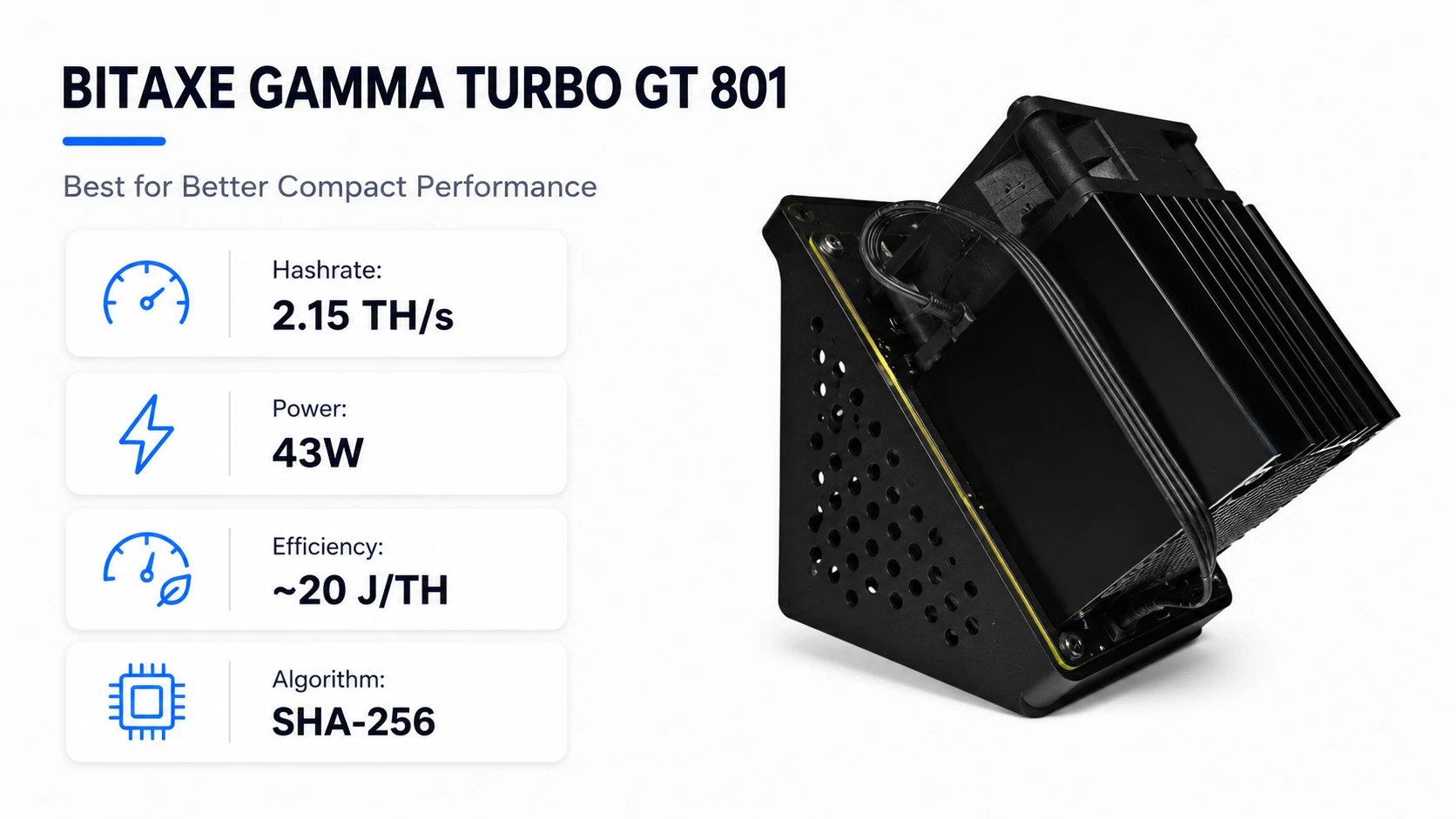
The Bitaxe Gamma Turbo GT 801 is a better fit for users who already understand the basics and now want a little more performance from a compact device. It still keeps the small Bitaxe style, but it gives more hashrate than the Gamma 601, which makes the setup feel more active without becoming too difficult to manage.
This model is commonly listed at around 2.15 TH/s with 43W power consumption. It also comes with dual BM1370 chips and a removable 0.91-inch OLED display. That display is useful because users can quickly check basic mining details without opening a separate dashboard every time. For people who like hands-on control, this small feature can make the whole setup feel more practical.
Main specs:
- Hashrate: 2.15 TH/s
- Power: 43W
- Chip: Dual BM1370
- Display: Removable 0.91-inch OLED
- Connection: Wi-Fi
- Best for: Users who want stronger performance in a small device
The Gamma Turbo GT 801 works well when you want more power than an entry-level model, but you still want to stay within a simple home-mining setup. It is not oversized, it does not need the same planning as an industrial miner, and it gives a better balance between hashrate, power use, and ease of operation.
Bitaxe Supra Hex 701: Best for Higher Hashrate

The Bitaxe Supra Hex 701 is the strongest model in this comparison when it comes to hashrate. It is made for users who want more mining strength from a compact device, but still do not want to move into a large and noisy mining setup. This makes it a better option for hobby miners who are more serious about performance.
This model is commonly listed with around 4.2 TH/s hashrate and 90W power consumption. The power draw is higher than the other Bitaxe models, but it is still much easier to handle than a full-size mining machine. You still need to think about airflow and placement, but the setup remains quite manageable for many home users.
Main specs:
- Hashrate: 4.2 TH/s
- Power: 90W
- Noise: Around 35 dB
- Connection: Wi-Fi
- Best for: Hobby miners who want higher hashrate
The Supra Hex 701 makes the most sense when performance is your main priority inside the Bitaxe range. It is not the lowest-power option, but it gives the highest output among these models. So, for users who want a stronger small miner and are comfortable with slightly higher power use, this model stands out clearly.
Bitaxe Touch: Best for Clean Monitoring
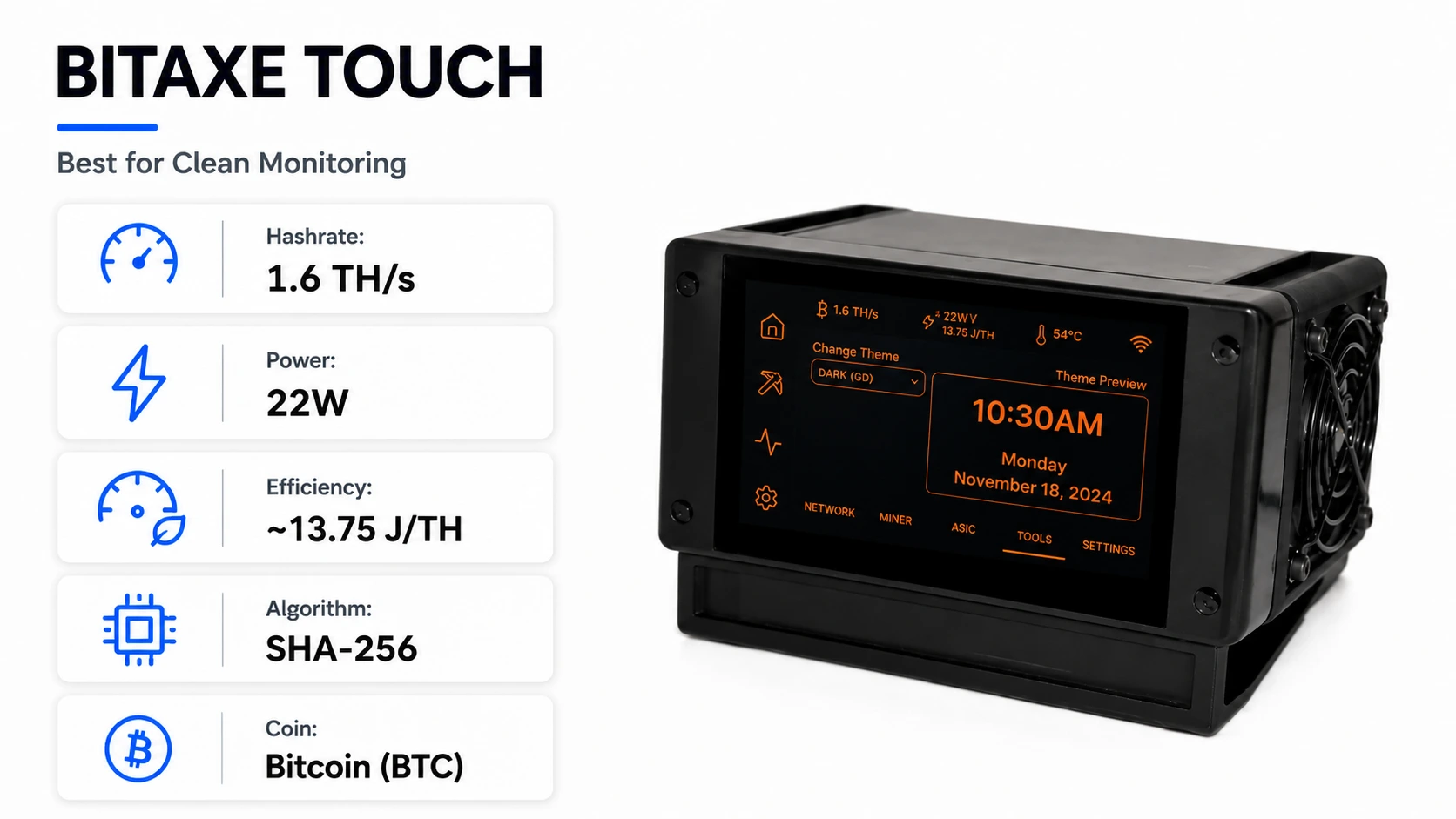
The Bitaxe Touch is different from the other models because it focuses more on usability. It is not only about hashrate. It is also about making the mining setup easier to view, monitor, and manage. For users who like a cleaner device experience, this model can feel more polished.
This model is commonly listed at around 1.6 TH/s with 22W power consumption. The built-in 800 × 480 LCD screen is the main highlight because it gives users a simple way to check mining activity directly from the device. It also uses Ethernet, which can be helpful for people who prefer a more stable wired connection instead of depending on Wi-Fi.
Main specs:
- Hashrate: 1.6 TH/s
- Power: 22W
- Display: 800 × 480 LCD
- Connection: Ethernet
- Best for: Screen-based monitoring and clean setup
The Bitaxe Touch may not be the highest-hashrate model here, but that is not really its main purpose. It is better for users who want easy tracking, a stable connection, and a more finished setup. If monitoring and convenience matter more to you than chasing the biggest hashrate number, the Touch is a strong option to consider.
Which Bitaxe Miner Is Best for Beginners?
For beginners, the best model is usually the one that is easiest to run, easiest to understand, and easiest to manage. On that basis, the Bitaxe Gamma 601 is the most beginner-friendly model in this comparison. It has low power consumption, a simple setup style, and enough hashrate to give users real exposure to mining. The running cost is also easier to manage, which matters when someone is still learning.
The Gamma Turbo GT 801 can also work for beginners who want a stronger start. It offers more hashrate and still keeps the compact design. But because it uses more power than the Gamma 601, users should be a little more aware of cooling and setup planning.
The Bitaxe Touch is also beginner-friendly in a different way. The display and Ethernet connection make it more convenient for users who prefer a clean device experience. It may feel easier to monitor, especially for someone who does not want to check everything through a separate dashboard.
For absolute beginners, the ranking may look like this:
| User Type | Best Pick | Why |
| Lowest-cost learner | Bitaxe Gamma 601 | Low power and simple use |
| Stronger beginner setup | Bitaxe Gamma Turbo GT 801 | Better hashrate with compact size |
| Display-focused user | Bitaxe Touch | LCD screen and Ethernet |
| Performance-focused hobbyist | Bitaxe Supra Hex 701 | Highest hashrate in this group |
This table is not about declaring one winner for everyone. It is about matching the model with the user. A good buying decision depends on your goal. If you want to learn first, go simple. If you want more hashrate, look at the stronger models. If you want a cleaner experience, the Touch may fit better.
Which Bitaxe Miner Has the Best Hashrate?
The Bitaxe Supra Hex 701 has the highest hashrate among the models in this guide. It is listed at 4.2 TH/s, which is clearly above the Gamma Turbo GT 801 at 2.15 TH/s, the Touch at 1.6 TH/s, and the Gamma 601 at 1.2 TH/s. But hashrate should not be the only deciding point. More hashrate usually means more power use. In this comparison, the Supra Hex 701 also has the highest listed power consumption at 90W. That is still low compared to large miners, but it is higher within the Bitaxe range. So the better way to look at this is not just “which one is strongest?” It is also “which one fits my setup?”
If you want the highest performance from these four, Supra Hex 701 is the answer. If you want the lowest power draw, Gamma 601 is better. If you want a balanced compact setup, Gamma Turbo GT 801 is interesting. If you want usability and monitoring, Bitaxe Touch has its own advantage. This is why Bitaxe comparisons should stay practical. The right model depends on whether you value low cost, easy setup, higher output, or better monitoring.
Power Use and Efficiency: What Should You Check?
Power use is one of the most important parts of any mining setup. Even with small miners, electricity cost still matters. The good thing about Bitaxe models is that their power draw is much lower than full-size machines.
The Gamma 601 uses 17W. The Touch uses 22W. The Gamma Turbo GT 801 uses 43W. The Supra Hex 701 uses 90W. These numbers make the devices easier to run for long periods without creating the same power burden as industrial miners.
Still, you should check your own electricity rate. A low-power miner is easier to manage, but it is still running continuously if you keep it online all day. Over time, even small power use adds up.
Here is a simple way to think about it:
- Low power models are better for learning and long-running experiments.
- Higher hashrate models are better for users who want more mining activity.
- Lower noise models are better for home or desk setups.
- Better monitoring features are useful if you want quick performance checks.
The right decision is not always the machine with the most power or the lowest price. It is the model that fits your space, electricity cost, and mining purpose.
Solo Mining vs Pool Mining With Bitaxe
Many users look at Bitaxe because they are interested in solo mining. Solo mining means you are trying to find a block independently or through a solo mining setup. The chance of finding a block with a small miner is extremely low, but some users like the lottery-style nature of it. That is why Bitaxe is often popular with hobby miners. It lets users participate in mining with a small device, learn how the process works, and support the idea of decentralized mining participation.
Pool mining is different. In pool mining, many miners combine their hashrate and share rewards based on contribution. With small devices, pool rewards are usually very small, but the experience can still be useful for learning.
For many Bitaxe users, the decision is not only about income. It is about understanding mining from the inside. You learn how to configure the device, connect to a pool, monitor hashrate, check temperature, and understand how mining rewards are reported. That hands-on learning is one of the biggest reasons people choose Bitaxe.
What Should You Check Before Buying a Bitaxe Miner?
Before buying any Bitaxe model, start with your goal. Are you buying to learn? To experiment with solo mining? To build a small home setup? To compare low-power SHA-256 devices? Your goal will decide the right model.
Next, check the basic specs. Hashrate, power use, noise level, connectivity, and display features all matter. A model with more hashrate may look better, but a lower-power model may be easier to run daily.
Also check your connection preference. Some models use WiFi, while the Bitaxe Touch uses Ethernet. If your mining area has weak WiFi, Ethernet may be better. If you want flexible placement, WiFi may be more convenient.
Then think about noise and space. Bitaxe models are small, but they still need airflow. Do not place them in a closed box or hot corner. Good airflow helps the device run more smoothly.
Finally, check product availability, delivery batch, warranty details, and what is included with the product. These details can change from model to model.
The best approach is simple: choose the Bitaxe miner that matches your setup, not just the one with the biggest number.
Bitaxe Buying Guide: Which Model Should You Choose?
If you want the easiest and lowest-power option, choose Bitaxe Gamma 601. It is simple, compact, and beginner-friendly. It is also a good option if you are not sure how deep you want to go into mining yet.
If you want more performance but still want a small device, choose Bitaxe Gamma Turbo GT 801. It gives you a higher hashrate than Gamma 601 while still keeping the compact Bitaxe form. If you want the strongest model in this comparison, choose Bitaxe Supra Hex 701. It has the highest listed hashrate and is better for hobby miners who want more serious output from a small device. If you want cleaner monitoring and an Ethernet-based setup, choose Bitaxe Touch. It is a good fit for users who care about display, usability, and a stable wired connection.
Each model has a clear purpose. The best one depends on your use case:
| Model | Best Reason to Choose It |
| Bitaxe Gamma 601 | Low-cost, low-power learning |
| Bitaxe Gamma Turbo GT 801 | Compact setup with stronger performance |
| Bitaxe Supra Hex 701 | Highest hashrate among these models |
| Bitaxe Touch | Display, Ethernet, and user-friendly monitoring |
This is the most practical way to compare them. Do not choose only by hashrate. Choose by your mining goal.
Are Bitaxe Miners Good for Home Use?
Yes, Bitaxe miners are generally much more home-friendly than larger mining machines. They use less power, make less noise, and take less space. That makes them easier to place in a home setup.
Still, they should be treated like real electronics. They need airflow, clean placement, and stable power. If the miner runs continuously, avoid placing it in a dusty, closed, or very hot space.
For home users, the most important things are:
- stable power
- good airflow
- reliable internet
- safe placement
- simple monitoring
These are not difficult requirements, but they matter. A small device can still perform better when it is placed correctly.
The Gamma 601 and Touch are especially easy to consider for low-power home use. The Gamma Turbo GT 801 and Supra Hex 701 offer more performance, but they also need a little more attention to power and airflow.
A reliable bitcoin miner can make home mining more approachable when the user starts with realistic expectations and proper setup planning.
Common Mistakes to Avoid
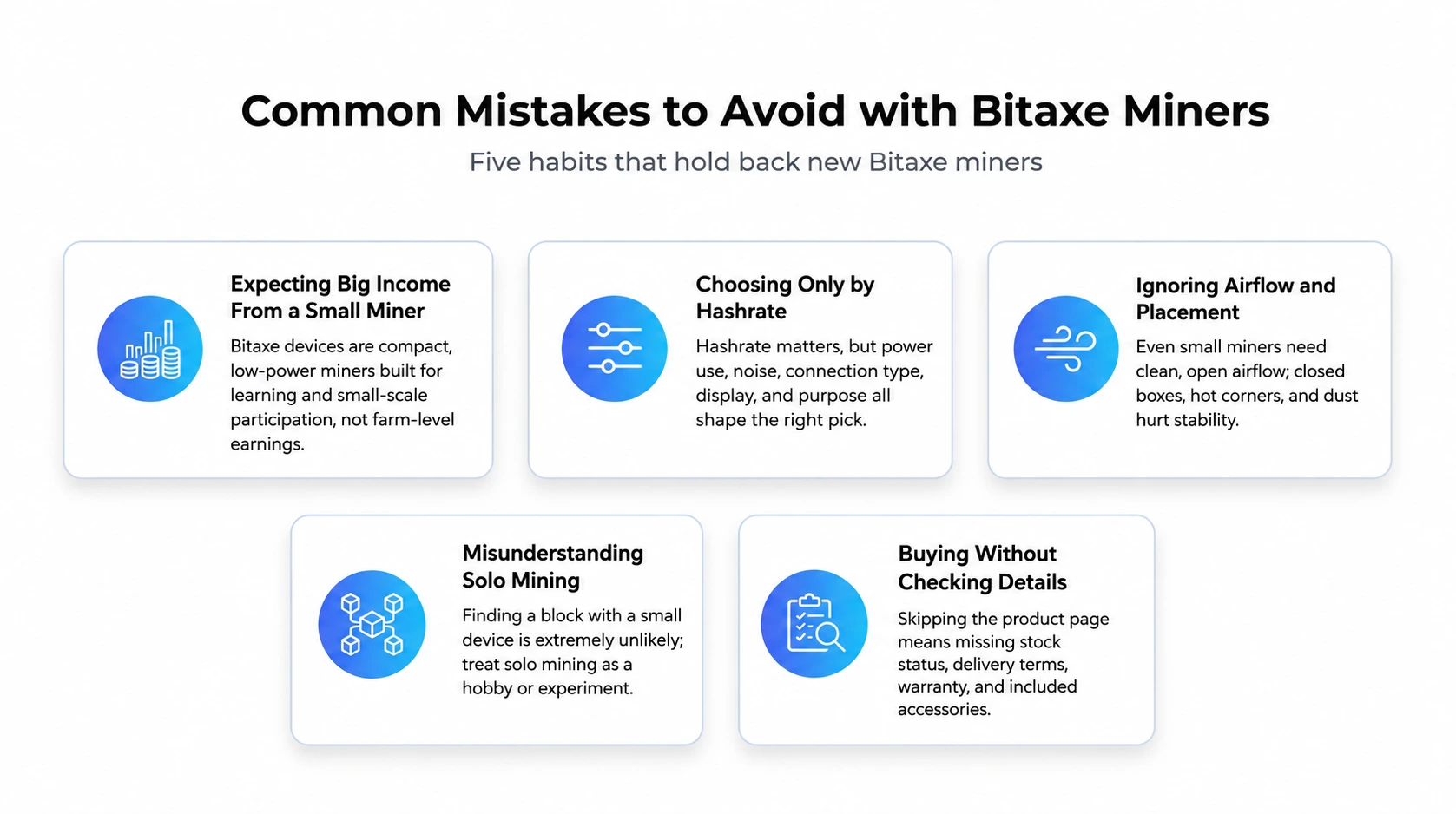
Expecting high income from a small miner: Bitaxe miners are compact, low-power mining devices. They are useful for learning, solo mining experiments, and small-scale participation, but they should not be treated like large mining farm machines. The better approach is to use them with realistic expectations.
Choosing only by hashrate: Hashrate is important, but it is not the only thing that matters. Power use, noise level, connection type, display features, and setup purpose should also be checked before buying. The highest hashrate model is not always the best option for every user.
Ignoring airflow and placement: Bitaxe miners are small, but they still need proper airflow. Keeping the device in a closed box, hot corner, or dusty area can affect stability. A clean and open setup helps the miner run more smoothly.
Not understanding solo mining: Solo mining can be exciting, but the chance of finding a block with a small device is extremely low. It should be understood as a hobby or experiment, not a fixed earning plan.
Buying without checking product details: Before placing an order, always check the latest product page, stock status, delivery details, warranty, and included accessories. This helps avoid confusion after purchase.
Final Thoughts Before Choosing a Bitaxe Miner
Bitaxe miners are useful because they make Bitcoin mining more approachable. They are small, practical, and easier to understand than large mining machines. For beginners and hobby users, that is the real value. The Gamma 601 is best for simple learning. The Gamma Turbo GT 801 gives more performance in a compact design. The Supra Hex 701 is the strongest option in this comparison. The Touch is best for users who want a screen and cleaner monitoring.
None of these models should be judged only by profit. They should be judged by what they help you do. If your goal is learning, experimentation, solo mining, or building confidence with SHA-256 hardware, Bitaxe can be a good category to explore. A positive crypto mining journey often starts with the right expectations, and Bitaxe makes that starting point easier for users who want hands-on mining without a heavy setup.
CONCLUSION
Bitaxe miners are not built for everyone, and that is exactly why comparing them properly matters. These compact SHA-256 devices are best for users who want a smaller, quieter, and easier way to understand mining. They are practical for learning, solo mining experiments, and home-friendly setups where space, noise, and power use matter.
If you want the simplest starting point, the Bitaxe Gamma 601 is a good option. If you want more power in a compact format, the Gamma Turbo GT 801 is a stronger step. If hashrate is your main focus, the Supra Hex 701 stands out. If clean monitoring and Ethernet matter more, the Bitaxe Touch is worth reviewing.
For more details, model availability, and current product options, visit CryptoMinerbros and explore the Bitaxe product collection before making your final choice.
Frequently Asked Questions
-
Which Bitaxe miner is best for beginners?
The Bitaxe Gamma 601 is usually the easiest beginner option because it has low power consumption, compact size, and simple setup. It is a good starting point for users who want to learn mining without handling a large machine.
-
Which Bitaxe model has the highest hashrate?
The Bitaxe Supra Hex 701 has the highest listed hashrate in this comparison at 4.2 TH/s. It is better suited for users who want stronger performance from a compact Bitaxe model.
-
Is Bitaxe good for solo mining?
Yes, Bitaxe devices are commonly used for solo mining experiments. The chance of finding a block is very low, but many users like Bitaxe because it gives them real hands-on mining experience with low power use.
-
Does Bitaxe use a lot of electricity?
No, Bitaxe models use much less power than full-size mining machines. For example, the Gamma 601 is listed at 17W, while the Supra Hex 701 is listed at 90W.
-
Which Bitaxe miner should I buy?
Choose Gamma 601 for simple learning, Gamma Turbo GT 801 for a stronger compact setup, Supra Hex 701 for the highest hashrate, and Bitaxe Touch for display-based monitoring with Ethernet.

Join our Newsletter
Get the week’s best cryptomining content in your inbox.

Han su
Han Su is a technical analyst at CryptoMinerBros, a leading provider of cryptocurrency mining hardware. He has over 5 years of experience in the cryptocurrency industry and is an expert in mining hardware, software, and profitability analysis.
Han is responsible for the technical analysis and research on ASIC Mining at Crypto Miner Bros. He also writes in-depth blogs on ASIC mining and cryptocurrency mining, and he has a deep understanding of the technology. His blogs are informative and engaging, and they have helped thousands of people learn about cryptocurrency mining.
He is always looking for new ways to educate people about cryptocurrency, and he is excited to see how the technology continues to develop in the years to come.
In spare time, Han enjoys hiking, camping, and spending time with his family. He is also an avid reader, and he loves to learn about new things.
Similar Blogs

Pinecone INIBOX Setup Guide: Initverse ASIC Miner Steps
Pinecone Initverse miner setup does not have to be complicated. If you have been looking into INI co...
Top NerdMiner Solo Miners: Specification and Profitability
NerdMiner Solo Miners have made solo Bitcoin mining more accessible than it used to be. Not long ago...
Best Kaspa Miners in 2026: Top Profitable Miners Compared
Kaspa Miners keep coming up in mining forums lately, and honestly, it’s not hard to see why. B... © 2018- Miner Bros Limited. All rights reserved

 EN EN
EN EN  ES
ES