


SUMMARY
Kaspa brings a new era with groundbreaking architecture that can handle multiple blocks simultaneously. The result is phenomenal, a second confirmation time that’s secure. The fresh consensus mechanism gets rid of orphaned blocks, and operations are more efficient without compromising decentralization.
The crypto industry is currently facing a major bottleneck because legacy blockchains are unable to scale. Bitcoin can only handle 7 transactions per second, while Ethereum is able to handle 15 to 30. Both networks become congested during the most active times. These are not software bugs but the architectural limitations of a serial blockchain design.
Kaspa overcomes this with cutting-edge technology by utilizing a directed acyclic graph that supports parallel block creation. Rather than shoving blocks into a single queue, Kaspa is capable of handling multiple blocks at the same time without compromising on security. This is not just a step forward, but a fundamental restructuring of distributed consensus that is able to combine the security of Bitcoin with near instant finality for real-world use cases.
What is Kaspa BlockDAG? Understanding the Foundation
Core Architectural Differences:
- Traditional Blockchain: Each block at a time, reference to a single parent
- Kaspa BlockDAG: Several blocks at once, reference to multiple parents
- Outcome: Parallel processing with no orphaned blocks
Understanding what is Kaspa BlockDAG comes from knowing that, in a directed acyclic graph, each block can refer back to several previous blocks rather than only one. It is similar to a braided rope as opposed to a single threadseveral strands combined make the rope stronger and allow for a bigger load.
Main Technical Benefits:
- Completely gets rid of the orphan block problem.
- Allows for block production rates as fast as one second.
- Ensures causality by going through directed references.
- Increases the transaction throughput without lowering the security.
- Recognizes and awards all miner’s contributed work.
This change to the Kaspa BlockDAG architecture results in a series of tangible benefits. Miners do not waste any energy on orphaned blocks, and users get to enjoy almost instant confirmations. Furthermore, developers can create applications with quick transaction settlement that gives the feeling of regular web services, yet still retains the trustless nature of cryptocurrency.
How GHOSTDAG Works
Understanding how GHOSTDAG works starts from the fact that it extends Bitcoin’s longest, chain rule to be compatible with DAG structures. Rather than picking the longest single chain, the GHOSTDAG consensus assigns scores to blocks according to their relative position within the whole graph structure.
GHOSTDAG Scoring Process:
- Each block receives a score based on referenced blocks
- Conflicts are resolved by selecting the highest-scoring chain
- Transaction ordering follows the highest-scoring path
- All blocks contribute to security, even conflicting ones
| Consensus Type | Structure | Conflict Resolution | Orphan Rate |
| Bitcoin (Nakamoto) | Linear chain | Longest chain wins | 1-2% |
| Ethereum (pre-merge) | Linear chain | Heaviest chain | 5-8% |
| Kaspa (GHOSTDAG) | DAG | Highest score | 0% |
The GHOSTDAG consensus method ensures security at the level of Bitcoin while handling a block each second. Just like in Bitcoin, a malicious one would have to control 51% of the hashing power to be able to revert the DAG. The game changing factor? Kaspa can handle hundreds of times more transactions within the identical period, demonstrating that crypto scalability does not have to give up on proof of work.
BlockDAG vs Blockchain Architecture
The blockDAG vs blockchain debate is about how both systems manage the production of multiple blocks at the same time. Conventional blockchains consider the occurrence of simultaneous blocks as an issue that needs to be resolved.
One block is chosen as the winner, the others are discarded orphans. This imposes an artificial limit on the number of blocks per unit of time. If you raise it too much, the rate of orphans will go through the roof, the miner’s energy will be wasted, and the security will be reduced.
Architectural Comparison Table:
| Feature | Traditional Blockchain | Kaspa BlockDAG |
| Block Structure | Linear chain | Parallel DAG |
| Block Time | 10 minutes (Bitcoin) | 1 second |
| Orphan Rate | 1-2% wasted work | 0% – all blocks included |
| Transaction Throughput | 7-30 TPS | Hundreds of TPS |
| Confirmation Time | 10-60 minutes | Seconds |
| Scalability Method | Layer 2 required | Native protocol |
Why This Matters:
- Bitcoin’s conservative approach prioritizes security over speed
- Layer-2 solutions add complexity and new trust assumptions
- Kaspa achieves crypto scalability at the base protocol level
- No orphaned blocks means 100% mining efficiency
- Developers avoid complex off-chain scaling integration
When examining Kaspa vs blockchain architecture, it’s evident that considering simultaneous blocks as a feature rather than a bug gets rid of the main bottleneck that pushes other networks to layer 2 solutions or different consensus mechanisms.
The Mining Revolution
Kaspa mining started with the kHeavyHash algorithm, which is specifically tailored for GPU mining and at the same time resists ASICs from gaining dominance. This allows the general public to continue having access and thus the security of the network is reinforced with decentralization.
Current Mining Specifications (January 2026):
| Specification | Details |
| Block Time | 1 second |
| Algorithm | kHeavyHash (GPU-optimized) |
| Orphan Rate | 0% (all valid blocks included) |
| Reward Schedule | Smooth chromatic emission curve |
| Network Type | Proof of work |
Recommended Mining Hardware:
- NVIDIA GPUs: RTX 3060 Ti, RTX 3070, RTX 3080, RTX 4070, RTX 4080
- AMD GPUs: RX 6700 XT, RX 6800, RX 6900 XT, RX 7800 XT, RX 7900 XTX
- Memory: Minimum 4GB VRAM per GPU
- Power Supply: Calculate 120% of total GPU TDP
- Cooling: Maintain GPU temperatures below 75°C for longevity
Features of Kaspa mining efficiency are deeply rooted in dissimilar principles to Bitcoin. One of the reasons is that there are no orphaned blocks, so all hashes either contribute to finding blocks or to securing the network. Your effective hashrate will always match your real hashrate as no work is wasted.
Choosing the proper mining hardware guarantees that your electricity expenditure will be directly converted into network participation and possible rewards.
No Orphaned Blocks:
Orphaned blocks are the biggest hidden inefficiency in cryptocurrency. With Bitcoin, about 1, 2% of the blocks that are mined go to waste; these are the blocks that are found but not put in the final chain. Think about it: a lot of electricity is wasted, miners lose money, and security is reduced because the proof of work that was done doesn’t help in making the chain more unchangeable.
The Orphan Problem Breakdown:
- Bitcoin miners waste 1-2% of all computational work
- Ethereum (pre-merge) wasted 5-8% due to faster blocks
- Orphans represent lost revenue for mining operations
- Wasted electricity provides zero network security
- Higher orphan rates discourage decentralized mining
Kaspa’s Solution:
Kaspa’s architecture eliminates no orphan blocks by ensuring that every valid block forms part of the DAG structure, even if it arrives after other blocks. For example, your block can become part of the permanent record together with the other block if you mine it just half a second after someone else.
Economic Impact:
- 100% of successful mining contributes to network security
- Zero revenue lost to orphaned blocks
- More predictable mining profitability calculations
- Improved energy efficiency per transaction processed
- Environmental benefits through eliminated computational waste
The consensus mechanism takes care of transaction ordering across parallel blocks and at the same time ensures consistency. For mining operations, this no orphaned blocks guarantee changes profitability calculations fundamentally; your investment converts directly to results without the orphan tax that traditional blockchains impose.
High Block Frequency and Instant Finality
Compared to Bitcoin’s ten-minute intervals, Kaspa’s high block frequency generates blocks per second, a 600x boost. This radically alters how apps communicate with the network; it’s not faster. Transactions appear nearly instantly thanks to one-second blocks, which provide instant finality with respectable security guarantees.
Confirmation Time Comparison:
| Network | Block Time | 1 Confirmation | 6 Confirmations |
| Bitcoin | 10 minutes | 10 minutes | 60 minutes |
| Ethereum | 12 seconds | 12 seconds | 6 minutes |
| Kaspa | 1 second | 1 second | 6 seconds |
Practical Applications Enabled:
- Point-of-sale systems with real-time settlement
- Gaming microtransactions with instant confirmation
- DeFi protocols without frustrating wait times
- Responsive user experiences like web applications
- High-frequency trading with on-chain settlement
After just ten seconds on Kaspa, you have ten confirmations embedded in an ever-growing DAG structure. The high block frequency combined with instant finality makes deep reorganizations economically and computationally impractical identical to Bitcoin’s security model but at 600x the speed.
For the developer community, it means developing applications that are responsive and have the properties of a trustless cryptocurrency. The days of apologizing for the slowness of blockchain are gone, as Kaspa provides the speed that modern applications demand.
Scalable Proof of Work: Next Generation PoW Security
The crypto industry largely abandoned proof of work scalability, assuming only alternative consensus mechanisms could achieve high throughput blockchain performance. Kaspa proves this assumption wrong with scalable proof of work that maintains PoW’s security model and decentralization benefits.
Next Generation PoW Advantages:
- No permissioned validators or stake-based governance
- True permissionless network participation
- Objective consensus rules without social coordination
- Security scales with market value naturally
- Mining remains accessible to retail participants
Security Model Comparison:
| Security Aspect | Traditional PoW | Scalable PoW |
| Attack Requirement | 51% hashrate | 51% hashrate |
| Decentralization | High (ASIC concerns) | High (GPU-friendly) |
| Energy Efficiency | Low (orphans) | High (no orphans) |
| Throughput | Limited | Hundreds of TPS |
| Scalability Path | Layer 2 required | Native protocol |
How Scalability Works:
The idea for next generation PoW is very simple: raise the block rate and make all blocks help with security. This has been impossible for traditional blockchains. As the block rate increased, more orphans would have been created. However, this is shattered by Kaspa’s DAG model.
“Faster blocks do not cause orphans in Kaspa, but rather construct a denser and more secure DAG.” Analysis indicates Kaspa is secure from the same types and quantities of attacks as the Bitcoin system, with the exact costs proportionate to the size of the network. The revolutionary twist is that the high throughput blockchain can validate so many more transactions with the same amount of security resources.
Is Kaspa Better Than Bitcoin?
Answering is Kaspa better than Bitcoin requires understanding they’re optimized for different priorities. Bitcoin maximizes security and decentralization absolutely, accepting limited throughput as necessary. Kaspa asks: what if we could achieve Bitcoin-level security with dramatically better throughput?
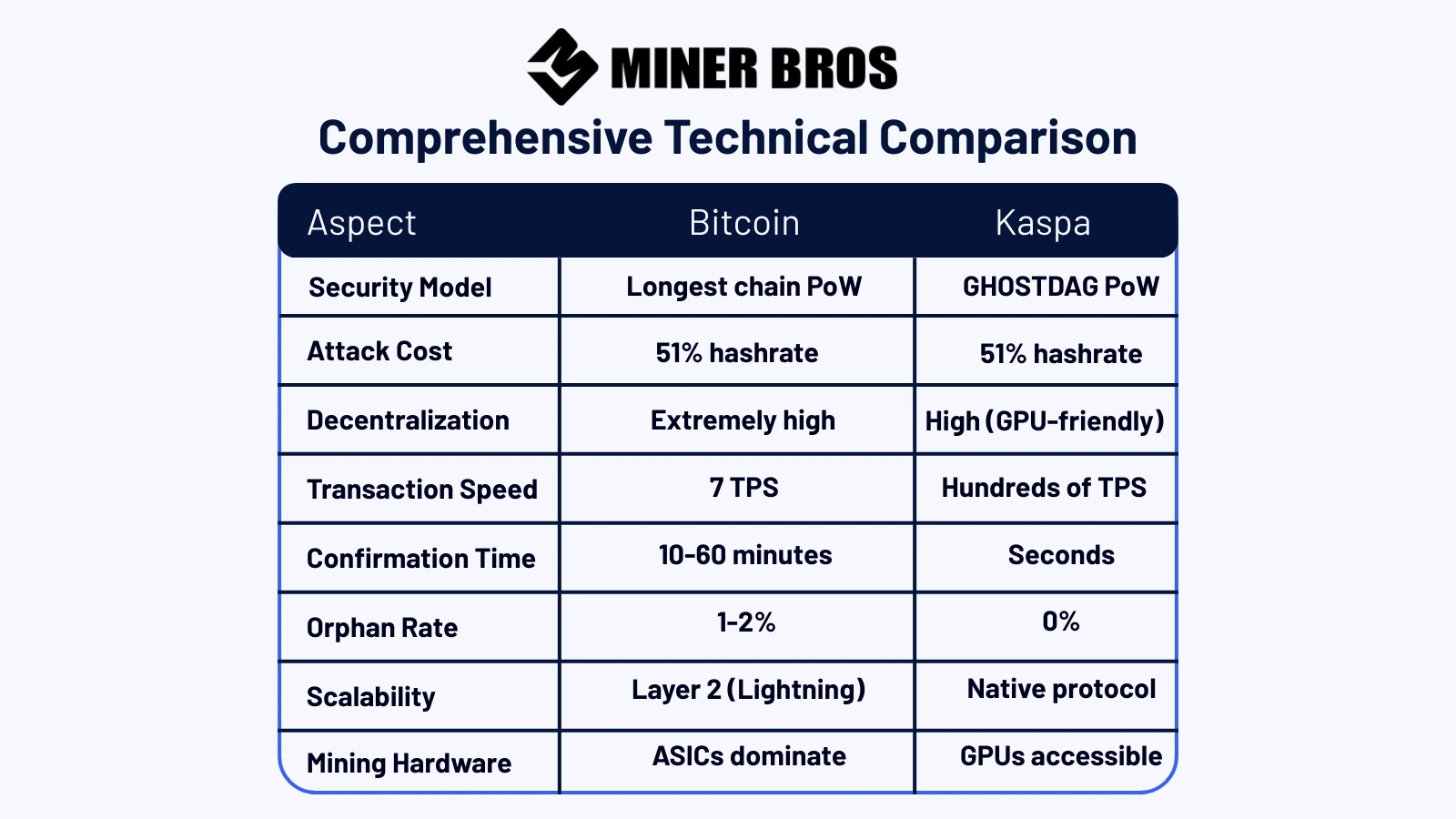
Comprehensive Technical Comparison:
| Aspect | Bitcoin | Kaspa |
| Security Model | Longest chain PoW | GHOSTDAG PoW |
| Attack Cost | 51% hashrate | 51% hashrate |
| Decentralization | Extremely high | High (GPU-friendly) |
| Transaction Speed | 7 TPS | Hundreds of TPS |
| Confirmation Time | 10-60 minutes | Seconds |
| Orphan Rate | 1-2% | 0% |
| Scalability | Layer 2 (Lightning) | Native protocol |
| Mining Hardware | ASICs dominate | GPUs accessible |
For Different Users:
- Maximum Security Seekers: Bitcoin’s conservative approach and battle-tested network remain unmatched for storing wealth across decades
- Application Developers: Kaspa provides responsive settlement enabling use cases impossible on slower networks
- Miners: Kaspa provides regular rewards, no orphaned waste, and easy GPU mining compared to ASIC hurdles
- Daily Users: Kaspa provides useful transaction speeds for business and payment purposes
The question of whether is Kaspa better than Bitcoin is not a universally applicable one, as Bitcoin is the ultimate secure store of value, and Kaspa facilitates applications that require fast finality. Kaspa is a sign of evolution that proves high-performance proof of work can be achieved without compromising the security principles of cryptocurrency.
Getting Started with Kaspa
Phase 1: Hardware Selection
Start your mining venture with the most up to date GPU mining hardware. Always figure out your electricity costs first since the profits depend to a large extent on energy prices and the efficiency of the hardware. Kaspa’s GPU friendly algorithm provides the chance for solo mining which is not possible on ASIC, dominated networks.
Recommended Entry Points:
- Budget Build: Single RTX 3060 Ti or RX 6700 XT
- Mid-Range: 4-6 GPU rig with RTX 3070 or RX 6800
- Large-Scale: Multiple rigs with RTX 4070 or RX 7800 XT
- Power: Dedicated circuits for stability and safety
Phase 2: Software Setup Process
- Download official Kaspa full node from verified sources
- Sync with the network (initial sync takes several hours)
- Install mining software compatible with kHeavyHash algorithm
- Configure wallet address (never mine to exchange addresses)
- Set GPU intensity based on model and cooling capacity
- Choose pool or solo mining based on your hashrate
Phase 3: Mining Configuration
| Setting | Recommendation | Purpose |
| Intensity | 18-22 (adjust per GPU) | Balance hash rate and stability |
| Temperature | Keep under 75°C | Hardware longevity |
| Fan Speed | 60-80% | Cooling efficiency |
| Power Limit | 70-85% of max | Efficiency optimization |
Pool vs. Solo Mining:
- Pool Mining: Consistent payouts, 1-2% fees, suitable for all hashrates
- Solo Mining: Full block rewards, requires patience, viable due to one-second blocks
- Consideration: Even modest hashrate can find solo blocks occasionally on Kaspa
Expected Returns:
Utilize online calculators with the current network difficulty and reward per block. Keep in mind that Kaspa mining provides a zero orphan rate, which means the effective hashrate is equal to the actual hashrate.
CONCLUSION
Kaspa has shown that it is possible to overcome the blockchain trilemma. By the use of innovative design and superior consensus algorithms, Kaspa provides far better performance than any cryptocurrency without giving up the security that can come from the use of proof of work or requiring permissioned validators.
However, for those interested in being involved, cryptominerbros and other mining communities are there for guidance on starting the process. The future of scalable proof of work already exists in the current state, and knowing the technical basics gets you an early start on benefiting from the technology. No matter if it’s for mining, developing, or using for fast transaction processing of cryptocurrency.
The question isn’t whether next generation PoW can scale Kaspa shows it can scale. The question is how fast the world of cryptocurrency will realize and expand upon what has been invented.
Frequently Asked Questions
-
What is the block size of Kaspa?
Kaspa does not have a fixed block size limit, like Bitcoin, but rather a dynamic block size that adjusts based on network demand and block rate, which enables flexible throughput as the network grows.
-
What is the price prediction for BlockDAG in 2026?
Price predictions are highly speculative and are based on market conditions, adoption rates, and technological developments; it is recommended that research be done and multiple sources be consulted instead of relying on a single prediction.
-
What are the 4 types of Blockchain?
The four main types of blockchain are Public (permissionless and open to all), Private (permissioned and restricted access), Consortium (semi-decentralized with multiple organizations), and Hybrid (combining public and private elements).
-
What is BlockDAG used for?
BlockDAG is used to help cryptocurrency systems with high throughput. It achieves this by parallelizing block creation, eliminating the concept of orphaned blocks, and offering speedy transaction verification with proof of work security and decentralization.

Join our Newsletter
Get the week’s best cryptomining content in your inbox.

David Atherton
David Atherton is an imaginative wordsmith and storyteller hailing from the bustling streets of New York.
Similar Blogs
Optimizing Mining Efficiency: Advanced Monitoring Tools and Metrics
A complete guide to mining efficiency metrics, real-time monitoring tools, and dashboards for smarte...
ASIC Firmware & Software: How to Keep Your Miners Updated and Secure
Discover how to upgrade ASIC firmware safely, safeguard against security risks such as Antbleed vuln...
Advanced Cooling and Noise Management for Home ASIC Mining Rigs
Complete guide on cooling and noise reduction for home bitcoin mining. Learn liquid cooling, immersi... © 2018- Miner Bros Limited. All rights reserved

 EN EN
EN EN  ES
ES