


SUMMARY
Blake3 Algorithm is a fast, energy-efficient hashing algorithm designed for modern mining. Its support for parallel processing makes it ideal for ASIC miners like the Goldshell AL series.
Miners prefer Blake3 for its high hashrate, low power use, and profitability. Alephium (ALPH) is the top Blake3 coin, well-suited for ASIC-based mining.
Blake3 offers a powerful, future-ready solution for efficient and scalable ASIC mining.
What is Blake3? A Simple Explanation
1. Understanding Hash Functions
To understand Blake3, let’s first look at a hash function. A hash function is like a digital fingerprint maker. It takes any input like a file, message, or transaction and turns it into a fixed-length output, called a hash.
No matter how big or small the input is, the output size always stays the same. Even changing one letter in the input gives an entirely different hash.
Hash functions are essential in cryptocurrency. They keep data secure, verify transactions, and ensure miners do real work to earn rewards. Without hashing, blockchains would not function securely.
2. So, What Is Blake3?
Blake3 is a cryptographic hash function introduced in 2020. It was designed to improve upon earlier versions like Blake2, which was already faster than traditional algorithms like SHA-256. Blake3 is built to be extremely fast, secure, and efficient. It’s not just faster it’s smarter.
Blake3 uses a Merkle tree structure and a feature called parallelism, which means it can run multiple hashing operations at the same time across different CPU or GPU cores. This makes it perfect for modern devices with multi-core processors. Blake3 can produce over 7 GB/s of hash output on a standard laptop, which is many times faster than SHA-256.
3. What Makes Blake3 Special?
- Speed: Blake3 is significantly faster than Blake2, SHA-256, and many other hash functions.
- Low resource use: It runs with less RAM and processing power.
- Parallel processing: It can use multiple cores at once, which is great for mining.
- Small code size: It’s easy to implement across different platforms and devices.
It’s Blake3 is not just made for crypto mining. It’s also used in data backup software, file verification tools, and apps that require fast and secure hashing.
4. Why It’s Important for Mining
Because of its speed and low resource use, Blake3 is very efficient for mining. It lets miners get more done with less electricity and less expensive Hardware.
How Blake3 Differs from Blake2 and Other Hashing Algorithms
1. Blake2: A Quick Recap
Before Blake3 came along, Blake2 was one of the fastest and most secure hash functions available. It was already a significant improvement over older algorithms like SHA-1 and SHA-256. Blake2 was efficient, easy to implement, and faster than most of its competitors. Many developers and security experts trusted it for applications like password hashing, file integrity checks, and digital signatures.
But even Blake2 had some limitations; it wasn’t designed to take advantage of modern, multi-core CPUs fully. That’s where Blake3 steps in and takes things to the next level.
2. Blake3 vs. Blake2: What’s New?
Blake3 builds directly on Blake2 but improves it in three major areas:
~ Speed: Blake3 is dramatically faster. In some cases, it’s over 2–3x faster than Blake2, especially when running on multiple cores.
~ Parallelism: Unlike Blake2, which processes data in a linear sequence, Blake3 can process many chunks of data at the same time. This makes it ideal for today’s computers that often have 4, 8, or even more CPU cores.
~ Deterministic Tree Hashing: Blake3 uses a Merkle tree structure, which boosts performance and allows it to verify partial data efficiently. That’s a game-changer for speed, scalability, and mining.
3. Blake3 vs. SHA-256, Ethash, and Others
Let’s see how Blake3 compares to more common crypto mining algorithms:
Blake3 is not only faster but also more energy-efficient. It’s less demanding on Hardware and can be implemented in a wide range of devices from phones to powerful mining rigs.
4. Why Miners Should Care
If you’re mining, speed and efficiency are everything. Blake3 gives you both. Its ability to work on many cores at once means you can get higher hashrates without needing massive power. That translates to lower costs and potentially higher profits.
Blake3 is lighter, faster, and brighter than previous algorithms. It’s made for today’s tech and future-ready for whatever comes next.
Why Blake3 is Great for Mining
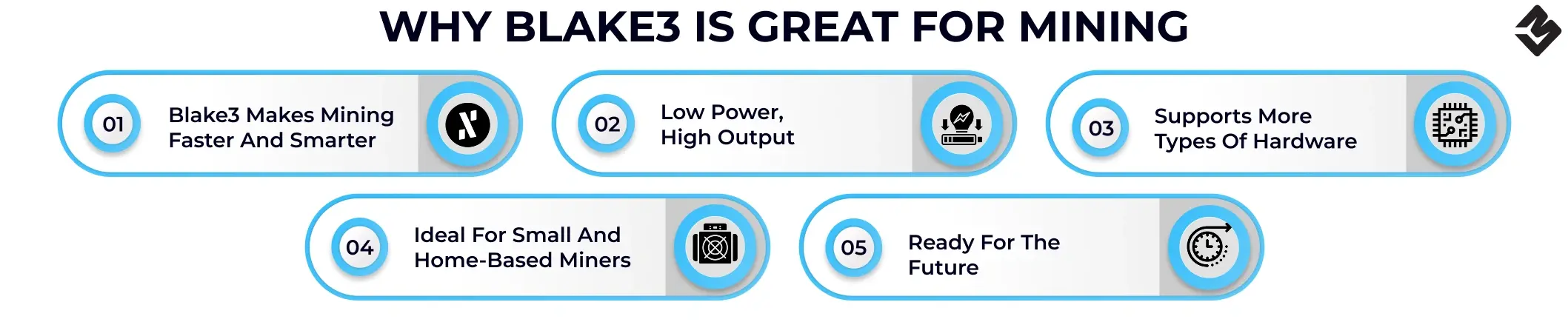
1. Blake3 Makes Mining Faster and Smarter
One of the biggest reasons miners are paying attention to Blake3 is its speed. In mining, speed matters because it increases your chances of solving blocks and earning rewards. Blake3 is one of the fastest hash functions ever created. It can process massive amounts of data in a very short time, much faster than SHA-256, Blake2, or Ethash.
This gives Blake3 miners a unique edge. While others are burning more electricity and getting fewer results, Blake3 allows miners to do more work with less energy.
2. Low Power, High Output
Energy costs are a significant concern in mining. Traditional algorithms often demand vast amounts of electricity to keep mining rigs running at high speeds. Blake3, however, was designed to be lightweight and energy-efficient. It doesn’t need as much memory or processing power, which helps lower your electricity bill.
Whether you’re mining on a CPU, GPU, or an ASIC device, Blake3 consumes less power than most older algorithms. This not only saves you money but also reduces heat, which means your mining rigs can last longer and operate more quietly.
3. Supports More Types of Hardware
Blake3 is Hardware flexible, meaning it works well across a wide range of machines. If you have a multi-core CPU or a GPU setup, you can start mining Blake3 coins without buying new Hardware. This is a huge benefit for beginners and solo miners who can’t afford expensive ASICs.
Even newer Blake3 ASIC miners like the Goldshell AL series are power-efficient and easier to maintain than traditional Bitcoin miners.
4. Ideal for Small and Home-Based Miners
Blake3’s efficiency and compatibility make it ideal for home miners. Unlike SHA-256-based mining, which often requires industrial cooling and high energy input, Blake3 can run smoothly in smaller setups. You can mine in your home or garage without worrying about massive heat output or electric bills.
5. Ready for the Future
Because it supports parallel processing, Blake3 is well-suited for the future. As mining continues to shift toward more efficient and eco-friendly solutions, Blake3 fits right in. It’s designed to scale with newer Hardware and technological upgrades, so your mining investment remains future-proof. Blake3 is a fast, efficient, and innovative algorithm that fits both modern hardware and mining needs. It offers a refreshing alternative to the power-hungry algorithms of the past.
How to Start Mining Blake3 Coins
Mining Blake3 Is Beginner-Friendly
One of the best things about Blake3 is that it’s easy to get started. Unlike other algorithms that demand specific Hardware or a complex setup, Blake3 supports a wide range of devices. Whether you have a CPU, GPU, or Blake3 ASIC, the setup is straightforward. Here’s a simple step-by-step guide to help you begin your mining journey.

Step 1: Choose the Right Blake3 Coin
The most popular and recommended coin for Blake3 mining in 2026 is Alephium (ALPH). It has a growing community, active development, and good potential for long-term value. Other experimental Blake3-based projects exist, but ALPH is currently the most stable and profitable.
Step 2: Get a Compatible Wallet
You’ll need a secure wallet to store your mined ALPH or other Blake3 coins. For Alephium, use the official Alephium Wallet, available for desktop and mobile. Make sure to back up your wallet phrase securely; it’s the only way to recover your funds.
Step 3: Pick Your Mining Hardware
Depending on your budget and setup:
- CPU: Great for beginners. Use high-core processors like AMD Ryzen 9.
- GPU: Mid-range or high-end cards (RTX 3070, RX 6800 XT) work well.
- ASIC: If you’re serious about mining, consider Goldshell AL Max or AL Box III.
Step 4: Join a Mining Pool
Pool mining increases your chances of regular payouts. For Alephium, you can join pools like:
- WoolyPooly
- Herominers
- AleoPool
Make sure the pool supports Blake3 and offers low fees and good uptime.
Step 5: Download Mining Software
Choose software based on your Hardware:
- lolMiner or TeamRedMiner for GPU mining
- XMRig-style tools for CPU mining
- Goldshell dashboard for ASIC miners
Enter your pool address, wallet address, and start mining.
Step 6: Monitor Performance
Once mining starts, keep an eye on:
- Hashrate
- Power consumption
- Pool payout stats
- GPU/CPU temperature
Free monitoring tools and mobile apps help track your miner’s status 24/7.
Blake3 mining is one of the easiest and most flexible ways to mine in 2026. With the right coin, basic setup, and regular monitoring, you can start earning with minimal hassle, no tech genius required.
Blake3 vs Other Mining Algorithms (Like SHA-256, Ethash)
1. Not All Mining Algorithms Are the Same
When choosing a cryptocurrency to mine, one of the first things you should check is the mining algorithm. This one decision affects everything from the kind of Hardware you need to your electricity bills and overall profits.
In 2026, the most common mining algorithms include SHA-256, Ethash, Scrypt, and now Blake3. Each has its strengths and weaknesses, depending on your goals, budget, and setup.
2. SHA-256 (Used in Bitcoin and Bitcoin Cash)
- Power-Hungry: SHA-256 is highly secure, but it requires a lot of power to run.
- ASIC Only: You can’t mine SHA-256 coins with a CPU or GPU anymore. ASIC miners are a must, and they’re expensive.
- Highly Competitive: Since everyone’s using robust Hardware, it’s tough to stand out or earn consistent rewards without a massive investment.
3. Ethash (Used in Ethereum Classic)
- GPU Friendly: Unlike SHA-256, Ethash still works well with graphics cards.
- Memory Heavy: It needs a lot of memory bandwidth, which means higher power usage and more heat.
- Transitioning: With Ethereum moving to proof-of-stake, ETC being its primary chain now, Ethash may fade in popularity.
4. Blake3 – The New Challenger
- Super Fast: Blake3 can hash data way faster than both SHA-256 and Ethash.
- Low Power Use: It’s lightweight, so it consumes much less electricity.
- Hardware Friendly: Works well on CPUs, GPUs, and new Blake3 ASICs like Goldshell’s AL Max and AL Box III.
- Beginner Friendly: Ideal for people starting or mining from home.
Which One Should You Choose?
If you have a big budget and want to mine Bitcoin, SHA-256 might make sense, but be prepared for high costs. If you prefer GPU mining and wider coin support, Ethash could work.
But if you’re looking for a faster, energy-efficient, and beginner-friendly option, Blake3 is the clear winner in 2026.
Pros and Cons of Mining Blake3 Coins
Is Blake3 Mining Worth It? Let’s Break It Down
Blake3 has been making waves in the crypto mining world because of its speed and efficiency. But like everything in crypto, it’s not a one-size-fits-all solution. Whether you’re a home miner, a hobbyist, or someone thinking about scaling up, it’s essential to look at both the advantages and the challenges before jumping in.
Pros of Mining Blake3 Coins

1. High Speed Hashing
Blake3 is one of the fastest hashing algorithms out there. This means your mining hardware can process more hashes per second, improving your chances of earning rewards faster.
2. Energy Efficiency
Unlike SHA-256 or Ethash, Blake3 uses far less electricity. This not only saves you money but also produces less heat, reducing the need for expensive cooling systems.
3. Runs on More Hardware
You don’t need to buy costly ASICs to mine Blake3. It works well on multi-core CPUs, GPUs, and now ASICs too, giving you the flexibility to choose your setup.
4. Great for Home Mining
Because it’s quieter and cooler, Blake3 is ideal for mining at home or in small spaces. There is no need for industrial fans or dedicated mining rooms.
5. Future-Ready
Blake3 is designed to scale with new tech. It’s optimized for modern CPUs and parallel processing, which means it’ll stay relevant as devices get faster.
Cons of Mining Blake3 Coins

1. Limited Coin Options
As of now, there aren’t many coins that use Blake3. Alephium is the main one, and while promising, it doesn’t yet have the market size of Bitcoin or Ethereum.
2. Lower Liquidity
Because Blake3 coins are newer, they may not be listed on all exchanges. This can make it harder to sell your coins or convert them to other crypto or cash.
3. Less Community Support
Since it’s a newer algorithm, you might find fewer tutorials, forums, or troubleshooting guides compared to established mining communities.
4. ASICs Are Entering the Space
Although Blake3 is now friendly to CPUs and GPUs, ASICs like the Goldshell AL Max are becoming dominant. This may lead to higher competition over time.
Blake3 mining offers real advantages: speed, low power use, and hardware flexibility. But it’s still early. If you’re okay with a smaller coin selection and like to be ahead of the curve, Blake3 mining in 2026 is a wise choice.
CONCLUSION
Blake3 is shaping up to be one of the most promising new algorithms in the mining space. It offers high speeds, low power usage, and support for a wide range of Hardware, from CPUs to high-end ASICs. For miners who want flexibility and efficiency, Blake3 is a breath of fresh air.
In 2026, Blake3-based coins like Alephium are giving both solo and pool miners a good reason to explore this new space. While the coin choices are still growing, the foundation is strong. Developers are choosing Blake3 for its scalability and security, and miners are loving the reduced costs.
Will Blake3 replace older giants like SHA-256 or Ethash? Maybe not yet-but it’s carving out a niche that’s hard to ignore. If you’re ready to try something new, save on power, and mine smarter-not harder-Blake3 might be the future.
Check out the latest Alephium Miners
FAQs ON BLAKE3 ALGORITHM
-
What is the Blake3 algorithm used for in crypto mining?
Blake3 is a fast and secure hash function used in cryptocurrencies like Alephium. It helps verify transactions while allowing energy-efficient mining.
-
Is Blake3 mining profitable in 2026?
Blake3 mining can be profitable, especially with low electricity costs and efficient hardware. Profit margins depend on coin prices and network difficulty.
-
How is Blake3 different from SHA-256 or Ethash?
Blake3 is faster, uses less energy, and works on more hardware types. It’s a newer, more efficient alternative to older mining algorithms like SHA-256.

Join our Newsletter
Get the week’s best cryptomining content in your inbox.

Han su
Han Su is a technical analyst at CryptoMinerBros, a leading provider of cryptocurrency mining hardware. He has over 5 years of experience in the cryptocurrency industry and is an expert in mining hardware, software, and profitability analysis.
Han is responsible for the technical analysis and research on ASIC Mining at Crypto Miner Bros. He also writes in-depth blogs on ASIC mining and cryptocurrency mining, and he has a deep understanding of the technology. His blogs are informative and engaging, and they have helped thousands of people learn about cryptocurrency mining.
He is always looking for new ways to educate people about cryptocurrency, and he is excited to see how the technology continues to develop in the years to come.
In spare time, Han enjoys hiking, camping, and spending time with his family. He is also an avid reader, and he loves to learn about new things.
Similar Blogs
ASIC Firmware & Software: How to Keep Your Miners Updated and Secure
Discover how to upgrade ASIC firmware safely, safeguard against security risks such as Antbleed vuln...
Advanced Cooling and Noise Management for Home ASIC Mining Rigs
Complete guide on cooling and noise reduction for home bitcoin mining. Learn liquid cooling, immersi...
Quantum Computing and Crypto Mining: Future Challenges and Opportunities
Full guide to quantum computing & crypto mining. Knowing blockchain quantum threats, post-quantum bl... © 2018- Miner Bros Limited. All rights reserved

 EN EN
EN EN  ES
ES