



SUMMARY
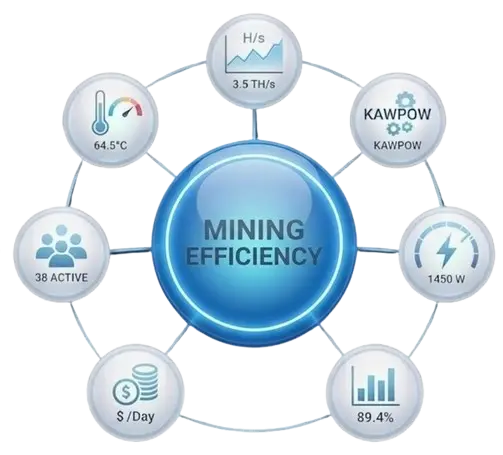
The mining of cryptocurrency has an industry with the aim of increasing profitability and efficiency. Due to the increasing cost of energy, as well as fluctuations in market conditions and the need for more powerful machines, miners must be able to constantly improve their operations. Modern equipment for monitoring mining and metrics play an essential part in ensuring that miners get the most profit while minimizing loss. This blog will examine the importance of efficiency in mining and how to track mining performance, as well as the tools and techniques that will assist in boosting the efficiency of your mining operations.
What is Mining Efficiency?
Mining efficiency is the ability of a miner to generate cryptocurrency earnings in relation to resource and energy used. A well-run mining operation will not only boost profitability, but also provide longevity in the long term.
The most important aspects of efficiency in mining are:
- Hashrate: A measure of the computing capability of a mining set-up by determining how fast it can tackle complex mathematical issues.
- Power Consumption: The amount of energy is required for your mining operation to produce a particular quantity of hashing energy.
- Profitability: The ratio between the mining reward and operational expenses, which vary in relation to how much energy is consumed, hashrate and the market value.
By enhancing these metrics, miners can guarantee higher-quality sustained hashrates and faster ROI recovery and long-term stability of operations.
Advanced Mining Monitoring Tools
In order to monitor the performance of mining in terms of efficiency and performance, miners depend on advanced monitoring tools. They provide real-time information that allows operators to tweak their mining setups to achieve the best performance. Here are the top mining monitoring tools that will increase the efficiency of mining
1. ASIC Monitoring Tools
The purpose of these tools is to monitor the efficiency of ASIC mining machines that are used extensively in mining cryptocurrency. They track metrics like hashrate, temperature and energy consumption. These are vital to ensure efficient mining.
- Examples:
- Awesome Miner: allows the user to oversee multiple ASIC miners, and monitor the hash rate, temperature, as well as the amount of energy consumed.
- Minerstat: a complete mining OS that tracks ASIC as well as GPU miners, and includes features like real-time monitoring as well as alerts.
2. Mining Dashboards
The purpose behind dashboards is to be the central platform for tracking mining performance. They permit miners to see different performance metrics and modify settings in line with the results.
- Features:
- Real-time mining data
- Power consumption measures
- Analysis of profitability
- Monitoring of the performance of mining
- Popular Tools:
- Hive OS: Known for its sophisticated mining platform, Hive OS offers real-time monitoring and tuning of performance to each of ASICs as well as GPUs.
- F2Pool: provides an easy-to-use dashboard that monitors the mining performance and profitability of various coins.
3. Power Efficiency Mining Tools
Their purpose is to concentrate on reducing energy waste while ensuring optimal hashrate. Mining tools that are power efficient are vital to reduce operational costs and boosting mining profit.
- Examples:
- PowerBI Mining: Use for a detailed investigation of consumption in relation to. hashrate. This tool assists miners in identifying the areas of inefficiency in their system.
- Energy-efficient ASICs:It is very important to always have an eye on the key metrics if you want your mining business to be running without interruptions. Regular checking of these metrics gives you a clear picture of the performance, helps find the problematic areas, and allows you to make the necessary changes which will increase the efficiency of the whole operation.
Key Metrics for Mining Efficiency
Regular evaluation of important metrics is necessary for a mining operation to function properly. Operators may readily identify inefficiencies, gain a better knowledge of site performance, and make adjustments that gradually improve efficiency by monitoring these figures.
1. Hashrate Tracking
- What is it: The speed of mining equipment can resolve issues and is typically measured in Terahashes each second (TH/s).
- Important: A higher hashrate directly boosts your odds of gaining rewards from mining but usually is associated with a greater power consumption.
- The Way to Monitor: A variety of mining monitoring tools offer live hashrate monitoring in real time to ensure that miners are running at their peak performance.
2. Mining ROI Monitoring
- What exactly is this measure calculates the ROI on investment you can get from the mining machinery you own. It’s important to determine if your mining equipment is still profitable, as market conditions and prices for electricity change.
- Monitoring ROI is crucial since it assists miners in determining whether to replace or improve their equipment.
- Tools such as NiceHash have ROI calculators which offer real-time analysis of profitability that is based on hashrate as well as the power consumption.
3. Power Consumption
- What exactly is: power consumption is the quantity of energy your mining equipment utilize to generate a particular quantity of hashpower.
- Importance: reducing power consumption and ensuring a high hashrate is crucial to attain long-term financial success.
- How to Track: Mining and power meters software such as Minerstat monitor and record power usage, allowing miners to optimize their energy usage to reduce waste.
Manual Monitoring vs Automated Dashboards
Monitoring your mining setup manually could be time-consuming. However, automated dashboards are an easier solution.
Let’s see how we may compare these two methods of thinking:
| Feature | Manual Monitoring | Automated Dashboards |
| Real-time Data | Limited | Continuous, real-time |
| Efficiency | Inefficient | High Efficacy |
| Alerting | Requires manual checks | Instant alerts |
| User-Friendliness | Complex | User-friendly |
| Scalability | Limited | It is easily scalable. |
Advantages of Automated Dashboards:
- Efficiency: They enable miners to have access to real-time mining information without manually reviewing every component.
- Scalability: The mining industry is growing. Automatic dashboards can expand easily, providing continuous monitoring of massive farms.
How to Track Mining Efficiency
Monitoring the efficiency of mining isn’t about checking the hashrate. It’s about studying various metrics, from energy consumption to mining performance.
how to measure the efficiency of mining:
Step-by-Step Guide:
- Install Mining Monitoring Tools: Set up a dashboard for mining, or monitoring software such as Minerstat as well as Awesome Miner.
- Monitor Hashrate: Monitor your hashrate to make sure it’s on par with expectations. If your hashrate is less than anticipated, you should check for network or hardware problems.
- Monitor Power Consumption: Utilize energy meters and software functions to monitor your energy use. Check this against your mining earnings to calculate the efficiency.
- Examine Profitability: Frequently check your mining’s profitability by using ROI tracking software. This will help you determine if your mining system is sustainable.
- Make adjustments: Based on the information, adjust your settings or swap out the inefficient equipment to improve performance.
Mining Performance Tuning vs Hardware Replacement
In terms of improving the efficiency of mining, miner typically are faced with two options to make: tuning their performance or replacing hardware.
We’ll discuss both of them:
Performance Tuning
- What is it: Adjusting the settings of software to maximize the performance of hardware that is already in place.
- When to use: If you’ve got an efficient mining system but you want to get more effectiveness from it.
- Tools to use: Mining OS software like Hive OS, which allows the tuning of clock speeds as well as voltages and fan speeds to boost efficiency.
Hardware Replacement
- What exactly is this: upgrading or changing mining equipment (ASICs as well as GPUs) to more efficient and powerful models.
- When to Use: If your hardware is inefficient or outdated and unable to achieve profit goals hardware replacement may be required.
- Popular ASIC Miners: the Antminer S19 Pro is known for its greater hashrate and higher power efficiency, which makes it an ideal option for long-term mining.
Small-Scale vs Farm-Scale Monitoring
The monitoring of small mining activities can be relatively simple, but monitoring farms is more complex. The following are the differences between them:
| Feature | Small-Scale Monitoring | Farm-Scale Monitoring |
| Setup | Simple | Complex |
| Tools Required | Basic software | Advanced dashboards |
| Energy Efficiency | Easy to maximize | Needs sophisticated tools |
| Profitability Tracking | Manual | Automated and in real-time |
Farm-scale operations require strong monitoring tools that can manage several mining rigs at once. Tools such as Hive OS and Minerstat are specifically designed to handle large-scale mining installations effectively.
Predictive vs Reactive Maintenance in Mining
In mining operations maintenance plays an essential part in ensuring that the mine is running smoothly and maximising efficiency. Traditionally, miners rely on reactive maintenance that responds to issues when they arise. However it is now increasing in popularity because it can avoid failures prior to them occurring.
Predictive Maintenance
- What exactly is: Predictive maintenance uses real-time data and analytics to determine when mining equipment is most likely to break.
- Benefits: Reduces downtime, increases the lifespan of equipment and assists in optimizing resources through scheduling maintenance at the most optimal timings.
- Instruments to use: The most advanced monitoring tools, like Minerstat as well as Awesome Miner, incorporate predictive analytics that help to detect patterns and help determine the need for maintenance.
Reactive Maintenance
- What exactly is: reactive maintenance focuses on fixing problems only if they occur that can cause unplanned downtimes as well as higher operating expenses.
- When to use: This method is usually used in smaller mining components, but it is still effective in smaller-scale operations.
Comparison:
| Maintenance Type | Predictive Maintenance | Reactive Maintenance |
| Downtime | Planned reduction, reduced | The increase is because of unexpected failures |
| Cost | Costs for long-term savings are reduced. | Costs can be higher because of unplanned repairs |
| Efficiency | Maximized through decreasing the time to shut down | Low efficiency, especially in the event of equipment failures |
With the help of the concept of predictive maintenance, miners will be able to guarantee an effective and efficient operation over the long term.
Real-Time Mining Data for Performance Tuning
Real-time data is crucial for miners who want to improve their settings. It lets them make instant adjustments based upon current performance, which ensures the best efficiency possible.
What is Real-Time Mining Data?
- Defined as: real time mining information includes metrics like the hashrate, temperature power consumption, network difficulty. It gives a live view of how mining equipment is functioning.
- Important: With access to data that is live miners are able to quickly spot problems, improve performance, and even prevent downtime.
How to Utilize Real Time Data
- Adjustments to Hashrate: If detect a decline in hashrate, you may change your miner’s clock speed or setting for voltage.
- Temperature Monitoring: Make sure you keep in mind temperatures of the mining machinery in real time. High temperatures can cause damage to equipment, so maintaining the correct temperature is crucial for effective mining.
Tools for Real-Time Data Monitoring:
- Fantastic Miner: Offers live-time mining information that is applicable to ASIC as well as GPU miners, allowing adjustments to ensure optimal performance.
- Hive OS: Provides a complete real-time dashboard, with actual-time performance metrics, which include temperatures, energy consumption and analysis of profitability.
Scalable Mining Management
As mining operations expand and expand, the management of them becomes more complicated. Scalability is essential to ensure that mining farms are able to grow without sacrificing effectiveness. A successful mining management that is scalable requires the appropriate methods, strategies, methods, and strategies in place.
What is Scalable Mining Management?
Scalable mining management is the capability to expand your mining operations without compromising efficiency, performance, or profit. The process involves managing several farms or rigs and tackling the complexities of managing large-scale operations.
Why is it Important?
- Efficiency: A well-designed scale-up management makes sure that even when you increase the number of rigs it will be efficient in terms of the power consumption and profit.
- Growing: Systems that can be scaled permit miners to expand their operations efficiently without the need to constantly update the management software.
How to Achieve Scalable Mining Operations
- Automation: Set up automated mining dashboards, such as Hive OS and Minerstat to manage and monitor multiple mining rigs.
- Centralized Management: Make use of centralized systems to monitor every aspect of the mining facility, including power usage temperatures, hashrate, and temperature across various drilling rigs.
- Batch Management: Split mining equipment into batches to ensure that maintenance, upgrades and adjustments are easier to manage.
Mining Security: Protecting Your Equipment and Data
Mining operations are getting more complicated and expensive, hence the requirement for security is a prioritization. Mining equipment is often at the mercy of hackers looking to extract mining revenues or infect systems with harmful software.
Common Security Risks in Mining
- Hacks and malware: Systems of miners are susceptible to being compromised in particular when they’re connected to the internet.
- Theft of cryptocurrency: If hackers get access to mining databases or wallets they could steal the cryptocurrency reward.
Best Practices for Securing Your Mining Setup
- Make sure you use VPNs: Always make use of the Virtual Private Network (VPN) to make sure that your mining network is safe.
- Two-Factor Authentication (2FA): Use 2FA for all accounts that are associated with your mining operation for example, exchanges and wallets.
- Periodic Software Updates: Check you have your software for mining and the firmware up-to the latest version to guard against weaknesses.
Mining Security Tools
- Blockchain Security Software: Tools like Coin Gate as well as Mining Security System help monitor and secure mining data as well as wallet addresses.
- Anti-Malware Tools: Utilize modern anti-malware tools to shield your mining equipment from attacks that are malicious.
Profitability Analysis: Key Considerations for Miners
Profitability is the main goal of every mining venture. In the current competitive mining environment it’s crucial to conduct a thorough profit analysis to be sure that your investment is yielding results.
Factors Affecting Mining Profitability
- Hashrate: A higher rate of hashing generally results in better mining profits, but it also means greater energy costs.
- Energy Costs: expense of electricity is a significant aspect in mining profitability. To maximize their profits mining companies must ensure that their energy costs are at a minimum while ensuring their performance at a high level.
- Mining Pool Fees: Costs for Mining Pools a member of mining pools, the fees can reduce the overall profit. Selecting the right mining pool that has reasonable fees is vital.
How to Perform Profitability Analysis
- Use Mining Calculators: Software such as What To Mine and Crypto Compare offer calculators that estimate the profitability of mining based on hash power, electric rates and value of coins.
Monitor Profitability Trends: Frequently check the indicators of profitability in time to identify trends and determine the most profitable coins.
CONCLUSION
Enhancing the efficiency of mining isn’t only about having the most efficient equipment or having the highest hashrate. It’s about governing every aspect of your mining business that includes real-time tracking of data to efficient scalability and security. By having the best monitoring strategies and tools implemented, miners will be able to increase their efficiency, decrease energy consumption, and improve profits.
At Cryptominerbros we are aware of the complexity of mining and offer tools and services to maximize the performance of mining. If you’re running a small-scale operation or a huge mining operation, we provide sophisticated mining monitoring dashboards, tools as well as expert advice to assist you in achieving success.
Frequently Asked Questions
-
How to calculate mining efficiency?
Mining efficiency is usually calculated by dividing power usage by hashrate.
Formula: Power Consumption (watts) ÷ Hashrate (TH/s) = Efficiency (J/TH). Lower values mean better efficiency. -
What does it mean to optimize efficiency?
Optimizing efficiency means producing more hashrate while using less electricity and reducing downtime. It focuses on lowering energy costs, improving performance, and increasing profitability.
-
How to get more mining efficiency?
You can improve mining efficiency by using efficient ASIC miners, lowering power waste, improving cooling, and monitoring performance regularly. Automation tools and dashboards help catch problems early and keep miners running smoothly.
-
What is efficiency in mining?
Efficiency in mining refers to how effectively a miner converts electricity into hashing power. Higher efficiency means lower energy use, less heat, and better long-term profits.
-
How to optimize efficiency?
To optimize efficiency, track hashrate and power usage, reduce overheating, tune miner settings, and replace outdated hardware. Using monitoring tools helps maintain stable performance and avoid unnecessary losses.

Join our Newsletter
Get the week’s best cryptomining content in your inbox.

Han su
Han Su is a technical analyst at CryptoMinerBros, a leading provider of cryptocurrency mining hardware. He has over 5 years of experience in the cryptocurrency industry and is an expert in mining hardware, software, and profitability analysis.
Han is responsible for the technical analysis and research on ASIC Mining at Crypto Miner Bros. He also writes in-depth blogs on ASIC mining and cryptocurrency mining, and he has a deep understanding of the technology. His blogs are informative and engaging, and they have helped thousands of people learn about cryptocurrency mining.
He is always looking for new ways to educate people about cryptocurrency, and he is excited to see how the technology continues to develop in the years to come.
In spare time, Han enjoys hiking, camping, and spending time with his family. He is also an avid reader, and he loves to learn about new things.
Similar Blogs
ASIC Firmware & Software: How to Keep Your Miners Updated and Secure
Discover how to upgrade ASIC firmware safely, safeguard against security risks such as Antbleed vuln...
Advanced Cooling and Noise Management for Home ASIC Mining Rigs
Complete guide on cooling and noise reduction for home bitcoin mining. Learn liquid cooling, immersi...
Quantum Computing and Crypto Mining: Future Challenges and Opportunities
Full guide to quantum computing & crypto mining. Knowing blockchain quantum threats, post-quantum bl... © 2018- Miner Bros Limited. All rights reserved

 EN EN
EN EN  ES
ES