


SUMMARY
If you’ve ever wondered how Bitcoin works, you’ve probably heard about Bitcoin mining. It sounds like something from a sci-fi movie machines solving tough math problems to earn digital money. But what do these math problems actually look like, and why do they matter?
Bitcoin is a type of digital money called cryptocurrency.
Bitcoin runs on a decentralized network. This means no one person or group is in charge. Instead, thousands of computers worldwide work together to keep everything running smoothly. That’s where the math comes in.
The blockchain is the public record of Bitcoin, and the first person to figure it out gets to add a new “block” of transactions to it. They are also rewarded with some fresh Bitcoins.
These puzzles aren’t typical math problems; they’re more like guessing games powered by computer algorithms. Solving them takes time, energy, and effort, which keeps the system secure. If someone tried to cheat, they’d need more computing power than everyone else combined, which is nearly impossible.
In this blog, we’ll walk through each part of the process in an easy-to-understand way. From how the math puzzles work, to why they change over time, and how they help keep Bitcoin alive and kicking.
The Role of Math in the Bitcoin Network
At first glance, Bitcoin might just seem like digital money you can send from one person to another. But under the hood, it’s a complex system that relies heavily on math. Without math, Bitcoin wouldn’t even exist.

Why Math Matters in Bitcoin
So, how exactly does math keep the Bitcoin network running?
Let’s think of Bitcoin as a giant, shared notebook. Everyone who uses Bitcoin has a copy of this notebook, and they all need to agree on what’s written in it. For example, if you send Bitcoin to your friend, everyone’s notebook needs to show that your balance went down and your friend’s balance went up. But who gets to write the next entry in the notebook? That’s where the math comes in.
Miners and the Race to Solve the Puzzle
In Bitcoin, miners compete to earn the right to write the next page or block in the notebook. To win this right, they have to solve a tough math puzzle. It’s like a race where all the miners are trying to guess a really specific number. The next block will be added, and the first person to correctly predict it will receive some Bitcoin in return.
Not Your Usual Math Problem
This math puzzle isn’t about solving equations like in school. Instead, it’s more about using a lot of computing power to guess a number that fits certain rules. The Bitcoin system sets the rules and is always getting harder as more people start mining. This way, blocks are added about every 10 minutes, keeping things running at a steady pace.
The Power of Cryptographic Hashing
What makes this all work is something called cryptographic hashing. It’s like a magic box: you put information in, and it gives you a unique output. But if you change even one tiny detail in the input, the output is completely different. Miners use this process to try millions of combinations until they find one that matches the rule.
Why the Puzzle Must Be Hard
This guessing game ensures that adding a block isn’t easy or free; it takes time and electricity. That’s important because it stops people from cheating. Someone could merely change history and quadruple their money if adding blocks were simple. But with math making things tough, cheating becomes too expensive and time-consuming.
Math: The Heart of Bitcoin’s Security
In short, math is the glue that holds the Bitcoin network together. It keeps things fair, secure, and running like clockwork. Without it, the entire system would fall apart.
What Is a Hash Function and Why Is It So Important?
Let’s dive into something called a hash function, one of the most important tools in Bitcoin mining. Don’t worry, we’re not going into complicated tech jargon. We’ll keep it simple and easy to understand.
Hash Function: The Magic Blender for Data
Think of a hash function like a magic blender for information. You can throw in anything a sentence, a number, or even an entire book and out comes a fixed-length string of numbers and letters. This output is called a hash.
The special thing about this hash is that it’s always the same length, no matter how big or small the input is. And here’s the crazy part: even the tiniest change in the input like changing “Hello” to “hello” gives you a completely different hash.
SHA-256: Bitcoin’s Chosen Hash Function
Miners use a specific hash function called SHA-256 in Bitcoin mining. It’s fast, powerful, and very reliable. A miner runs all of the data from a new block of transactions via SHA-256 before adding it to the blockchain.
But here’s the twist the resulting hash needs to start with a certain number of zeroes. That’s the puzzle miners have to solve.
The Guessing Game: Trial and Error
There’s no shortcut to finding this hash. Miners have to guess and check millions of times, running different inputs through SHA-256 until the hash with the right number of leading zeros appears. It’s like playing a giant game of scratch-off tickets you keep scratching (hashing) until you win.
Why Hash Functions Are So Important
Why all this trouble? Because hash functions keep Bitcoin secure.
It is practically hard to alter a block once it has been hashed and uploaded to the blockchain. If anyone tries to mess with a past block, the hash changes completely, which instantly alerts everyone in the network that something’s wrong.
This is a built-in security feature, all thanks to the math behind hash functions.
Hash Functions as a Block’s Fingerprint
You can think of a hash function as a unique fingerprint for each block. It ensures the block is one-of-a-kind and hasn’t been tampered with. And since it’s easy for everyone to check a hash but really hard to create one that fits the puzzle, it keeps everyone honest, without having to trust any single person.
Hash functions are the backbone of Bitcoin mining. They’re the tool miners use to solve puzzles, earn rewards, and most importantly, keep the whole system safe and trustworthy.
Understanding the SHA-256 Algorithm
If hash functions are the tools behind Bitcoin mining, then SHA-256 is the star of the show. It’s the specific algorithm miners use when trying to solve the Bitcoin puzzle.
What Exactly Is SHA-256?
So, what exactly is SHA-256? Let’s break it down in simple terms.
The SHA stands for “Secure Hash Algorithm,” and it generates a 256-bit hash, which is essentially a lengthy series of ones and zeroes. That might sound technical, but here’s what matters: SHA-256 takes any input and turns it into a unique string of 64 characters. No matter what goes in, the result is always the same length.
SHA-256 as a Secret Code Vending Machine
Imagine SHA-256 like a vending machine that gives out secret codes. You put something in like a bunch of Bitcoin transactions and a random number, and it spits out a unique code. If the code meets certain conditions (like starting with a bunch of zeros), you win!
Miners use this system to try different inputs over and over again, hoping to find a winning code. It’s like rolling a million-sided die until you get a lucky number. There’s no shortcut or trick; you just have to keep trying.
What Makes SHA-256 Special?
What makes SHA-256 so important for Bitcoin’s security? Here are the key features:
- It’s fast: Computers can run it quickly, which is important since miners try millions of guesses per second.
- It’s one-way: Once you get the output, you can’t reverse it to find the input. This makes it tamper-proof.
- It’s consistent: The same input always gives the same output. But even the tiniest change gives a totally different result.
Why Bitcoin Chose SHA-256
So why does Bitcoin use SHA-256 and not some other formula? Because it’s tried and tested. It’s been around for years and is trusted by security experts. Plus, its one-way feature means it’s perfect for securely locking in transaction data.
The Puzzle Miners Must Solve
Let’s dive into the main event: the actual math puzzle that Bitcoin miners solve. This is where all the action happens and where the powerful mining machines show their muscle.

Not Your Typical Math Problem
Here’s the big secret: miners aren’t solving math problems like you did in school. No algebra, no calculus, no chalkboard formulas. Instead, they’re playing a high-stakes guessing game.
How the Puzzle Works
Every time a new block of transactions is ready, miners gather all that data and run it through the SHA-256 hash function. But just doing that isn’t enough. The resulting hash must start with a certain number of zeroes.
How many zeroes? That depends on the network difficulty, which controls how hard the puzzle is. The more zeroes needed at the beginning of the hash, the tougher the puzzle.
SHA-256 is the workhorse behind Bitcoin mining. It’s the tool that miners use to create hashes, solve puzzles, and secure the network. Without it, there’d be no reliable way to check or protect the data on the blockchain.
The Role of the Nonce
Miners don’t just wait around for a correct hash. They add a number called a nonce (short for “number used once”) to the data and hash it. If the result doesn’t start with enough zeroes, they change the nonce and try again. Over and over. Millions or even billions of times.
It’s like trying to guess a safe combination except the safe has trillions of combinations, and the lock changes every few minutes.
Proof of Work: Showing You Did the Work
This process is called proof of work. It proves a miner did real, measurable work to find a valid block. Once the right hash is found, it’s shared with the network. Everyone else can quickly verify it, and if it’s correct, the block is added to the blockchain. The winning miner earns a Bitcoin reward.
Why This Puzzle Matters
The challenge is simple to check but difficult to solve. Finding a winning hash requires a lot of processing power, yet anyone can verify it in a matter of seconds.
Miners are guessing the right number to get a hash that starts with enough zeros. No shortcuts, just lots of trial and error. That’s why mining rigs are so powerful and use so much electricity. It’s a digital treasure hunt, and the first to find the gold gets paid.
How Difficulty Adjustment Works in Bitcoin Mining
If miners are just guessing, what keeps the game fair? Great question! That’s where difficulty adjustment comes into play. It’s Bitcoin’s way of keeping everything balanced, no matter how many people are mining or how powerful their machines are.
The Dartboard Analogy
Imagine you’re organizing a game of darts. If players keep hitting bullseyes too easily, you’d make the target smaller. If no one hits anything, you’d make the target bigger. That’s exactly what Bitcoin does every two weeks to keep the game fair.
Keeping the Block Time Steady
Approximately every ten minutes, a new block is added to the blockchain by the Bitcoin network. If miners start solving puzzles faster than that say, every 8 minutes the system notices and makes the puzzle harder. If they’re solving it too slowly, maybe every 12 minutes, the system makes it easier.
How Often Does Adjustment Happen?
This automatic adjustment happens every 2,016 blocks, which is roughly every 14 days. The goal is to keep block times steady at around 10 minutes, no matter what.
What Actually Changes?
It’s not the rules or the process that change, but the target hash miners need to find. The lower the target number, the more zeros the hash must start with, making it harder to find a valid result.
Responding to Changes in Mining Power
If more miners join the network or machines get faster, blocks get solved quicker. Bitcoin responds by tightening the puzzle. If there are fewer miners or less power, it loosens the puzzle.
Why This Matters
This system keeps Bitcoin stable and predictable. It prevents a flood of blocks when mining power surges and avoids long delays when power drops. In other words, difficulty adjustment keeps the system from spinning out of control.
The Thermostat of Bitcoin Mining
Think of difficulty adjustment like a thermostat for Bitcoin Mining it keeps everything at just the right temperature, not too hot, not too cold. And once again, it’s all thanks to the math quietly running behind the scenes.
Why the Math Problem is Like a Lottery
If you’re still wondering how miners “win” in Bitcoin mining, it helps to think of the process like a lottery. But instead of buying a ticket with money, miners “buy” tickets with electricity and computing power.
The Global Guessing Game
Every miner in the world is trying to solve the same puzzle at the same time. They’re each guessing different numbers (called nonces) and running those guesses through the SHA-256 hash function, hoping to get the winning result.
More Guesses, Better Chances
The more guesses a miner can make per second, the better their chances of hitting the jackpot, just like buying more lottery tickets increases their odds of winning. That’s why miners invest in high-powered computers and build massive mining farms. The more power you have, the more guesses you can make.
Luck Plays a Role Too
But even with a big setup, it’s still mostly luck. A small miner with just one machine could get lucky and find the right hash before a massive mining farm does. Although it is uncommon, it is possible, much like how a single lottery ticket might still result in a grand prize.
What’s the Prize?
What’s the prize in this lottery? Right now, it’s 3.125 Bitcoins (as of the latest halving event), plus transaction fees from the block. That’s a pretty big deal, especially with Bitcoin’s price. But remember, only one miner wins each round, which happens about every 10 minutes.
Keeping Mining Fair and Decentralized
The lottery-like nature of mining is what keeps it decentralized. No one can cheat or jump the line. Everyone has to follow the same rules and do the same kind of work. That’s why it’s called proof of work: you have to show that you did the work to get a chance at the prize.
A Game of Chance Powered by Math
So, even though mining involves a lot of advanced technology and math, it’s still a game of chance at heart. The math problems (hashes) make the game fair and secure, and luck decides who wins each round.
What Happens When a Miner Wins the Puzzle
So, let’s say a miner finally guesses the right number and finds a hash that fits all the rules. What happens next?
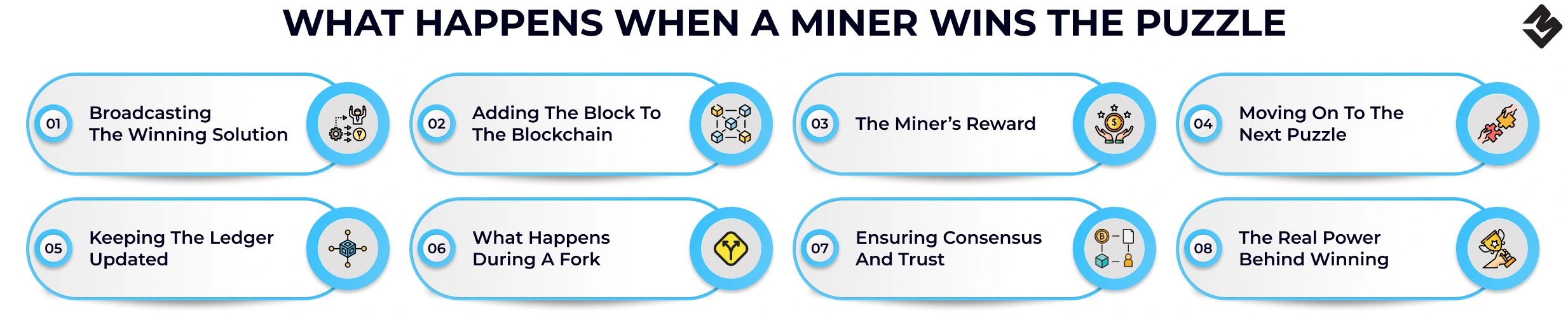
1. Broadcasting the Winning Solution
First, the miner broadcasts their winning solution to the entire Bitcoin network. Every other node (which is just a fancy word for a computer running the Bitcoin software) checks the work. It’s easy to verify, much easier than finding the right answer in the first place.
2. Adding the Block to the Blockchain
Once everyone agrees the solution is valid, the miner gets the green light to add their block to the blockchain. That block includes all the transactions that were waiting in line to be confirmed, plus a special transaction called the coinbase transaction, which is how the miner receives their reward.
3. The Miner’s Reward
The reward includes two parts:
- The block reward is a fixed amount of new Bitcoins created by the network.
- Transaction fees: small fees paid by users for including their transactions in the block.
4. Moving On to the Next Puzzle
Once the block is added, the network moves on to the next round, and all the miners start the guessing game again with a new puzzle.
5. Keeping the Ledger Updated
This process is what keeps Bitcoin’s ledger updated. Instead of one central authority writing everything down, miners compete to earn that right, and math decides the winner.
6. What Happens During a Fork
But there’s more: just because one miner found the winning block doesn’t mean everyone automatically accepts their version of the blockchain. If two miners find valid blocks at nearly the same time, there might be a temporary “fork” like a split path in the road. Eventually, the chain with the most work (the longest chain) wins, and the other block gets dropped.
7. Ensuring Consensus and Trust
This system ensures that only one chain survives, and everyone agrees on the same version of history. Again, it’s all based on math and rules, no human judgment needed.
8. The Real Power Behind Winning
So, when a miner wins, they don’t just earn Bitcoin; they also help keep the system alive and trustworthy. That’s the real power behind the puzzle.
The Importance of Randomness in Mining
Randomness might sound like a strange thing to rely on, but in Bitcoin mining, it’s a big deal. Randomness is what keeps the game fair, secure, and unpredictable.

Why Guessing Is the Only Way
The Bitcoin mining puzzle is based on creating a hash that meets a certain condition. But you can’t figure out the right input by thinking about it or working it out step by step. The only way is to guess. Over and over. It’s like playing millions of rounds of rock-paper-scissors with a robot that changes its answer every time.
Where the Randomness Comes From
This randomness comes from trying different nonces and combinations of block data. Each attempt gives you a new hash, and each hash is unpredictable. Even if you change just one letter or number in your input, the entire hash changes in a completely random way.
Why Randomness Prevents Cheating
That’s what makes it impossible to cheat or “game” the system. You can’t look at a hash and figure out what nonce made it. You can only try as many guesses as your computer allows and hope one of them works.
Randomness Keeps Mining Fair and Decentralized
Randomness also keeps mining decentralized. The next block’s winner is unpredictable. Big miners have better odds, but they still don’t control the outcome. It’s like shuffling a deck of cards; every draw is a new chance, no matter how many times you’ve played before.
Why Randomness Is Good for Bitcoin
In everyday life, randomness can feel annoying or unfair. But in Bitcoin, it’s a good thing. It’s what keeps the network balanced and secure. If mining were predictable, people could rig the system. But because it’s not, everyone has to play by the same rules, powered by math and chance.
So the next time you hear about someone mining Bitcoin, remember this: they’re playing a giant, high-speed guessing game. And it’s the randomness of those guesses that keeps the entire system honest.
What Are Merkle Trees and Why Do They Matter?
Now let’s talk about something that sounds fancy but is actually pretty straightforward: Merkle trees.

Handling Lots of Transactions
In Bitcoin, every block contains a list of transactions. Some blocks can have hundreds or even thousands of them. So, how does the system keep track of all that data efficiently? Enter the Merkle tree.
Breaking Down the Data
Imagine you’re organizing a big stack of papers and want to keep track of whether anything changes. Instead of checking every single page each time, you break the stack into smaller chunks, then specially combine them. That’s what Merkle trees do: they help Bitcoin summarize and verify large amounts of data quickly.
How Merkle Trees Work
Here’s how it works:
- Every transaction in a block is turned into a hash.
- Pairs of hashes are combined and hashed again.
- This process continues until you get one final hash, the Merkle root.
Why the Merkle Root Matters
This final hash acts like a fingerprint for the entire block of transactions. If even one transaction changes, the Merkle root changes too. That’s how the system can detect tampering by checking just one hash.
Benefits of Merkle Trees
Merkle trees matter because they make it fast and easy to check if a transaction is part of a block, without needing to look at every other transaction. This saves time, memory, and computing power.
For miners, it means faster validation and less strain on their machines. For the Bitcoin network, it means stronger security and better performance.
Merkle trees are like compression tools for transaction data; they keep things tight, tidy, and easy to verify. And once again, it’s math doing all the work behind the scenes.
Why Energy and Hash Rate Are Tied to the Math
By now, you know that Bitcoin mining is a lot of guessing, and guessing takes power. Not just brainpower, but electrical power. That’s why Bitcoin miners care so much about energy and hash rate.
What Is Hash Rate?
The hash rate measures how many guesses (or hashes) a miner can make every second. The higher your hash rate, the more chances you have to solve the puzzle and win the block reward.
Powerful Hardware Needs Power
But higher hash rates need more powerful hardware. And powerful hardware requires a lot of electricity. That’s why mining farms are filled with rows of machines running 24/7, trying to crank out as many guesses as possible before someone else solves the puzzle.
How Energy and Math Keep Bitcoin Secure
This connection between math and energy is what keeps Bitcoin secure. The more miners there are, and the more power they use, the harder it is for any single person or group to take over the network.
The Energy Debate
Some people criticize Bitcoin for using too much energy. Others argue it’s a fair trade-off for a secure, decentralized currency. Either way, the link between energy and math is at the heart of how mining works.
Think of Hash Rate as Horsepower
So when you hear “hash rate,” think of it as a miner’s horsepower. And the fuel? That’s electricity, the silent partner in solving Bitcoin’s never-ending stream of math problems.
CONCLUSION
Bitcoin mining might seem complicated at first, but at its core, it’s a brilliant system built around solving mathematical puzzles. These puzzles are not just random challenges they’re carefully designed to keep the network secure, fair, and trustworthy without relying on any central authority.
By requiring miners to put in real effort through proof of work, Bitcoin ensures that every new block added to the blockchain is legitimate and that the entire system remains tamper-proof.
Though mining uses significant resources, this cost is the trade-off for a decentralized currency that runs smoothly across a global network. Understanding these math problems demystifies how Bitcoin operates and why it has become such a revolutionary technology.
So next time you hear about Bitcoin mining, remember: it’s not magic or luck alone but a complex, ongoing dance of math and machines working in harmony to keep the future of money secure and accessible to all.
Check out the latest Bitcoin Miners
FAQs ON WHAT MATH PUZZLES DO BITCOIN MINERS SOLVE
-
What math problem do Bitcoin miners solve?
Miners try to find a hash that starts with a certain number of zeros by guessing nonces. This process is called proof of work and secures the blockchain.
-
Why is mining compared to a lottery?
Because it’s mostly about luck miners make trillions of guesses, and anyone can win if they guess the right hash first.
-
What is a nonce in Bitcoin mining?
A nonce is a random number miners change repeatedly in their block data to find a valid hash that meets the network’s difficulty target.
-
How does Bitcoin adjust mining difficulty?
Every two weeks, the network checks how fast blocks are being mined and adjusts the difficulty to keep block time close to 10 minutes.
-
Why does Bitcoin mining consume so much energy?
Because miners use powerful machines to make trillions of guesses per second, which demands massive electricity to stay competitive.

Join our Newsletter
Get the week’s best cryptomining content in your inbox.

Han su
Han Su is a technical analyst at CryptoMinerBros, a leading provider of cryptocurrency mining hardware. He has over 5 years of experience in the cryptocurrency industry and is an expert in mining hardware, software, and profitability analysis.
Han is responsible for the technical analysis and research on ASIC Mining at Crypto Miner Bros. He also writes in-depth blogs on ASIC mining and cryptocurrency mining, and he has a deep understanding of the technology. His blogs are informative and engaging, and they have helped thousands of people learn about cryptocurrency mining.
He is always looking for new ways to educate people about cryptocurrency, and he is excited to see how the technology continues to develop in the years to come.
In spare time, Han enjoys hiking, camping, and spending time with his family. He is also an avid reader, and he loves to learn about new things.
Similar Blogs

How Crypto Mining Really Works (And Why It’s Easy Money)
What is Crypto Mining? In essence cryptocurrency mining can be described as the procedure of confirm...
Bitmain Antminer S21 Series: Best ASIC Miners for Home and Farm Mining in 2026
Overview of Bitmain Antminer S21 Series The Antminer S21 series from Bitmain contains the most power...
Optimizing Mining Efficiency: Advanced Monitoring Tools and Metrics
A complete guide to mining efficiency metrics, real-time monitoring tools, and dashboards for smarte... © 2018- Miner Bros Limited. All rights reserved

 EN EN
EN EN  ES
ES