


SUMMARY
Bitcoin mining in 2026 is a professional industry requiring powerful ASIC hardware, cheap electricity, and innovative strategies. Mining keeps the Bitcoin network secure while rewarding miners with 3.125 BTC per block plus fees.
Use an efficient ASIC on cheap power, join a reputable pool, set your payout wallet, and monitor hashrate, uptime, and temperature.
The best method today is pool mining, since solo mining is impractical and cloud mining carries risks. Profits depend on hardware efficiency, energy costs, and Bitcoin’s price.
While challenges include high expenses, difficulty increases, and environmental concerns, solutions like renewable energy and efficient cooling are reducing risks. Mining is no longer a hobby – it’s a serious business demanding investment, planning, and optimisation.
What Is Bitcoin Mining and Why Does It Matter?
Bitcoin mining is the process of creating new Bitcoin and securing the Bitcoin network at the same time.
Miners use powerful computers to solve challenging math problems. When they solve one of these problems, they add a new block of transactions to the blockchain, and in return, they earn rewards in Bitcoin.
This reward is known as the block reward, and it is the main reason people mine Bitcoin – it allows them to earn cryptocurrency directly.
Why does Bitcoin need mining?
Bitcoin is a digital currency, but here’s the cool part – it doesn’t have a central bank or a company running the show. Instead, it’s powered by something called blockchain, which is basically a public ledger that tracks all transactions.
So, how does Bitcoin stay secure and trustworthy? That’s where miners come in. Every time someone sends Bitcoin to someone else, miners step up to check and verify that the transaction is legit. This keeps things like double-spending in check, so no one can try to send the same Bitcoin twice.
Without miners, Bitcoin wouldn’t be safe. There wouldn’t be anyone making sure transactions are real, and the whole system could be easily manipulated or attacked. Mining is what makes Bitcoin different from traditional money. It lets the whole network run smoothly without needing to rely on banks or governments.
How do miners get rewarded?
When a miner adds a block to the blockchain, they receive two types of rewards:
- Block Reward: A fixed amount of Bitcoin for mining a new block. In 2026, the block reward is 3.125 BTC per block (after the April 2024 halving).
- Transaction Fees: Small payments from users who send Bitcoin are added as extra income for the miner.
This reward system encourages miners to keep the network safe and running.
Why does Bitcoin mining matter today?
Mining is important for three key reasons:
1. Security of the Network: Mining makes it extremely hard for hackers to change or fake transactions.
2. Supply of Bitcoin: New Bitcoin enters circulation only through mining, which ensures it stays scarce, just like gold.
3. Decentralisation: Mining happens all over the world. No single person or government controls it. This global nature keeps Bitcoin independent.
Bitcoin mining is not just about making money. It plays a critical role in the cryptocurrency ecosystem. Without it, Bitcoin would lose its trust, security, and even its value. That’s why understanding mining is the first step before deciding if you want to join this industry.
How Does Bitcoin Mining Work Step by Step?
Bitcoin mining might sound complicated at first, but it’s actually pretty simple once you break it down. At its core, mining is all about verifying transactions and competing to solve puzzles that keep the Bitcoin blockchain secure. Let me walk you through how it works, step by step!
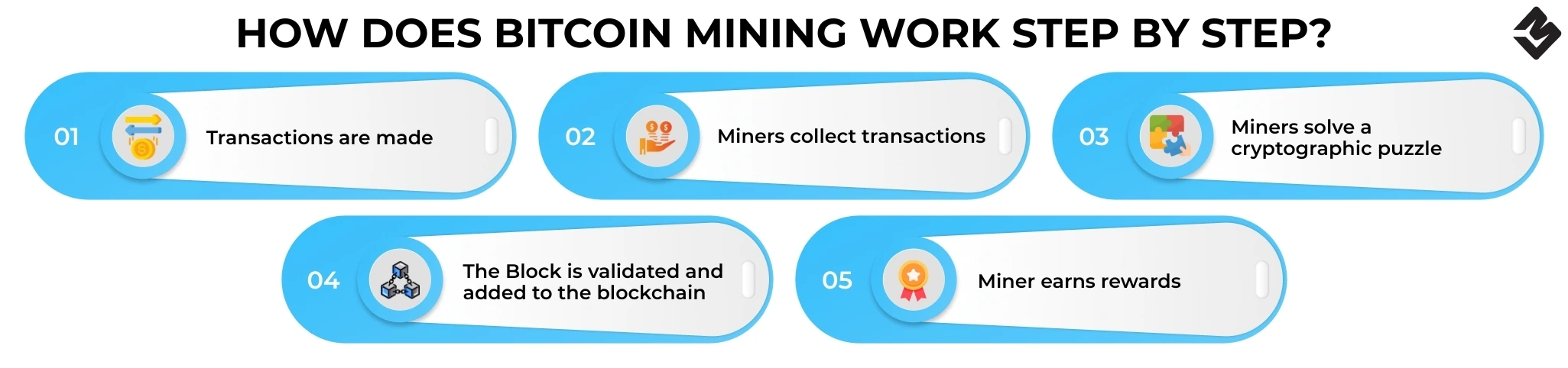
Step 1: Transactions are made
When someone sends Bitcoin – say, Alice sends 0.1 BTC to Bob – the transaction is broadcast to the network. This transaction joins thousands of others waiting to be confirmed. These unconfirmed transactions sit in a digital queue called the mempool.
Step 2: Miners collect transactions
Miners select transactions from the mempool and group them into a block. Think of a block as a digital page in Bitcoin’s ledger. Each block has a size limit (currently 1MB plus extra via SegWit), so miners choose which transactions to include, often prioritising those with higher transaction fees.
Step 3: Miners solve a cryptographic puzzle
Once a block is ready, miners compete to solve a complex math problem. This problem is part of the Proof of Work (PoW) system. Miners must guess a number (called a nonce) that, when combined with the block’s data and passed through a hash function, creates a result that meets Bitcoin’s difficulty target.
This is like a lottery: miners try billions of guesses per second until one finds the correct answer.
Step 4: The Block is validated and added to the blockchain
When a miner finds the correct hash, they transfer the blocks to the rest of the Bitcoin network. Other miners and nodes verify the solution to secure it. If the block checks out, it is officially added to the blockchain.
Step 5: Miner earns rewards
The successful miner earns:
- 3.125 BTC block reward (as of 2026).
- Transaction fees from all the transactions in that block.
These rewards are paid directly to the miner’s Bitcoin wallet.
Why is this process necessary?
- Fairness: Mining ensures no single user controls the system.
- Security: Proof of Work makes it extremely costly to attack Bitcoin.
- Consistency: New blocks are added roughly every 10 minutes, keeping the system stable.
Bitcoin mining works like a decentralized competition. Miners gather transactions, race to solve puzzles, and secure the blockchain in the process. This system is what makes Bitcoin trustworthy without needing banks or intermediaries.
What Do You Need to Start Bitcoin Mining?
If you want to mine Bitcoin, you need the proper setup. Mining today is very different from the early days when people could mine with just a laptop. Now, the competition is more brutal, and specialized machines are required. Here’s what you need to begin.
- Full hardware list: Top 10 Most Profitable Bitcoin Mining Machines
Mining Hardware: The Heart of Bitcoin Mining
The most essential piece of equipment is your mining hardware. There are three main types:

1. CPU Mining (Not Practical Anymore): In Bitcoin’s early days (2009–2010), people mined using regular computer processors. But now it’s impossible to compete with CPUs.
2. GPU Mining (Mostly Outdated for Bitcoin): Graphics cards (GPUs) are used in other cryptocurrencies like Ethereum Classic. Still, the difficulty of Bitcoin mining is too high for GPUs to be effective.
3. ASIC Mining (Best Choice for Bitcoin): ASICs (Application-Specific Integrated Circuits) are machines built just for mining. They are much faster and more energy-efficient than CPUs or GPUs. Popular models in 2026 include Antminer S21 XP and Antminer S23, which can deliver high hash rates while consuming less power.
For serious Bitcoin mining, ASIC miners are the only practical option.
Mining Software: The Control Center
When you have hardware, you need software to run it. Mine software connects ASIC with Bitcoin Blockchain or a mining pool. General software includes:

- CGMiner – Open-source, reliable, and widely used.
- BFGMiner – Similar to CGMiner but with advanced features.
- NiceHash – Easy to use and can automatically choose the most profitable coin to mine.
- BraiinOS – Explicitly designed for ASIC miners.
The choice depends on whether you want simplicity or complete control.
Bitcoin Wallet: Where Your Rewards Go
After mining, you’ll receive Bitcoin. You need a wallet to store it safely. Options include:

- Software Wallets (like Exodus or Electrum) – Easy to use, suitable for beginners.
- Hardware Wallets (like Ledger or Trezor) – These are more secure and keep your Bitcoin offline.
- Exchange Wallets (like Binance or Coinbase) – Convenient but less secure if you keep large amounts.
For miners, a hardware wallet is usually the safest option.
Stable Internet Connection and Power Supply
Mining requires your machine to run 24/7. A fast and reliable internet connection is a must, but you don’t need very high speeds – just stability. The bigger cost is electricity. Mining machines consume a lot of power, so make sure your setup can handle it.
Quick Checklist to Start Mining
- ASIC miner (Antminer, Whatsminer, etc.)
- Mining software (CGMiner, NiceHash, etc.)
- Bitcoin wallet (preferably a hardware wallet)
- Stable internet and electricity supply
To succeed in mine Bitcoin in 2026, you need special hardware, proper software, a safe wallet and strong infrastructure. Without these basic things, you will not be able to compete or make a profit.
Bitcoin Mining Hardware Comparison (2026)
| Hardware Type | Example Devices | Speed (Hashrate) | Power Use | Practical for Bitcoin? | Cost Range (USD) |
| CPU | Regular computer processor | Very low (MH/s) | Low | Not practical | $100-$500 |
| GPU | NVIDIA RTX 3080 | Moderate (MH/s – GH/s) | High | Outdated for BTC, used in other coins | $500-$1,500 |
| ASIC | Antminer S21 XP, Antminer S23 | Extremely high (100+ TH/s) | High but efficient | Best choice | $2,000-$6,000 |
- Calculate efficiency and hashrate conversions using our Hashrate Converter
Which Mining Methods Are Best in 2026?
For most people, pool mining is the best balance between cost, control, and profit. Solo mining is nearly impossible without massive investment, while cloud mining can work but comes with trust issues. If you are serious about Bitcoin mining in 2026, joining the best Bitcoin mining pool with your own ASIC hardware is the safest and most profitable path.
What is Solo Mining?
Solo mining means you run your own ASIC machine(s) and try to find blocks by yourself. In Bitcoin’s early years, many miners used this method successfully. But today, with network difficulty so high, solo mining is hazardous. Unless you own a huge farm with thousands of ASICs, your chances of finding a block alone are close to zero.
Best for: Big players with massive setups and cheap electricity.
What is Pool Mining?
Pool mining allows many miners to join forces. Instead of competing alone, miners combine their computing power. When the pool finds a block, rewards are shared among members based on how much work each miner contributed.
This method gives smaller miners a more predictable income. For most individuals in 2026, pool mining is the most realistic choice. Popular mining pools include F2Pool, Foundry USA, and AntPool.
Best for: Small to medium miners who want steady earnings.
What is Cloud Mining?
Cloud mining means renting mining power from a third-party provider. You pay a fee (usually upfront) and receive a share of the Bitcoin mined. The advantage is that you don’t need to buy expensive hardware or deal with electricity costs.
However, cloud mining carries risks:
- Many providers charge high fees that eat into profits.
- Some companies are scams that never pay out.
- You don’t have complete control over the equipment.
Best for: People who want exposure to mining but don’t want to run machines.
Mining Method Comparison (2026)
| Method | How It Works | Pros | Cons | Best For |
| Solo Mining | Mine with your own ASICs, no sharing | Full block reward if successful | Extremely unlikely for individuals; requires huge farm | Large-scale operations |
| Pool Mining | Join a group of miners and share rewards | Steady payouts, low entry barrier | Rewards are smaller and shared | Small to medium miners |
| Cloud Mining | Rent power from providers | No hardware setup, no electricity worries | High fees, risk of scams, low control | Casual users, beginners |
Which method is best in 2026?
For most people, pool mining is the best balance between cost, control, and profit. Solo mining is nearly impossible without massive investment, while cloud mining can work but comes with trust issues. If you are serious about Bitcoin mining in 2026, joining a reputable mining pool with your own ASIC hardware is the safest and most profitable path.
How Much Can You Earn From Bitcoin Mining Today?
Bitcoin mining can definitely be profitable, but how much you make depends on a few key factors. Things like the price of Bitcoin, how efficient your hardware is, the cost of electricity, and whether you’re mining solo or in a pool all play a huge role.
So, it’s not just about mining – it’s about how you manage all those moving parts!
Main Factors That Affect Earnings
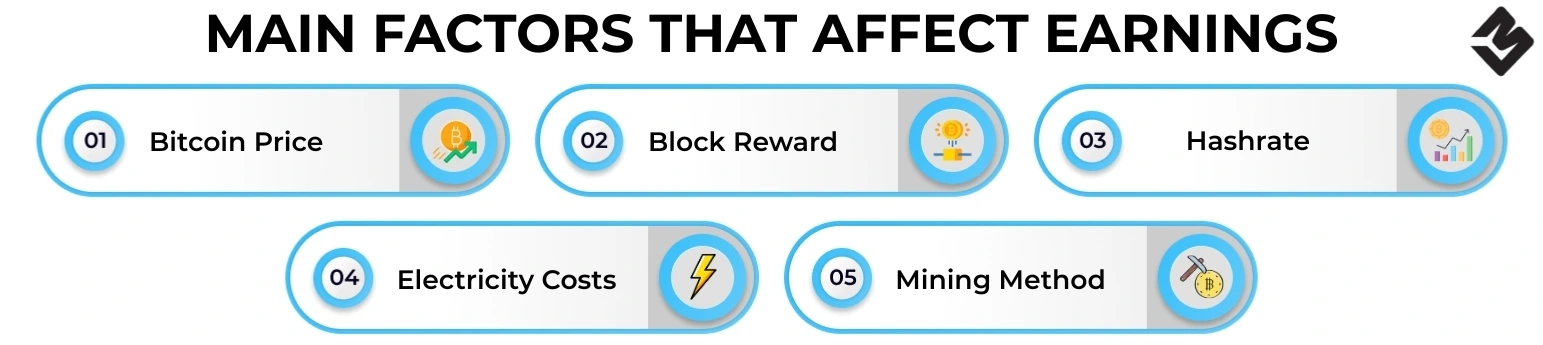
1. Bitcoin Price – The higher the price, the more valuable your rewards. In 2026, Bitcoin was trading around $100,000 – $115,000, making mining attractive.
2. Block Reward – As of 2026 (after the April 2024 halving), the block reward is 3.125 BTC plus transaction fees.
3. Hashrate – The speed of your mining hardware. Higher hashrate = more chances of finding blocks.
4. Electricity Costs – Mining machines consume vast amounts of power, so cheap electricity is key.
5. Mining Method – Pool mining gives steady but smaller payouts, while solo mining offers huge but rare rewards.
Example: Mining with an ASIC (Antminer S21)
- Hashrate: 200 TH/s
- Power Consumption: 3,500 W
- Electricity Cost: $0.10 per kWh
Using today’s difficulty and Bitcoin price, this machine could earn around:
- $15-$25 per day in revenue (before electricity).
- $5-$10 per day in net profit (after electricity costs).
How Mining Pools Affect Earnings
If you join a pool, your earnings are smaller but more frequent. For example:
- Solo miner: Might wait months or years to find a block (high risk, high reward).
- Pool miner: Earns small daily payouts based on their hashrate contribution.
Most individuals choose pools because they want a consistent income.
Key Takeaways
- Mining can still be profitable in 2026, but only with efficient ASICs and cheap electricity.
- If your electricity costs are above $0.12 per kWh, profits may shrink or even turn negative.
- Old hardware is almost useless in today’s environment.
With modern ASICs and the right conditions, miners can make a steady profit, but margins are tighter than ever.
What Are the Costs and Risks of Bitcoin Mining?
Mining Bitcoin is not as easy as simply hooking up a device and letting it run. There are significant costs and risks that you have to be aware of before you take the plunge.
Without the right sort of planning, it can become a losing venture in a very short time. Hence, if the idea of mining is on your mind, it is a must that you perform thorough research and confirm your readiness for the obstacles that lie ahead.
Main Costs of Bitcoin Mining

1. Hardware Costs
ASIC miners are expensive, ranging from $2,000 to $6,000 for modern models like the Antminer S21 XP or Antminer S23. Older devices are cheaper but usually not profitable.
2. Electricity Costs
Power is the most significant ongoing expense. Each ASIC consumes 3,000 – 3,500 watts running 24/7. At $0.10 per kWh, one machine may use around $7 – $10 per day in electricity.
3. Cooling and Maintenance
Mining rigs generate a lot of heat. To keep them running, you’ll need fans, cooling systems, and regular maintenance, which increases costs.
4. Internet and Hosting
Mining requires a stable internet connection, though bandwidth usage is low. Some miners also use hosting centers where they pay monthly fees for electricity, cooling, and management.
Cost Breakdown Example (2026, Single ASIC Machine)
| Expense Type | Estimated Cost (USD) | Notes |
| Hardware (ASIC) | $3,500 – $5,500 | One-time purchase |
| Electricity | $200 – $300/month | At $0.10/kWh, 3,500 W machine |
| Cooling/Setup | $100 – $300 upfront | Fans, ventilation, etc. |
| Internet | $20 – $50/month | Regular home internet works |
| Hosting (optional) | $50 – $200/month | If using a mining farm |
Risks of Bitcoin Mining

1. Price Volatility
Bitcoin’s value changes daily. If the price drops, your mining income may no longer cover costs.
2. Mining Difficulty
The network adjusts difficulty every two weeks. As more miners join, earning Bitcoin becomes harder, reducing profits.
3. Halving Events
Every four years, Bitcoin’s block reward is cut in half. In April 2024, rewards dropped from 6.25 BTC to 3.125 BTC. The next halving in 2028 will cut it further to 1.5625 BTC, reducing miner income.
4. Hardware Obsolescence
ASIC miners lose value quickly as newer, more efficient models are released. An expensive machine today may be nearly worthless in 3 – 4 years.
5. Regulatory Risks
Some countries restrict or ban mining due to energy use. Regulations can affect your ability to mine legally or profitably.
Mining bitcoins requires a significant advanced investment and ongoing operating expenses. It is a high-risk, high-income business. Competence depends on cheap electricity, skilled machines, and a stable bitcoin value. If any of these factors change, miners can withstand a loss instead of profits.
How to Set Up a Bitcoin Mining Rig?
Setting up a Bitcoin mining rig might sound technical, but with the right equipment and instructions, it’s manageable. In 2026, most miners will use ASIC miners instead of custom-built GPU rigs since Bitcoin mining requires extreme computing power.
Here’s a step-by-step guide to help you get started.

Step 1: Buy Your Mining Hardware
- Choose a reliable ASIC miner such as Antminer S21 XP or Antminer S23.
- Consider factors like hashrate, power consumption, and cost.
- Don’t buy outdated models, as they may not be profitable.
Step 2: Set Up Power and Cooling
- ASIC miners consume 3,000 – 3,500 watts. Make sure your electrical wiring can handle the load.
- Use surge protectors to protect your equipment.
- Place your miner in a cool, ventilated room to prevent overheating. Some miners even use industrial cooling or immersion cooling tanks.
Step 3: Connect to the Internet
- A stable internet connection is essential, though bandwidth needs are small.
- Connect the ASIC to your router via Ethernet cable for the most stable connection.
- Avoid Wi-Fi, since interruptions can cause downtime.
Step 4: Install Mining Software
Once connected, you’ll need software to control your miner. Popular options include:
- CGMiner
- BFGMiner
- NiceHash (beginner-friendly)
- BraiinOS (specialized for ASICs)
Configure the software with your miner’s details and pool information.
Step 5: Join a Mining Pool
Solo mining is nearly impossible for individuals in 2026, so join a reputable pool like Foundry USA, AntPool, or F2Pool. Pools provide steady payouts based on your share of work.
Step 6: Set Up a Bitcoin Wallet
You’ll need a wallet to receive mining rewards. Options include:
- Hardware Wallets (Ledger, Trezor) – safest option.
- Software Wallets (Electrum, Exodus).
- Exchange Wallets (Coinbase, Binance) – convenient but less secure.
Step 7: Start Mining and Monitor Performance
- Turn on your miner and let it connect to the pool.
- Monitor your hashrate, temperature, and earnings through the mining software.
- Regularly check for updates and firmware improvements.
Quick Setup Checklist
- Buy ASIC miner (Antminer S21 XP, Antminer S23)
- Ensure proper power supply and cooling
- Connect to a stable internet
- Install mining software
- Join a mining pool
- Set up a secure Bitcoin wallet
- Start mining and monitor results.
Installing Bitcoin mining requires a careful plan, but once it’s installed, it automatically works 24/7. Success depends on choosing the right tools, joining a strong mining pool, and keeping the rig calm and stable.
How to Optimize Bitcoin Mining for Maximum Profits?
Mining Bitcoin is not only about plugging in your machine – it’s about running it as efficiently and profitably as possible. With electricity costs rising and mining difficulty increasing, optimization can be the difference between profit and loss.
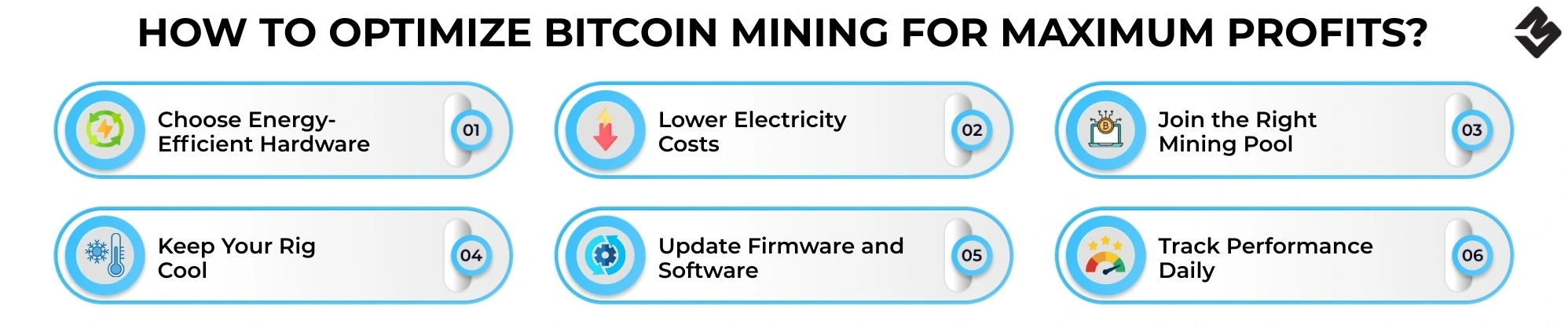
1. Choose Energy-Efficient Hardware
- Newer ASICs like the Antminer S21 XP and Antminer S23 are designed to deliver more hashrate with less power.
- Old machines may still run, but they often consume more electricity than they earn in Bitcoin.
- Always compare the hash rate-to-watt ratio before buying hardware.
2. Lower Electricity Costs
Electricity is the most significant expense for miners. Strategies to cut costs include:
- Mining in regions with cheap power (e.g., hydro-powered regions or areas with surplus energy).
- Renewable energy, like solar or wind, can be used to offset costs.
- Off-peak mining in areas with variable electricity pricing.
3. Join the Right Mining Pool
- Pools differ in fees, payout methods, and reliability.
- Some pools take a higher cut but offer stable payouts.
- Compare before choosing, since pool fees can eat into profits.
4. Keep Your Rig Cool
- Overheating reduces efficiency and can damage hardware.
- Use strong ventilation, fans, or immersion cooling.
- Running cooler often means your ASIC lasts longer and uses slightly less energy.
5. Update Firmware and Software
- Many mining machines have firmware updates that improve efficiency or unlock advanced settings.
- Some third-party firmware (like BraiinsOS) allows undervolting and overclocking, giving more control over power and hashrate.
Optimization Comparison (2026)
| Optimization Method | Effect on Profitability | Difficulty Level | Notes |
| Energy-efficient ASIC | High impact | Medium | Best ROI long term |
| Cheap electricity | Very high impact | Hard | Location-dependent |
| Pool selection | Medium impact | Easy | Compare fees and payouts |
| Cooling improvements | Medium impact | Medium | Prevents downtime |
| Firmware tuning | Low to medium impact | Medium – High | Risk of errors if misused |
6. Track Performance Daily
- Use mining dashboards to track earnings, hashrate, and power use.
- If profit margins get too low, consider shutting down until conditions improve.
Maximizing Bitcoin mining profits is about efficiency and intelligent management. The most successful miners combine cheap electricity, modern hardware, proper cooling, and good pool choices. Minor improvements add up, turning a break-even setup into a profitable one.
What Are the Environmental Impacts of Mining and Are There Solutions?
Bitcoin mining has gotten a lot of flak over its energy use and environmental impact, and even in 2026, the debate is still going strong.
Some people think it’s just a waste of energy, while others argue it’s actually pushing innovation in renewable energy. It’s one of those conversations that keeps evolving, and there’s no clear-cut answer yet. What do you think?
The Environmental Impacts of Bitcoin Mining
1. High Energy Consumption
- Mining requires powerful ASIC machines that run 24/7.
- The Bitcoin network uses energy that is comparable to that of some small countries.
2. Carbon Emissions
- If miners use fossil fuel-based electricity, mining contributes to CO₂ emissions.
- This is especially an issue in regions that rely heavily on coal.
3. Electronic Waste (E-Waste)
- Old ASICs become obsolete quickly, creating tons of discarded hardware each year.
- Disposal of these machines adds to global e-waste problems.
Positive Developments
1. Shift Toward Renewable Energy
- Many mining farms now run on hydropower, wind, or solar energy.
- Some companies use stranded or wasted energy that would otherwise be lost (e.g., flared natural gas).
2. Grid Balancing
- Mining can act as a “flexible consumer.” Miners can shut down during peak demand, helping stabilize electricity grids.
3. Innovation in Cooling
- Techniques like immersion cooling reduce energy waste and extend machine life.
Environmental Impact vs. Solutions (2026)
| Impact | Problem | Solution in Practice |
| Energy Use | Huge electricity demand, strains grids | Use cheap renewables, off-peak energy |
| Carbon Emissions | Fossil-fuel-based power adds CO₂ | Relocate farms to hydro, wind, solar regions |
| E-Waste | Obsolete ASICs pile up quickly | Recycling programs, longer hardware lifespan |
| Heat Production | Large heat output in mining farms | Repurpose heat for homes/greenhouses |
Trends in 2026
- Over 50% of global mining power now comes from renewable sources (hydro, wind, solar, geothermal).
- Mining companies in North America and Europe increasingly recycle e-waste responsibly.
- Some miners sell excess heat to nearby buildings or use it for agriculture, turning waste into value.
Bitcoin mining does consume a lot of energy, but solutions are emerging. The shift toward renewables, recycling, and efficient cooling is reducing its environmental footprint. While critics remain, many experts believe mining can drive green innovation rather than harm the planet.
Bitcoin Mining in 2026 and Beyond: What’s the Future?
The process of Bitcoin mining has significantly changed over time and will continue to change. The competition will be fierce, worldwide, and mining will consume less energy than today by 2026.
But the miners will be wondering what will happen next amidst all these transformations. The future is bright but also quite uncertain. Can you guess what mining will look like in the coming years?
Key Trends in 2026
1. High Competition
- Mining difficulty is at record highs due to advanced ASICs and more miners joining.
- Small miners face tighter margins, while large mining farms dominate.
2. Decentralization Shift
- Mining power is more spread out across countries than in the past.
- North America, the Middle East, and parts of Africa are rising hubs due to cheap renewable energy.
3. Profitability Challenges
- With the block reward halved to 3.125 BTC in 2024, miners rely more on transaction fees.
- Only efficient hardware and cheap electricity setups remain profitable.
What to Expect Beyond 2026
1. Next Halving (2028)
- Block rewards will drop to 1.5625 BTC.
- Transaction fees will play a bigger role in miner income.
2. Hardware Innovation
- ASICs will likely become smaller, faster, and more energy-efficient.
- Immersion cooling and AI-driven optimizations may become standard.
3. Green Mining Expansion
- Renewables will dominate mining power sources.
- Governments may push miners to use sustainable energy only.
4. Regulations
- Some countries may tighten restrictions due to energy use.
- Others may encourage mining to stabilize grids or use stranded energy.
Bitcoin Mining: Present vs Future
| Year/Period | Block Reward | Mining Difficulty | Hardware Trend | Profitability Driver |
| 2026 (Now) | 3.125 BTC | Record highs | Antminer S21 XP, Antminer S23 | Cheap electricity + ASIC efficiency |
| 2028 (Next Halving) | 1.5625 BTC | Higher | More efficient ASICs, cooling | Transaction fees + renewables |
| 2032+ | 0.78125 BTC | Very high | Specialized green mining farms | Mostly transaction fees |
- Bitcoin mining will never return to the easy profits of the early days.
- The future belongs to miners who can adapt to tighter margins, embrace renewable energy, and invest in efficient technology.
- Mining is moving from being a hobby to being a professionalized global industry.
In 2026 and beyond, the Bitcoin mining operation will remain the spinal cord of the network. Successful miners will combine innovation, stability, and efficiency. The future of mining is not just about benefits – it’s about shaping the future of Bitcoin.
CONCLUSION
Bitcoin mining is about more than just keeping the cryptocurrency network running – it’s also a way for miners to earn rewards. In 2026, if you want to be successful, it’s all about having modern ASIC machines, access to low-cost electricity, and being active in mining pools. It’s no longer just about quick profits; it’s about being efficient, stable, and having a well-thought-out strategy.
Of course, mining isn’t without its risks. Bitcoin’s price can be unpredictable, rewards get halved over time, and your hardware needs to keep up with the network’s growth. But for those who are ready to adapt, there are real opportunities. If you’ve got cheap energy and the right gear, mining can still be very profitable.
For beginners, taking things step by step is key. And as we look ahead, the future of Bitcoin mining seems to be all about innovation, renewable energy, and larger, globally coordinated operations. What do you think the future holds?
Check out the latest Bitcoin Miners
FAQs on How to Mine Bitcoin
-
Can I still mine Bitcoin with my laptop or PC?
No. Regular computers (CPUs) or even gaming GPUs cannot compete with Bitcoin’s difficulty anymore. You need specialized ASIC miners to have any chance of earning rewards.
-
How much does it cost to start mining Bitcoin?
It depends on your setup:
~ ASIC Machine (e.g., Antminer S21 XP, Antminer S23): $3,000 – $6,000 each.
~ Electricity Costs: $200 – $300/month per machine (at $0.10/kWh).
~ Additional Costs: Cooling, internet, wallet, and possibly hosting. Starting small with one ASIC may cost around $4,000 – $7,000 total. -
How can we prevent the environmental hazards that happen due to Bitcoin mining?
Moving to green mining and leveraging renewable energy resources for Bitcoin mining is the best way to minimize carbon footprints and other environmental hazards due to Bitcoin mining.
-
How long does it take to mine 1 Bitcoin?
This depends on your hashrate and pool share. With a single Antminer S21 XP, it could take years to mine a full Bitcoin alone. That’s why miners join pools, where you earn a small portion daily instead of waiting for one full BTC.
-
Is Bitcoin mining still profitable in 2026?
Yes, but only under the right conditions:
~ Modern ASICs with high efficiency.
~ Cheap electricity (below $0.12/kWh).
~ Joining a reputable mining pool.Old hardware or expensive power makes mining unprofitable.
-
What happens when all 21 million Bitcoin are mined?
Around the year 2140, miners will stop receiving block rewards. They will only earn transaction fees from users. This will still give miners incentives to secure the network.
-
Is mining legal everywhere?
No. Some countries (like China and certain regions with energy shortages) have banned or restricted mining. Others, like the U.S. and El Salvador, allow and regulate it. Always check local laws before starting.
-
Can I use renewable energy for mining?
Yes. Many miners now use hydro, solar, wind, or geothermal power. Not only is it cheaper in the long run, but it also reduces environmental impact and regulatory risk.

Join our Newsletter
Get the week’s best cryptomining content in your inbox.

Han su
Han Su is a Technical Analyst at CryptoMinerBros, a leading provider of cryptocurrency mining hardware. He has over 5 years of experience in the cryptocurrency industry, and is an expert in mining hardware, software, and profitability analysis.
Han is responsible for the technical analysis and research on ASIC Mining at Crypto Miner Bros. He also writes In-depth blogs on ASIC mining and cryptocurrency mining, and he has a deep understanding of the technology. His blogs are informative and engaging, and they have helped thousands of people learn about cryptocurrency mining.
He is always looking for new ways to educate people about cryptocurrency, and he is excited to see how the technology continues to develop in the years to come.
In his spare time, Han enjoys hiking, camping, and spending time with his family. He is also an avid reader, and he loves to learn about new things.
Similar Blogs
Optimizing Mining Efficiency: Advanced Monitoring Tools and Metrics
A complete guide to mining efficiency metrics, real-time monitoring tools, and dashboards for smarte...
ASIC Firmware & Software: How to Keep Your Miners Updated and Secure
Discover how to upgrade ASIC firmware safely, safeguard against security risks such as Antbleed vuln...
Advanced Cooling and Noise Management for Home ASIC Mining Rigs
Complete guide on cooling and noise reduction for home bitcoin mining. Learn liquid cooling, immersi... © 2018- Miner Bros Limited. All rights reserved

 EN EN
EN EN  ES
ES